


Highlighting art, storytelling, and community visibility, October marked the celebration of Disability Cultural Awareness Month at Georgetown.
The celebrations aligned with the federally recognized National Disability Employment Awareness Month, which began in 1945 as a way to highlight the contributions of disabled workers and the importance of inclusive employment. At Georgetown, this month highlighted the intersection of disability activism with art.
The Disability Cultural Center (DCC) organized a variety of events to celebrate the disabled community on campus and spotlight the voices of prominent disabled activists and artists. These celebrations included mediums like visual art, writing, and performance to honor resilience within disability culture.
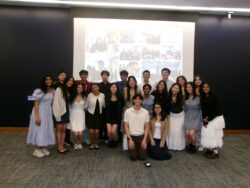
Riggs Library was transformed into a vibrant performance stage for the DCC’s annual “Art Celebrating Disability Culture” event on Oct. 21. From cultural dance performances to canvas paintings, percussion, and poetry, Hoyas within the disabled community gathered to share their art and foster community.
At the event, DCC Student Assistant Seven Brimmer (CAS ’28) read an original poem titled “24.” The poem situates listeners at the intersection of politics and warfare, including physical and psychological conflict.
The repetitive reference to the Constitution’s “We the People” describes how the communities meant to hold power are the very ones subjected to mistreatment by the elite class.
“If We the People, why do we receive the lies? If We the People, why break our laws? If We the People, why damage our lives?” Brimmer read.
Brimmer aimed to highlight current global divisions while drawing attention to the policies and systems that reinforce this division which disproportionately affects marginalized communities.
In an interview with the Voice, Brimmer said this month allowed for intersectional diversity in the disabled community.
“All aspects of the disability community come together to express themselves and that they are all equal. Disability is only a title,” Brimmer said.
Dr. Amy Kenny, the director of the DCC, shared how celebrating this month at Georgetown has built connections between students, faculty, and staff within the disabled community.
“One of the biggest focuses of this year’s Disability Cultural Month is the concept of disability joy in all its facets. Disability is such a rich tapestry of experience, and DCC hosts events and community-building that invites students and colleagues to learn more about our vibrant community,” Kenny said.
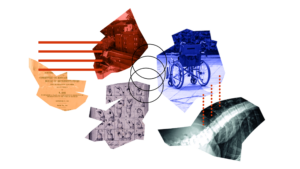
Joining Brimmer’s poetry performance at the event was a collage of nine MRI brain scans of Natalie Gustin (CAS ’26), a student assistant for the DCC and Disability Studies Program. The scans, arranged by Gustin, each featured different aspects of her life, including oil pastel art, friends, family, and nature.
For Gustin, art is not only a way to showcase her creativity, but also a form of protest. One of these scans showcased Gustin’s dedication to activism work and mutual aid. During her presentation, Gustin explained the philosophy that guides her activism and art.
“My disability culture means never being complicit in a genocide. My disability justice is reliant on the liberation of all people. My disability joy is not joy until all disabled people have joy, until all populations are liberated and experience freedom,” Gustin said.
Gustin also called on the wider disabled community to support marginalized communities facing injustice globally beyond their own.
“I do not feel comfortable sitting here and celebrating disability culture and disability joy without acknowledging the fact that simultaneously there is a genocide happening where people are going without medical treatment,” she said. I’m sitting here with my crutch, and someone who’s sitting in Palestine does not have a mobility aid.”
This call to action through artwork resembled themes from earlier in the month highlighted in the DCC event titled “Disabled Oracles.” This event, held in partnership with the Lecture Fund and moderated by Gustin, featured late disabled activist Alice Wong, who founded and authored the Disability Visibility Project.
Wong reflected on the importance of collective action and organizing within the disability community, and the necessity to “dream lots of radical dreams” through organizing.
“If we bring a future where disabled wisdom is centered, we can build a better reality together,” Wong said.
Gustin credited Wong as one of her greatest inspirations in disability activism and expressed how grateful she felt to play a role in the event with a speaker whose Asian American and disabled identities mirror her own.
Wong passed away due to an infection on Nov. 14.
Despite the progress Georgetown has made in recognizing the disabled community, Disability Studies Professor Theodora Danylevich believes there is still much work to be done. She would like to see the university put more resources into educating professors about the disabled community on campus.
“There needs to be a way to educate [my colleagues] so that accommodations don’t become a space of contention, but rather a space of care and meeting people where they are at,” Danylevich said.
Gustin said the competitiveness and fast-paced environment at Georgetown clashes with the realities of disabled students.
“When you are disabled, time doesn’t pass in the same way. You have to take breaks for fatigue or doctor’s appointments,” Gustin said. “Academia in general was not built for disabled students.”
Gustin added that such rigid expectations fail to account for the extremely non-linear nature of chronic illnesses.
“It’s hard to understand that yesterday I came to class, I was totally fine, but today I can’t see and I have a really bad migraine. These kinds of shifts aren’t understood by academia,” Gustin said.
Federal policies about education on disabilities have also created obstacles for disabled students.
Many students pursuing the Disability Studies program face uncertainty due to funding cuts to the Department of Special Education, according to Professor Libbie Rifkin, the associate director of the Disability Studies Program.
“I would like to see us hold strong and continue to convince students of the value of a disability studies degree, because 20% to 25% of the population is disabled and we need people who can help advance their lives,” Rifkin said.
Despite changes to federal regulations and difficulties facing the community, the DCC centered this month on uplifting hope through the arts.
As a way to share the Georgetown disability culture with the wider D.C. community, the DCC curated an exhibition titled “Not Without Us: A Celebration of Disabled Joy” at the Martin Luther King Jr. Memorial Library which features student animation, a wood carving, paintings, stamp art, and a tapestry. In the exhibition, students share stories of grief, hardship and hope. This exhibition was open from the beginning of October to the end of November.
“Art is transformative and has a way of allowing us to connect with a chapter in someone’s story that might be different from our own,” Kenny said. “Art can be vulnerable to share, but it is often in that sacred space where we develop connection.”