


From the pep band that plays at basketball games to the melodious jazz and chamber Music ensembles, music is a crucial component of the Georgetown community. Yet for students hoping to pick up an instrument or enhance their performance, resources such as practice spaces and private lessons aren’t easily accessible.
Rebecca Boateng (MSB ’28) used to play the drums in middle school, but she didn’t know about the practice room for drums at Georgetown until her friend, who took Music-1170, a class on the history of rock music, told her about it.
The practice room is located in the basement of New North. According to Boateng, it is challenging to find.
“It seems like it’s kind of tucked away,” Boateng said. “If I didn’t know someone taking the rock history class, I probably wouldn’t have ever found the practice room in that space.”
Although she eventually could book the room through the Department of Performing Arts’ (DPA) portal, the room is generally locked from students to protect the equipment and requires a special code to obtain the key.
“The only reason I was able to get the key is that my friend was in the class and sent me the codes to get the key,” she said. “If not for that, I don’t think I’d be able to get in.”
To Boateng, these musical resources on campus are essential to students. While she was grateful for access to the space and the drum set, she said there are informational barriers that block student access to these resources.
“It was very gate-kept,” she said. “It’s kind of only for people who are in the Pep Band or other ensembles, or people in a class where you need to learn the drums.”
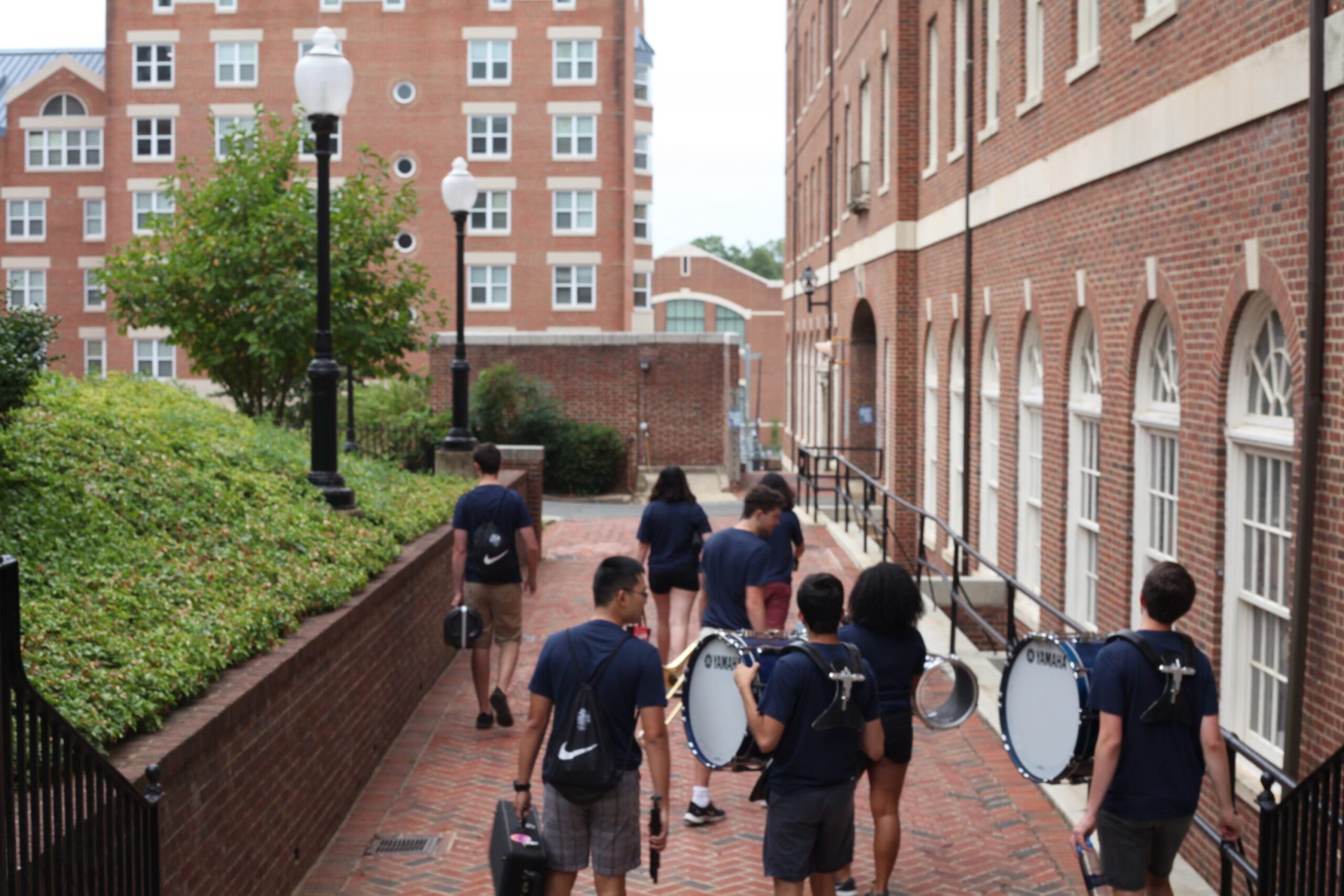
Being part of a music group, such as Pep Band, does break down some of these barriers. As a student-run organization, the Georgetown University Pep Band supports students with less musical experience through their sectional training rehearsals. It also offers accessible resources for students who want to pick up or switch to a new instrument.
“We definitely want to be that space for people who are trying to learn a new instrument,” Mason Hall (MSB ’26), President of Pep Band, said. “The band definitely tries to help people by providing them access to instruments if they don’t own them, and making sure that they know where they can practice, making sure that they do have access to those instruments anytime they need.”
However, for students new to an instrument, the band has limited capacity to provide music instruction or lessons, requiring self-motivation in instrument learning, especially at Georgetown.
“We are less focused on teaching people how to play instruments, given that we’re a student-run organization, and we don’t really have the capacity to be those music teachers,” Hall said.
Instead, Hall said that Pep Band can help students find resources to practice, and those who are self-motivated enough to learn a new instrument are encouraged to join.
This exposes another barrier for students hoping to learn an instrument on campus— the lack of private instruction.
According to Benjamin J. Harbert, Chair of the Department of Performing Arts, Georgetown does not have a private instrument lesson program, which limits opportunities for students who wish to start practicing an instrument with little or no experience. As a result, most musical ensembles on campus cater to students who have musical experience.
“Music and arts in general at Georgetown were fairly constricted because of space and finances, and so we are one of the very few institutions that doesn’t offer private instruction,” Harbert said. “Unfortunately, we don’t have many opportunities for people to learn instruments from the beginning.”
Currently, the DPA adopts an informal approach to providing music lessons for students by connecting them with an instructor and allowing them to make private arrangements regarding schedule and payment. The department’s website encourages students seeking private instrument lessons to contact the Departmental Administrator to be matched with a member of Georgetown’s music faculty. Beyond that, the department also connects students with resources outside Georgetown to facilitate their learning.
“I refer students to people at the Levine school of music or 7DrumCity, or some private instructors whom we know through our networks,” Harbert said.
Students can also reach out to professors directly through email for opportunities regarding private lessons or information, according to Professor Ben Capps, a cellist and the coordinator of the Chamber Music Ensemble.
“I hope that cellists out there know that they can contact me via email for lessons,” Capps said. “There are also other cello teachers in the community that I could forward them to if they didn’t want to study with me, so I’d be happy to pass people on as well.”
Having accessible instrument learning opportunities on campus can play a significant part in students’ music education and personal development. According to Harbert, music learning is essential to one’s wellbeing, builds community, and serves Georgetown’s core tenet of “cura personalis,” or care for the whole person.
“Music is part of the original concept of the liberal arts,” Harbert said. “There’s a way of looking at music beyond entertainment, but as exploration, as investigation, as serious study.”
Capps also emphasized how private lessons, or “individual study,” not only contribute fundamentally to overcoming challenges of technical practices of instrument learning, but moreover impact one’s musical and personal growth in a subtle yet significant way.
“I think that private lessons in music are an incredibly important facet to someone’s development as a person,” he said. “If they do indeed want to be a musician, having individual lessons or private lessons really gives the teacher and the student a chance to develop aspects of your personality that kind of go unnoticed.”
Due to the indispensable role of individual instrument lessons, Harbert said the department has proposed to launch a private music lessons program, but the initiation has been stalled.
“We get requests from the department every week for people wanting to learn an instrument, and it breaks my heart to turn them down, because music, to me, is a part of how, as a student, I came to know the world,” Harbert said.
The lack of an official private music instruction program likely stems from concerns about the practical complications of a private lesson program at Georgetown, including how such classes fit into the credit system, the distribution of resources, and the university’s priorities, according to Capps.
“I would instinctively be worried that in offering private lessons as an accredited offering at the university that you would be taking away from some other opportunities that already exist at the school,” Capps said. “Because it’s not like just because something is important, automatically, there’s going to be money for it.”
Despite the absence of a private music program, the DPA strives to offer a range of alternative opportunities that enrich students’ artistic exposure and enable those with prior instrumental experience to re-engage with music through supplementary programs.
“We often bring coaches who are professional musicians from outside the university, and they’ll come and lead the string section and work on performance,” Harbert said.
Harbert emphasized that Georgetown’s ensemble directors work to use their network to connect students to professionals who can help them grow. He recalled a time when the DPA brought the Georgetown orchestra to Cuba to play with a professional Cuban orchestra.
Outside of official Georgetown programming, students see independent study as a way to engage with music. When reflecting on her personal experience, Mason emphasized how self-motivation has really fostered growth in her musical abilities at the college-level instrument learning in Pep Band.
“I will definitely say I think I’ve become much more musical in band at college than I think I was in high school,” she said. “That’s because of the self-motivation that it takes in college, because there’s not somebody who’s grading your performance on the instrument in the pep band.”
Nonetheless, according to Boateng, when it comes to making learning an instrument more accessible beyond the established music circles, Georgetown still has spaces for improvement, especially in terms of outreach.
“It’s kind of kept on the down low. People probably wouldn’t find out about it unless they really, really look into it,” she said. “They can probably make it more accessible to everyone, in case people want to get more involved.”