


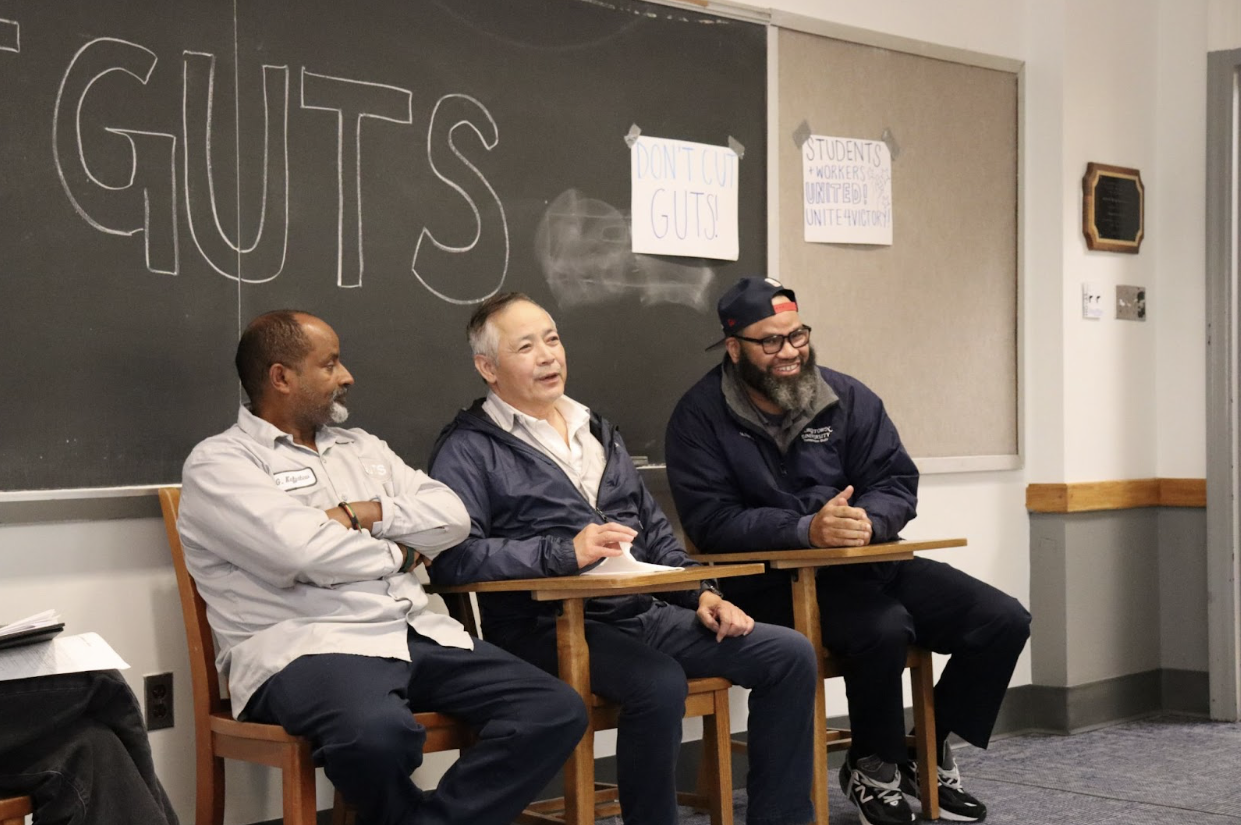

Georgetown University Transportation Shuttle (GUTS) drivers have received written confirmation from the university that they will remain as Georgetown employees, if they choose. The victory, which was announced on Instagram on Dec. 16, came after months of organized efforts from drivers and the Georgetown Coalition for Workers’s Rights (GCWR), who rallied support from students and community members through protests and petitions.
In the middle of July, GUTS’s 18 university-employed bus drivers were informed that the university planned to terminate their contracts and outsource to third-party Abe’s Transportation in an effort to limit university spending. This move would have eliminated all permanent GUTS bus driver positions, requiring current drivers to transfer to Abe’s or an alternative facilities department. The latter would reduce their pay and limit their access to benefits, according to GCWR.
A university spokesperson wrote to the Voice that the university is in ongoing talks with Abe’s Transportation to accommodate the drivers. Abe’s Transportation will take over the management, infrastructure, and equipment for the GUTS shuttle program while drivers themselves can choose to remain under the university’s employment.
“Any current bus driver who wishes to remain a direct employee of the University in the capacity of a GUTS bus driver will continue with their current job duties as a Georgetown University employee driving for the selected University subcontracted vendor,” the spokesperson wrote. “The vendor has agreed to offer employment to any GUTS bus driver who wishes to voluntarily be hired as a direct employee of the vendor. The University anticipates executing a service agreement with the vendor, effective January 31, 2026.”
The decision comes after continued pressure from GCWR’s “Don’t Cut GUTS” campaign started in September. The campaign took off with a protest, followed by the delivery of a petition with over 1000 signatures to Interim President Robert Groves’s office, demanding that the university doesn’t pursue a contract with Abe’s Transportation.
Fiona Naughton (SFS ’26), a member of GCWR, wrote to the Voice that the campaign was powered by both the drivers themselves and student support.
“Over the past five months, we have gotten to know the drivers personally and learned more about what an important and essential job they play at Georgetown — this university quite frankly could not function without them,” Naughton wrote. “This was truly a joint campaign, with complete and total solidarity between the workers and the rest of the Georgetown community, and this victory is a testament to the power of the people united.”
One of the campaign’s victories secured by students and drivers was an Oct. 23 meeting, where Georgetown’s Advisory Committee on Business Practices (ACBP) voted unanimously in favor of passing a resolution to Chief Operating Officer David Green recommending that all GUTS drivers remain university employees.
Following up on the ACBP’s recommendation, students and drivers delivered a letter to Green’s office and set a deadline of Nov. 12 for a response on Nov. 5. The office did not respond to the letter, leading to a sit-in on Dec. 2 in the President’s Office in Healy Hall. Community members gathered to demand a written commitment from Green and to support GUTS drivers as they discussed their feelings about the change.
After their extensive efforts, Green wrote to current GUTS drivers that they would be permitted to remain Georgetown employees.
“At this time, I am writing to confirm that any current bus driver who wishes to remain a direct employee of the University in the capacity of a GUTS bus driver will continue with their current job duties as a Georgetown University employee driving for the selected University subcontracted vendor,” Green’s office wrote to GUTS drivers, according to a screenshot of the email posted on GCWR’s Instagram.
Elinor Clark (CAS ’27), a member of GCWR, said that the group is excited that the drivers received this news ahead of winter break.
“This campaign has been going on since the summer, and it’s really exciting to know that going into the holiday season, the bus drivers know that their jobs are secure,” Clark said. “The bus drivers fought so hard for this, and we are all so relieved and happy that Georgetown has finally committed to doing the right thing.”
Despite the campaign’s success, Naughton, also a member of ACBP, highlighted that she believes the university should be held accountable for their behavior throughout the negotiation process.
”The university loves to claim credit for worker-student activism, but let the record show that the administration brought police drivers to monitor meetings with the bus drivers and did not consult them whatsoever in making the initial outsourcing decision,” she wrote. “Because people paid attention to the workers on campus, because the GUTS drivers’s commitment and effort was brought to the surface, people finally paid attention to the essential nature of Georgetown workers.”
With one victory secured, Clark emphasized that GCWR and Georgetown’s workers will need continued support from students this spring as Georgetown’s unionized facilities workers (including GUTS drivers) enter new contract negotiations.
“As facilities workers move into contract renegotiations next semester, we’re hoping that the Georgetown community stays involved, stays motivated and stays energized to continue to hold Georgetown accountable to its Jesuit values of protecting workers,” Clark said. “I think that we also have an opportunity here to revisit some of these protections that Georgetown already has in place and make sure that the accountability systems and language is comprehensive enough to ensure that something like this doesn’t happen again.”
Naughton also stressed that Georgetown has not signed its executive service agreement with Abe’s Transportation, and thus continued pressure is needed. In this campaign and beyond, she wrote, students must hold the university accountable in how it treats its employees.
“We have to remain vigilant and attentive to what workers are going through on Georgetown’s campus, which means that our fight doesn’t just end with this victory — it must continue, and we must highlight all injustices happening on campus if we wish to truly support facilities workers as they re-negotiate their contract,” she wrote.