

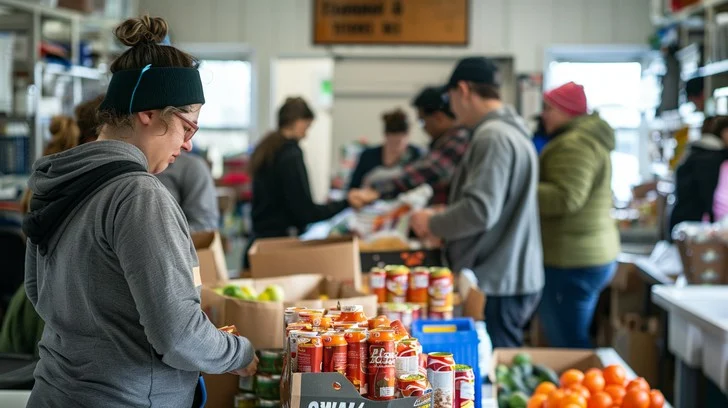

Liz spends many of her mornings volunteering at the Capital Area Food Bank. In an average day, the food bank packages over 550 boxes of beans, canned fruits, and juice in service of those facing food insecurity in Washington, D.C. Yet, despite these efforts, there always seems to be more need than can be met.
“This isn’t going to be nearly enough to feed them all,” one volunteer said, pointing to the packaged boxes.
This year in D.C., demand for food has skyrocketed, in part from the government shutdown and cuts to nutritional aid organizations by the Trump Administration. While the overall rate of food insecurity in 2025 has remained constant in D.C., at around 37%, the percentage of D.C. families with “low food insecurity,” or reduced access to quality and variety in their diet, has jumped to 22%, up from 16% three years prior.
Proposed changes to the Supplemental Nutrition Assistance Program (SNAP), including stricter eligibility criteria and reduced federal support for the program, as well as the residual effect of SNAP cuts during the government shutdown, have caused D.C. residents to turn to food banks more frequently.
Adapting to these changes, food banks are navigating increased demand during the holiday season. Furthermore, food security activists in the District are seeking comprehensive solutions to these unprecedented challenges.
Food insecurity in D.C. under the Trump Administration
Under the Trump Administration, particularly following the government shutdown, food insecurity has grown substantially. During the shutdown, access to food stamps was threatened, and although these benefits have been restored, there is still heightened anxiety around the state of benefits, which has led more individuals to turn to food banks. NW Community Food, a D.C. food bank, has seen a large increase in people in the past few months.
“We’ve had our highest number of visitors yet,” Ingram said. “We served 404 families, up from about 392 the previous couple of weeks.”
Tiffany Williams, CEO and President of Martha’s Table, wrote to the Voice that her food bank has seen substantial growth as well.
“So far this year, our growth continues, with visits to our markets up 47%since January, showing that even more families are turning to Martha’s Table for support,” Williams wrote.
Alexander Moore, Chief Development Officer of D.C. Central Kitchen (DCCK), has had to adjust to the higher demand. DCCK is a social enterprise that combats hunger and poverty through job opportunities, job training, and running from-scratch kitchens in D.C.
“We’ve identified more than a dozen partner agencies where they’ve seen a 50-100% increase in regular demand for their food distribution efforts,” he said. “We’re doing an extra 500 meals per day since the start of November.”
In addition to fulfilling increasing needs, food banks and organizations that provide support for food-insecure households have faced cuts in grants and resources.
“We have been fortunate that we haven’t seen large-scale cancellations of our government grants, but we are certainly seeing it from our partners,” Moore said.
Ingram expresses a similar observation of NW Community Food’s partner organizations.
“They saw about a 50% cut in their food stocks, and they’re really struggling,” she said, referring to a partner organization that has been in business for over 40 years.
As some food banks lose their federal funding, the need is shifted to independent food banks and organizations, placing a greater burden on organizations that must rely on private donors. According to Ingram, NW Community Food depends on individual donations from neighbors, family and friends, and even volunteers.
Even with unprecedented government policies, the high-pressure demand is not uncommon for DC food banks. The COVID-19 pandemic increased food insecurity, with rates rising to 16% in 2020 from 10.6% in 2019. Since 2020, the District hasn’t been able to return to pre-pandemic food insecurity levels, according to Sabine O’Hara, an environmental and agricultural economist at the University of D.C.
Today’s uncertain climate has made the situation for the holiday season worse. LaMonika Jones, Director of D.C. Hunger Solutions, a branch of the Food Research and Action Center, an organization dedicated to improving public policies to end hunger, said that incoming SNAP changes may place an even greater burden on food banks and families this holiday season.
“Now with the changes to SNAP, we are worried that this will push households further into food insecurity,” she said. “Food banks are already stretched. They’re trying to do everything they can, but the need is greater.”
Food insecurity during the holiday season
For food banks, the holiday season typically presents a host of challenges. Jones explains that increasing costs of living translate into a higher demand for food banks.
“The weather is colder, so there’s an increased cost when it comes to heat, and people are trying to offset that. And typically they pay the price with their food,” she said.
Along with higher heating costs, the holiday season proves difficult for some of D.C.’s most at-risk populations.
“When schools are closed, those are really tough in terms of the food security impacts, particularly on our children, and they are the most vulnerable,” O’Hara said.
O’Hara also notes that the holidays can be an emotionally challenging period for people, resulting in an increased desire to provide for those around them.
“The holiday season is tough for a lot of people. It brings out loneliness, because not everybody has a family to get together with,” she said.
Ingram agrees, emphasizing the emotional intensity associated with the holiday season.
“I think people just feel, no matter how badly they’re doing or how much they have to watch their pocketbook, there’s a pull of the holidays that makes them really want to be able to set a nice table for family and friends,” she said.
Due to high uncertainty around SNAP benefits, the holiday season is particularly tough for food banks to connect with people who may not realize they need support, resulting in a need for increased outreach. Ingram worries about many of her customers whom she hasn’t seen in recent weeks.
“We’ve noticed that some people aren’t coming,” Ingram said. “It’s a good season to check on your neighbors and make sure they’re getting what they need.”
How food banks are responding this holiday season
Despite the myriad obstacles, food banks remain resilient in finding immediate ways to adapt to increased need, while also looking towards long-term solutions.
Some banks, such as Central Union Mission and Capital Area Food Bank, are engaging in holiday-specific drives and events to bolster holiday spirit and increase support for residents in these higher-demand times. In addition to these initiatives, locations like NW Community Food have also seen greater support from their neighbors this year.
“People were just really, really concerned, and we saw contributions, both in-kind and monetary contributions, go way up,” Ingram said.
These community efforts have shown impact—NW Community Food’s second annual Turkey Drive, for example, saw an increase in participation.
“[Last year] wasn’t nearly enough, and this year, we pulled out all the stops and advertised heavily,” Ingram said. “We got 460 birds, and the number of birds was more than the number of people we were serving that weekend.”
DCCK has seen similar success in its efforts, providing almost 2800 turkeys to over 20 community partners. The organization also engaged with Edlavitch DCJCC in their “Everything but the Turkey” activation, providing homemade Thanksgiving side dishes to homeless and food-insecure individuals.
Besides their current operations support, Moore says that DCCK is looking for additional ways to support those who have never experienced food insecurity before. Following cuts to various federal departments, DCCK a program to provide 50% discounts to all federal workers at its cafes, to support those seeking new employment opportunities.
“We’re also trying to make sure that we’re meeting people where they’re at if they haven’t previously needed charitable support,” Moore said.
While these changes provide necessary and immediate support during the holidays, Moore said that supplying food for people isn’t enough to address systemic issues.
“There is no quantity of food that will end hunger, as hunger is a symptom of poverty,” he said. “We have to use food as a way to get people employed, to get people thinking about those root causes of hunger, and about larger-scale interventions that are getting people to a place of financial sustainability.”
O’Hara, who has done extensive research on urban food systems and solutions to food insecurity, also believes in tackling the root problem.
“It’s one thing to provide better access. But access doesn’t mean security,” she said. “If you introduce fresh produce into neighborhoods that have not had access to it in the past, then you also need to tell people what to do with it; how would they know if you have neighborhoods that have gone two generations of no access to unprocessed food?”
Professionals believe responding to food insecurity requires a whole-systems approach. According to Jones, this might include increased employment support, cooking and nutrition education, or promoting household food-waste reduction.
DCCK has begun a similar whole-systems initiative, providing customers with culinary training programs to help them build up careers in the hospitality industry.
“The transformative work comes from creating employment opportunities,” Moore said.
Above all, addressing food insecurity involves engaging with the community and adapting to the changing times, a challenge that many organizations have met head-on.
“Access to healthy food is a basic right, not a privilege,” Williams wrote. “We will keep expanding our markets, partnerships, and community programs so families don’t have to face these challenges alone.”
All of the organizations referenced in this article are actively seeking donations. Donate here: D.C. Hunger Solutions, D.C. Central Kitchen, Martha’s Table, NW Community Food, Capital Area Food Bank.