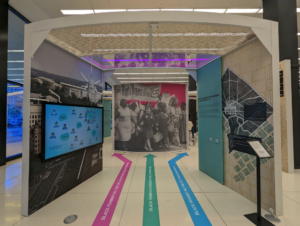





In the fiscal year of 2024, Georgetown was allotted $195 million in federal research support, which came predominantly from the National Institutes of Health and the Centers for Disease Control.
Since the start of President Trump’s second term in January, significant cuts in research and education funding have been made. With a projected $35 million annual loss, many university research projects have been disrupted or terminated, and graduate fellowship programs have been eliminated. Georgetown is currently working to secure alternative research funding sources.
As part of the Professor Research Series, the Voice sat down with research professors across a variety of disciplines to discuss their careers and recent projects.
English Professor Mecca Jamilah Sullivan studies the intersection of Black studies, women’s and gender studies, African diaspora studies, and creative writing. Her scholarship and creative writing focuses on Black queer, and feminist writers and artists who use language, voice, and character to challenge and critique systems of power in the United States and across the African diaspora.
In an interview with The Voice, Sullivan discussed her current creative project: a historical fiction novel that draws on her areas of expertise.
This conversation was condensed and edited by the Voice for clarity.
The Voice: What are the central themes of your historical fiction novel?
Sullivan: The project that I’m looking at charts a lineage of Black queer history and historical belonging. When we think about Black queer subjectivity, art, and culture there tends to be a bias toward understanding or focusing on the most recent manifestations. Black culture as it exists today is a very important site for thinking about the intersections between Blackness and queerness. But in my recent research, I’m really interested in thinking about the function of Black queer history and what role it plays in both Black and queer contemporary culture.
So that’s sort of one side of it. And then the other side of is thinking about, what does it mean for Black people to truly belong on a global scale. In the U.S, we tend to often think about Blackness as a nation bound in a certain way, especially from historical context—the idea that the Black American experience is, of course, the foundational part of the American experience, but that’s only one part of the global Black experience. We don’t spend enough time focusing on this sort of transnational resonances and mobilities about Black experience, and that the Black experience is a global experience.
The Voice: What historical moments does this novel focus on?
Sullivan: In terms of this particular book, I’m thinking about Black queer life in the early 2000s of Paris, France and in the 1960s of Harlem, New York City. As a Black queer person from Harlem, I think a lot about how Harlem is a site rich in history and its contributions to American literary history. There’s generally an understanding among scholars that that history is, in large part, a queer history. I’m really interested in thinking about what it means to really look at Harlem’s queer history, as central to Harlem’s Black History and Harlem’s cultural history.
The Voice: You mentioned that you identified as Black and queer. Do elements of your personal experience appear in the novel?
Sullivan: Writers often talk about how all of their characters sort of come from them, right? And I think that is the case for me as well. Every character I write is in some way drawing on either an experience that I’ve got or a perspective that I hold or a curiosity that is meaningful to me.
In the case of this novel, I would say, there is one character who spends time in Paris in the early 2000s, and that is an experience that I got to have. That’s when I was actually doing research for the book that ended up becoming my academic book, The Poetics of Difference: Queer Feminist Forms in the African Diaspora. When I was researching for that book, I ended up spending a good amount of time in Paris, really connecting with Black queer and lesbian communities. I was thinking about how Black and queer feminist literature and translation become building blocks and tools for community organizing and building across the diaspora.
The Voice: Have any documents or visual texts been especially influential in your process?
Sullivan: For me as a writer, I love research. I’ve been researching this novel for a while, arguably since that moment in the early 2000s when I realized, oh, there’s a book here. I’ve been kind of collecting ideas, images, having conversations, and jotting down notes. In fall 2023, I was on fellowship at the Schaubberg Center for Research on Black Culture. There’s an archive at the Schaubberg Center called the In the Life archive, which is just an amazing archive of Black queer oral history.
The Voice: Have there any materials that you’ve encountered that challenged your initial understanding of these time periods or the community that you’re researching?
Sullivan: That’s a good question. So there was not necessarily anything that called into question any assumptions I had, but I learned a lot about Black queer life at various points in history. One figure that comes to mind is Joan Jet Black, a Black queer woman who staged a presidential campaign in 1992. Hers was a name that I had heard, but knew very little about her story. At the Schaubberg Center, there’s a video of her campaign showing the vibrancy and irreverent naming of power in her image.
The Voice: What challenges have you faced while writing this novel?
Sullivan: For me, as a writer there are two main challenges. For those who write fiction, a part of the task at hand is to create a world that becomes an immersive experience. And that is hard to do when you’re having to chunk your time to make further obligations. I’m fortunate that at Georgetown what I’m teaching is directly connected to creative writing. Any time I’m spending in the real world is time I’m not spending writing. The opportunity for immersion usually comes during the summer. During the academic year is when I’m doing more of the research and outlining. The biggest challenge is just coming up with the time to truly immerse myself in the world of the novel. Because the novel is historical fiction, that immersion becomes even more important because I need to be able to not only know the facts of the time period, but feel like I can see the fashion and hear the music and even the speech patterns of characters.
The other challenge is related to research. Research is a way to stay in touch with the project, even when I’m not able to move forward as quickly as I’d like to with the writings. But the challenge then becomes that I have this wealth of research. Right now, the draft of the novel is much longer than it should be because there’s so much that I want to say. There’s going to be a pretty significant revision process where I start to sculpt, shape what actually belongs to what novel.
The Voice: What do you hope readers take away from the novel?
Sullivan: I think that in all my fiction, honestly, in all my writing, what I want readers to come away with is a changed sense of who they are. Specifically, who they are in relation to larger social structures, particularly structures of power. For some readers that might mean feeling seen in this novel. Certainly, I want readers to be more aware of the presence of Black and queer history, the centrality of Black history to American history and global history. One of the aims of my writing really is to shake up people’s ideas about language, power and locate themselves within that landscape of language and power differently.
Students can learn about Professor Sullivan’s research and novels on her website. In fall 2026, Professor Sullivan will be teaching both “Introduction to Fiction Writing”, an introductory-level creative writing workshop, and “Storytelling & Hip-Hop”, an intermediate seminar at the Capitol Applied Learning Labs (CALL) program on Georgetown’s Capitol Campus. As she conducts her research, she is currently being assisted by two graduate students through summer 2026, but plans on opening up more research assistant spots next semester. Though her novel is still in the developmental stages, she is currently working on some smaller essays and articles on similar themes of Black queer, feminist life and expression. Outside of her teaching and writing obligations, you can find Professor Sullivan speaking at various campus events. She enjoys connecting with students especially interested in queer expression and African diaspora literary works.
Have a professor you want to nominate? Email your suggestion to news@georgetownvoice.com.