


After biking from Georgetown to Adams Morgan, I was sweaty and flustered as I stumbled into the DC Arts Center on 18th Street NW. As I gazed upon construction tools and tarps scattered across the gallery floor, the artists—clearly in the middle of something and startled by my noisy entrance—asked, “How can we help you?” Not wanting to interrupt, I explained that I was there to write a story about the Arts Center and was hoping to get a glimpse of the galleries on display. They welcomed me eagerly and allowed me to look around as they finished mounting works on the wall.
I was initially there to see Family Ties: Thingumabob Self-Portraits, a collection of abstract, otherworldly portraits that had been on display for around a month. But, after a short conversation with the two curators, Lucas J. Rougeux and Izy Carney, I found out they were setting up We Mend In End Times, the Arts Center’s newest exhibition. While their display wasn’t fully ready, they allowed me to peruse the portraits and invited me to preview the works before the exhibition’s grand opening on Feb. 13.
Family Ties: Thingumabob Self-Portraits by Maryland-based artist Hyunsuk Erickson is a collection of drawn portraits depicting Erickson’s Thingumabob sculptures. These sculptures—organic, column-like structures made of ceramic, wood, or PVC pipe and embroidered with yarn—were previously on display. In each portrait, the abstract, tubular forms intertwine, diverge, and converse in vibrant explosions of colored pencil, ink, and marker. In four, figures dance and flash across the page like shooting stars, reminiscent of brushstrokes rather than colored pencil lead. Three portraits of the Thingumabobs, titled In the Jungle 1-3, situate the beings in a more colorfully saturated habitat than their usual blank sheet of paper, coexisting among vibrant plant life. As described in the collection’s title, the Thingumabobs are a family; each individual is unique, but commonalities emerge. This family connection was endearing to me, humanizing them from simple blobs of color to sentient creatures.
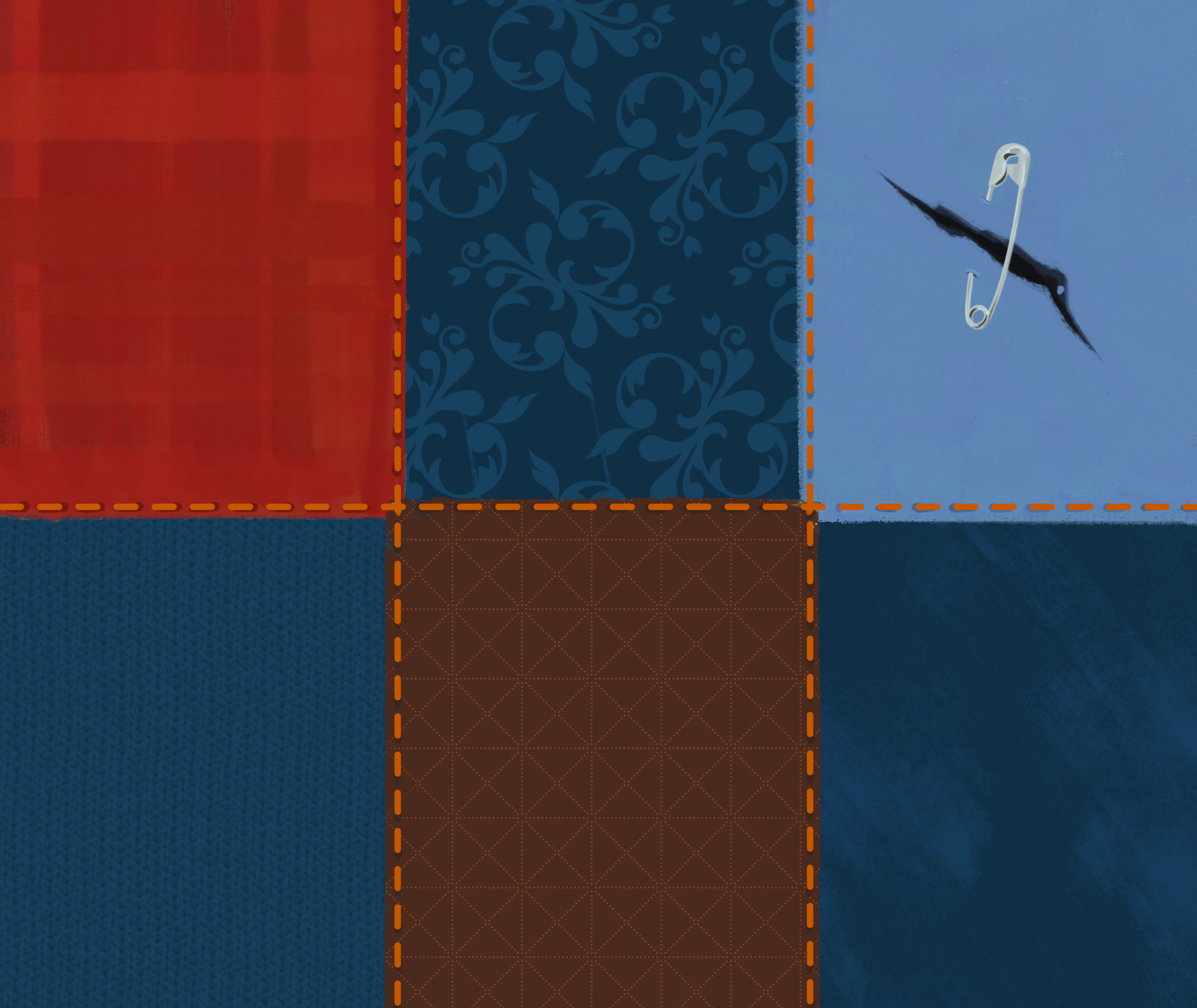
The next day, I returned to a completely transformed gallery. Walking through We Mend In End Times, my initial beliefs about textile art were shattered. As a sewist, I’ve always held flawlessness as a heavenly ideal, comparing myself to the most perfect garment and quilt constructors. Seeing the beautifully imperfect masterpieces in this collection made me realize that imperfection is just as valuable. Each work on display incorporates purposeful imperfection, focusing on making statements rather than conventionally functional pieces.
This collection consists of six artists, and while each has a distinct approach to textile art, the idea of mending as a way to build community and solidarity cuts through these differences. Carney, Rougeux, Milan Warner, Eliza Clifford, Grace David, and Fatima Janneh create quilts, sculptures, garments, and animations that venture beyond any preconceived notion of textile craft.
The Land Grows Through Its Scars by co-curator Rougeux immediately captured my attention. She embroidered beads over gauze to create a wounded field of poppies, where some are healing and some have never been hurt. In the gallery pamphlet, she emphasized that “Poppies, a flower of remembrance and of Palestinian heritage, are both soaked bandages and hopeful possibilities for regrowth: a reality unreached without scars.” They made this piece to show that, through mending, we create meaning and healing. The poppies covered with gauze will never heal, but the act of repairing them creates a sense of pride behind the scars. As I spoke with Rougeux, we agreed that art can never be made in a bubble; art is always created in response to the experiences of communities surrounding it.
This healing motif is continued in Oscillation: birthday quilt #26, a stop-motion quilt created by Carney, the exhibition’s other co-curator. The quilt depicts the oscillation between two people slumping down and standing up, helping each other get up when the other can no longer move forward. Words embroidered on the quilt form poems that convey the comfort found in this relationship. In our short conversation, Carney and I connected over the painful perfectionism that runs rampant in the quilting community. The fact that she patched the quilt with her loved ones at a birthday party fortifies the idea that a community created through mending is much more fulfilling than a perfect product.
When I arrived at the gallery to attend the premiere event the next night, the space was, yet again, completely transformed. People hugged each other, discussed the artwork, conversed with the artists, and created the bustling atmosphere of a house party rather than an art gallery. In place of beer pong and a DJ, there was a community mending table where visitors could learn and practice mending techniques on one large sheet of fabric.
Though I only arrived in D.C. six months ago, this event made me feel as if I had been a part of this community forever. On Friday, We Mend In End Times and Family Ties attracted a ragtag team of menders, artists, and appreciators who, without trying, filled the missing role in the collection. The lively community I witnessed that night will continue to thrive, as the exhibitions are open until March 13, with multiple sewing and quilting bees taking place over the next month. To quote the title of one of Carney’s stop-motion quilts, Run, don’t walk! to the DC Arts Center to experience the most important aspect of textile art: the community it creates.