

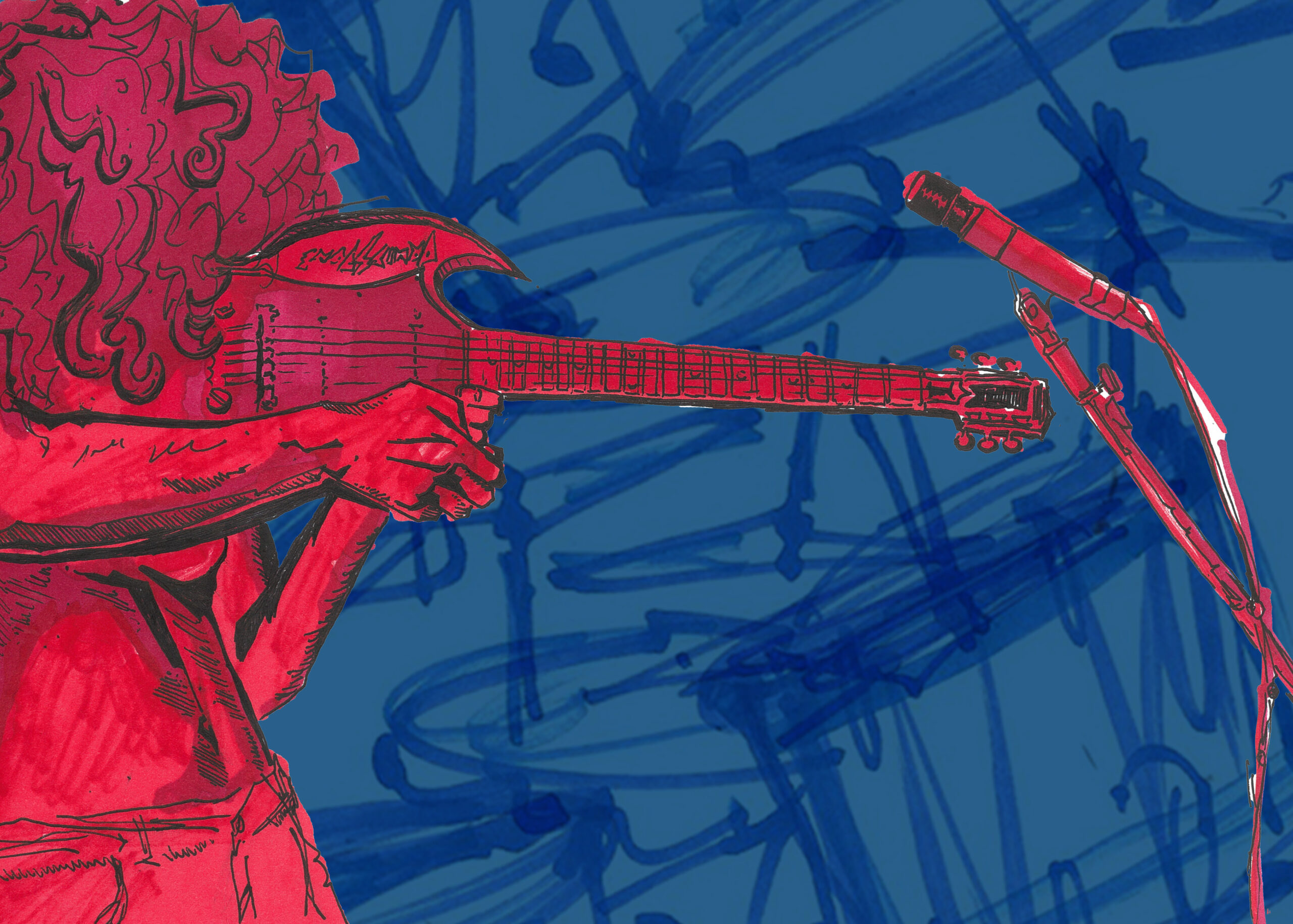

Having been plucked from my Midwest emo basement scene, I’d been wandering around D.C. terribly nauseous from the withdrawals. Where was the screaming and the guitar smashing? The desperate cries for change? Where was the sweat? The math-rock-riff-backed rants about SSRIs’ effects on one’s ability to truly understand the epic highs and lows of American Football? There wasn’t a single desperate loser at Georgetown trying to sell me their lousy CDs. In this strange new place, I was lost. I had a hypersexual-transgender-anarcho-communist punk band-shaped hole in my heart.
That was, until I found Druid Stone.
If you haven’t yet met Pie Shop on H St., it’s a two-in-one pie shop (as the name might suggest) and punk music venue. The venue caters to drag shows, a culture of chain smoking on its porch, and the finest of the DMV’s underground metal. I was a starry-eyed child when I first saw the band Druid Stone at Pie Shop. Everything about them was raw, sensationally erotic, and mildly disturbing. The lead singer and guitar abuser, Demeter, spent over seven minutes on an ear-deafening feedback solo. By the end of their set, the entire band was soaked in sweat and dead upon the stage, terribly and tragically murdered by the drum kit.
Right then and there, under the dim black lights, I felt the fissure in my soul mend. As much as I love the half-smokes, D.C. is a cheese grater of careerism and elitist attitudes. This ivory tower is a desert devoid of unmanicured personalities. “What do you do?” and “Where are you going this summer?” haunt this city. An individual’s merit and character are defined by status through hierarchical employment and wealth. A culture of appeasement and conformity gatekeeps opportunities. Creativity is waterboarded and stifled when meeting other people for lunch has a purpose, clothes are a constant reflection of your status, and the bullshitting of one’s weekend is premeditated a week in advance. Southwest D.C. is waking and breathing in the pursuit of productivity. Worst of all, the lives of our little Capitol-career foot soldiers quickly become centered around “networking” rather than building genuine community.
I never liked the Midwest, but you don’t realize what you have until it’s gone. Druid Stone was able to say something I lacked the words for. Demeter’s guitar sang something only my heart knew how to say. The second guitar’s sour cries soothed me, offering back the world of free self-expression I left behind in my neighborhood. The blown-out Peavey amp screamed everything I’d been holding in for the past two years. Another guitar neck was lost that night—rest its soul—but in its wake, life was breathed back into me.
Druid Stone was my gateway drug into D.C.’s punk scene, and since, Pie Shop has been my faithful dealer. Now, I know what you’re thinking: “Druid Stone, the self-described “Lesbian Drug Cult,” is quintessential doom metal, not punk!” But “punk” isn’t a singular music genre or sound. Punk is a desperate, rattly cry into the void for change, given the perils of the current human experience. Punk is a disposition. When Demeter shook where she stood, singing to me the way a dying siren would as she ripped off her shirt—that was punk.
Punk and counterculture emerge only in the places that need them most. D.C. was an entrepreneur in the punk scene in the 1970s, taking the grit of the London bleeding empire’s underground sound and making it its own. HarDCore pioneers like Bad Brains and Minor Threat spent their tracks screaming at the Capitol and mocking polite society. Given Washington’s abundance of war criminals and historical apathy towards the working class, the District’s policies and culture have always been catalysts for passionate critique—which is always best paired with a little screaming and a simple chord progression.
As one of the world’s most powerful cities, D.C. needs punk as much as punk needs D.C. Left to its own devices, D.C. fosters an echo chamber of political theory that fails to be self-critical in the absence of counterculture. Any healthy and true democracy needs its policies and culture to adapt to the needs of its people. Punk offers D.C.—and popular culture itself—the loudest feedback possible.
Druid Stone was able to breathe into the microphone what I’ve been struggling to explain to my dean. It’s been hard to feel like I belong here. It’s not that anyone has said anything particularly pointed towards me, but it’s the way there’s a general dress code that just doesn’t align with anything I own—it’s the way people talk and conduct themselves as if every classroom is an interview. Not many people experiment with their style or appearance. Rarely do I meet people here who dedicate themselves to their art and ideas. Where are the men with eyeliner? Where are the dreamers and the poets? It’s replication after replication of whatever is safe and employable.
I can’t conform to it—and even if I could, I don’t think I should.
Creativity is what makes humanity beautiful. In the same way that evolutionarily beneficial genes develop first from random mutations, “defections” if you may, our culture’s most beautiful assets only come from those who try new, risky, and unpopular things. Democracy’s best ideas will come from those who are willing to put aside appeasement and propose something new.
I want a place where it feels normal to be a little unique, and perhaps even a little original. I owe the world to Druid Stone, Pie Shop, and D.C.’s incredible punk scene for giving that to me.