


Trump administration lawyers and Georgetown postdoctoral fellow Badar Khan Suri’s legal team sparred during oral arguments before the United States Court of Appeals for the Fourth Circuit on Tuesday, March 17—the one-year anniversary of ICE’s detainment of Khan Suri. The case was heard by federal judges Pamela Harris, J. Harvie Wilkinson III, and DeAndrea G. Benjamin.
Wilkinson, a Reagan appointee, seemed sympathetic to the government’s arguments based on his line of questioning, while Harris, an Obama appointee, and Benjamin, a Biden appointee, seemed skeptical of their case.
Khan Suri was detained outside of his Rosslyn, Virginia home last year while traveling back from campus. Khan Suri, an Indian national, is in the U.S. legally on a J-1 exchange visa given to students, scholars, and teachers. He was detained for 58 days in five separate locations, spending the majority of his incarceration at Prairieland Detention Center in Alvarado, Texas. In May 2025, Judge Patricia Tolliver Giles at the district court for the Eastern District of Virginia ordered Khan Suri’s release on bond.
Khan Suri is currently undergoing two different court cases. He has an immigration case, which will determine whether he is deported—courts most recently ruled that Khan Suri is deportable, though he is appealing this decision through the Board of Immigration Appeals. Tuesday’s case, that Giles previously reviewed, is about whether his detention was illegal and in retaliation for his support of Palestine and marriage to a Palestinian.
The March 17 hearing was a response to the government’s motion to appeal Giles’ decision to release Khan Suri on bond. A different 4th U.S. Circuit Court appeals panel ruled during an initial hearing in July that Khan Suri should not be immediately returned to detention, as they found no reason to disturb Giles’ ruling.
Habeas Corpus Petition
Tuesday’s arguments centered around whether Khan Suri’s lawyers could continue to pursue a petition of habeas corpus, a legal proceeding challenging the government’s incarceration of a detainee, alleging that the Trump administration violated his free speech rights under the First Amendment and right to due process under the Fifth Amendment. A ruling on the case likely won’t be issued for several months.
The Trump administration argued that the court never had the jurisdiction to issue the release orders. They claimed Khan Suri should not be able to pursue a separate suit against the government claiming his detention was unlawful—rather, they say that should be included in his separate immigration court proceedings. In the administration’s view, the bond order should be reversed, and Khan Suri should be redetained.
Khan Suri’s legal team disagrees, maintaining that Giles ruled correctly and he should remain out of detention. While the government lawyers say that the suit duplicates arguments made in Khan Suri’s separate immigration proceedings, his legal team maintains that the two cases pertain to different aspects of his experience: the habeas case is regarding his unlawful detention, and the immigration case is about whether he can be removed from the country.
“The government’s arguments are quite sweeping,” Noor Zafar, one of Khan Suri’s attorneys, said in a press conference following the hearing. “In the district court, the government did not contest that it took all of these actions because of Dr. Suri’s speech, but it’s saying that it should be able to do this, and that no federal court should be able to review it.”
Khan Suri’s legal team alleges he was detained as retaliation for his support of Palestine and his marriage to Mapheze Ahmad Saleh (MSFS ’26), both of which fall under the freedoms of speech and association guaranteed by the First Amendment, according to his lawyers.
Saleh is an American citizen who was raised primarily in Gaza. According to a 2018 interview with the Hindustan Times, Saleh’s father was a “senior political advisor” to Hamas.
Two days after Khan Suri was detained, then-Department of Homeland Security (DHS) spokesperson Tricia McLaughlin wrote on X that Khan Suri was “deportable” because he was “actively spreading Hamas propaganda,” seemingly referring to pro-Palestine social media posts Khan Suri made on his personal accounts. She also wrote that he has “close connections to a known or suspected terrorist, who is a senior advisor to Hamas.”
Khan Suri was one of several non-citizen students and scholars across the country detained for speech in support of pro-Palestinian causes. Two weeks before Khan Suri’s detainment, ICE officials arrested Mahmoud Khalil, a Columbia University graduate and pro-Palestine organizer, with the Trump administration advocating for his deportation.
The Trump administration’s team argued that §1252(b)(9) of the Immigration and Nationality Act determines that an individual going through immigration removal proceedings cannot also file a habeas suit against the government.
“The guiding principle is, if you can raise it before an [immigration judge], and it could ultimately be heard by Circuit Court through a [petition for review], then that’s how it must be raised,” Drew Curtis Ensign, an attorney for the Trump administration, argued. “Only if it would be impossible for it to be there is it something that’s outside the zipper clause.”
According to Guerrero-Lasprilla V. Barr, Attorney General, the “zipper clause,” or §1252(b)(9) is meant to “consolidate judicial review of immigration proceedings into one action in the court of appeals.”
In the courtroom, debates arose over the interpretation of Congress’s intentions with their decision to prioritize immigration court proceedings in §1252(b)(9). Judge Wilkinson stated concerns over the subject-matter jurisdiction, which determines what type of subjects the court has authority to hear, rather than personal jurisdiction, which involves which specific parties are involved. He worried that there would be an unnecessary duplication of the case that could result in conflicting rulings from different courts.
“What Congress, it seemed to me, wanted to do was to avoid having the immigration proceedings and the habeas proceedings running into each other, where they were duplicating each other and conceivably producing opposite rulings on the very same questions,” Wilkinson said. “The whole immigration process of this country could get involved in a very serious tangle if you say that the immigration proceedings and the habeas proceedings can go forward simultaneously on the same claim.”
Khan Suri’s lawyers said that the statute only blocks individuals from launching two separate cases about the same event. However, they would classify concerns about Khan Suri’s detention and removal proceedings as different events. They agreed that Congress intended to limit duplicate cases, but argued it did not intend to prohibit individuals from bringing concerns about their rights to the courts.
“The government comes before this court with an extraordinary argument. That it should be able to arrest non-citizens for their pro-Palestine speech, detain them for as long as they want to censor this speech, and deny them any judicial forum to seek prompt relief,” Noor Zafar, Khan Suri’s attorney and senior staff attorney at the American Civil Liberties Union, said. “Congress did not intend—and the constitution does not allow—the government to use the immigration detention system to implement a policy of censorship.”
Judge Harris also questioned the interpretation of Congress’s policy on immigration court proceedings as arguments against the duplication of claims.
“You say it’s because the petitioner’s claims are the same, but I’m guessing from [Dr. Suri’s] perspective, it’s just because the government is doing the same unlawful thing twice,” Harris said, referring to the claims against detention and removal, in a question to Ensign. “So can you tell me why I should think that is what Congress wanted the result to be—that if the government does it twice, it’s off limits, but if you only do it once, you can bring a habeas petition?”
The Trump administration’s legal team also implied that Khan Suri wished to push the habeas case because it would move faster through the courts, as immigration cases are slower-moving.
“Dr. Suri does not deny that he can obtain review of his claims through the [immigration judges] and ultimately circuit courts through a [petition for review],” Ensign said. “He prefers otherwise, but that’s simply a policy choice that Congress has made.”
Judge Harris, however, seemed skeptical that this “preference” did not have significant implications on Khan Suri’s livelihood in this case.
“You might prefer things for any number of reasons,” she said. “The idea that you can be detained for years and then, ‘Good news!’: at the end of that years-long detention period you can get review of whether, for the last several years, you’ve been illegally detained. I feel like that goes beyond personal preference.”
Harris also questioned whether Khan Suri’s detention was considered mandatory under his removal orders, given that he has not been convicted of a crime and is not a flight risk.
“Your Honor, I believe detention is mandatory under the Foreign Policy charge,” Ensign responded.
“Are you sure?” Harris asked.
“I am 80% sure of it, and I will quickly correct the board if I’m wrong about that,” Ensign said.
Even after Harris followed up later, Ensign did not provide any information during the hearing as to whether Khan Suri’s detention was mandatory.
Unknown Custodian arguments
At the hearing, lawyers on both sides also rehashed arguments regarding the unknown custodian exception.
The “unknown custodian” is used in cases where specific details about where a detainee is held or physically located are unclear, and thus, the center or prison that would have custody over the individual is unknown. In cases where there is an unknown custodian, the case should be filed where the detainee was removed from.
In Khan Suri’s May 2025 hearings, the government argued that his case should be tried in Louisiana, where he was at the time that the suit was filed, or in Texas, where he was eventually incarcerated. However, because Khan Suri’s legal team could not get in contact with him and did not have information as to where he was, the case was filed where he was detained, in the Eastern District of Virginia.
Ensign argued in his rebuttals that the unknown custodian exception only applies when the custodian is unknown—and he argues that Khan Suri’s lawyers knew where he was.
“Do you think the custodian was known when he filed the suit?” Harris asked in response.
“Almost, your honor,” Ensign said. “This case has somewhat unusual facts.”
Judge Benjamin pressed him on that response, saying that Khan Suri’s location was not available in the ICE detainee locator, nor was he allowed a phone call with his attorneys before the suit was filed.
“How was his attorney, filing his habeas petition, supposed to know that, if it was not in the locator?” Benjamin asked.
“Dr. Suri could’ve told his attorney those facts,” Ensign responded.
“How? The government gave him a phone call?” Benjamin asked. Khan Suri shook his head ‘no’ in the audience, and Ensign was not able to confirm that he had been given a phone call before the case was filed.
Why was this hearing important?
At the hearing, Judge Wilkinson stated that Khan Suri would receive an avenue for review even if the habeas proceedings do not materialize, arguing that immigration proceedings will allow a challenge to an order of the Board of Immigration Appeals (BIA), although this alternate proceeding would likely “not come as quickly” and be “less desirable” than Khan Suri’s team hoped.
“That review would come too late to offer meaningful relief to Dr. Khan Suri,” Zafar said in response.
In a later press conference, Khan Suri’s team clarified the importance of the habeas proceeding when asked why an immigration proceeding would not be adequate.
“Every immigration judge is an employee of the Department of Justice, answerable to Pam Bondi and Donald Trump,” Johnny Sinodis, a partner at Van Der Hout LLP, a law firm representing Khan Suri, said. “They’re subject to extreme political influence, and I have no doubt that in many instances, if not all, they’re receiving direction on how these cases should be decided and handled.”
Khan Suri and his lawyers speak out
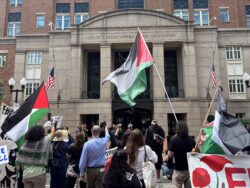
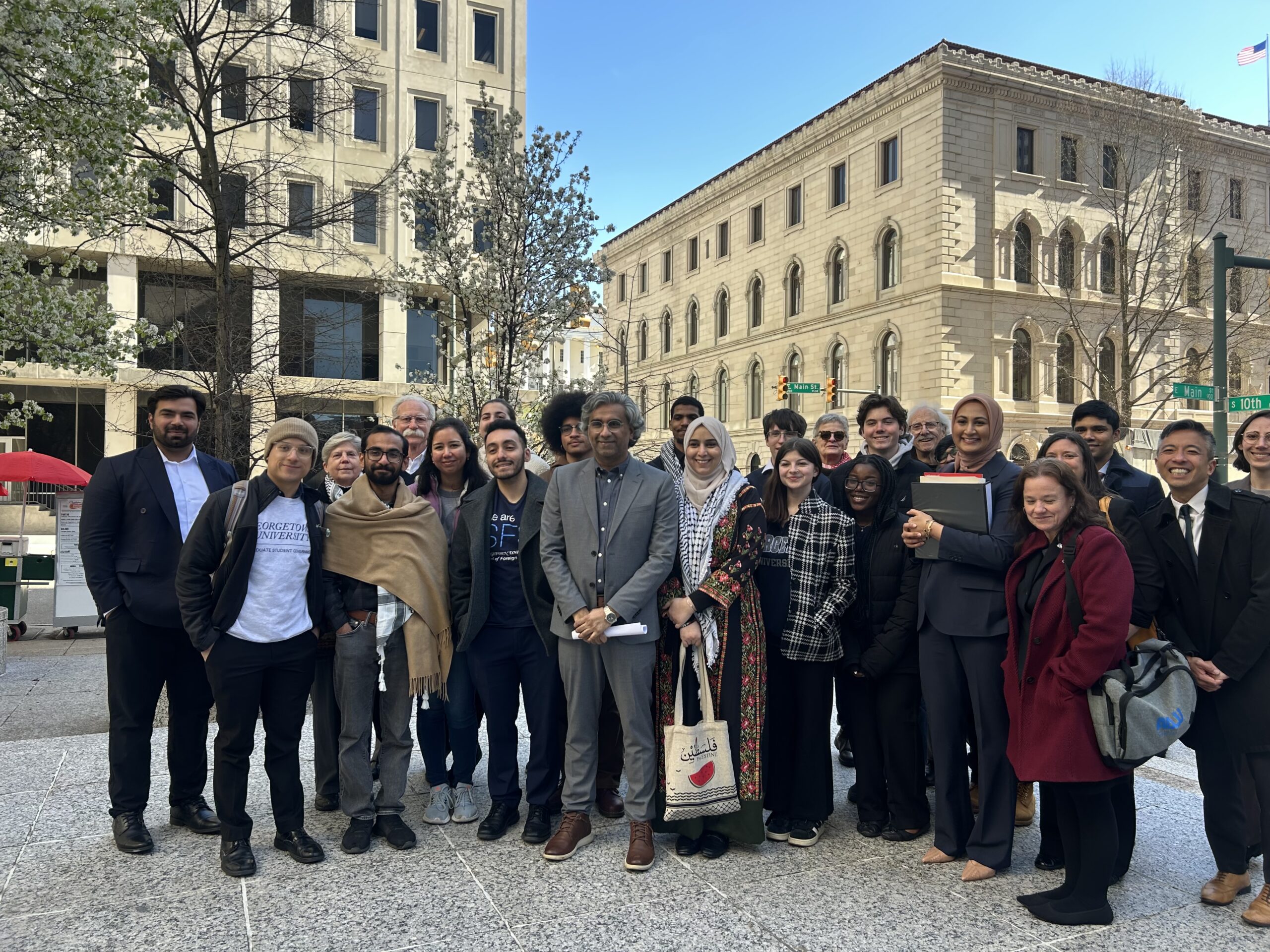
Outside of the courthouse, Khan Suri gave a brief speech. He thanked his students, friends, and other community members for coming to support him, and reaffirmed his faith in the legal system to deliver justice.
“Here I stand exactly on the same day after a year, still confused, yet still fighting for constitutional protections,” he said. “I am a legal immigrant. I’m married to a U.S. citizen. I’m a father of three children, a loved member of the community, and yet for expressing solidarity with Palestinians facing genocide, I found myself detained and facing deportation proceedings that are still ongoing.”
In the press conference, Zafar said that she is taking an optimistic outlook on the judges’ potential rulings.
“We’re hopeful that some of the judges were receptive to our arguments, and we are hopeful that it’ll sort of see through that they’ll see through the government’s arguments and affirm the district court’s orders,” she said. “But of course, it’s hard to predict.”
Concluding his speech outside the court, Khan Suri emphasized that the impacts of his case stretch farther than just his fate.
“The questions before the court today go beyond law. They touch the core principles of academic freedom and freedom of expression,” Khan Suri said. “A confident democracy does not fear debate. It protects it. The true test of democracy is how it reads those who dissent peacefully.”
“When students, scholars, or citizens are intimidated or punished for expressing ideas, the public space where democratic life exists begins to shrink,” he added.