



The Council of the District of Columbia held a performance oversight hearing on housing, education, and policing on Feb. 25. During the Judiciary and Public Safety Committee hearing, council members addressed Washingtonians’ concerns surrounding the Metropolitan Police Department’s (MPD) level of involvement with federal authorities, particularly Immigration and Customs Enforcement (ICE).
Committee Chairperson Brooke Pinto (D-Ward 2) opened by noting that earlier council questioning of the MPD, following a December hearing, had led to explanations that were “frankly unsatisfactory and didn’t provide clarity.”
“One of the most fundamental needs we have to create safety in our community is to have trust between our residents and our law enforcement,” Pinto said.
During the hearing, Interim Chief of Police Jeffery Carroll insisted that the MPD does not currently collaborate with ICE, acknowledging the support they did provide to ICE during the 30-day federalization of the capital last year, where President Donald Trump redirected MPD efforts beyond their regular responsibilities to immigration enforcement.
“We’re not working with the ICE enforcement removal operations,” Carroll said, specifying that collaboration would include joint patrol, information sharing, or engagement in civil immigration enforcement.
Yet Carroll was unable to provide clarity on several specific incidents in which ICE activity overlapped with MPD. In one case, a man was taken into custody by ICE at a police station after arriving to pick up his stolen vehicle. Carroll stated he did not know the details of that instance and suggested that ICE officers could have acquired the man’s immigration status at any point, including during the initial stolen-car report.
“MPD will never inquire to anyone’s immigration status, other agencies can,” Carroll explained. “If you’re not in police custody, then questions can be asked. Once you’re in custody, we can share no information with federal immigration authorities, and at no time can we inquire about immigration status.”
He added that MPD responds to 911 calls, but federal agencies, such as the U.S. Park Police and the Secret Service, have access to MPD’s radio channels and can arrive at any incident unannounced.
Carroll also acknowledged that MPD does not track federal agents’ activity at scenes involving MPD, leaving them without specific data on such interactions. Pinto urged MPD to start collecting this information, emphasizing that D.C. is currently “flying blind” with what occurs in its communities when “federal agents are present.”
Two acts of emergency legislation were passed unanimously by the D.C. Council on March 3, one of which was introduced by Pinto, that increased the responsibility of MPD officers in promoting transparency with the activity of federal agents, including requiring body-cam footage to automatically be released in instances of serious or deadly force and documentation of federal agents present at the scene of an arrest.
Residents expressed several concerns about the impact of ICE’s presence on their communities. Robyn Swirling from Ward 4 testified that she had personally witnessed federal authorities, including the FBI, working with MPD.
“MPD and [federal authorities] alike are behaving like people who know they will face no consequences. As of so far they have been right. And that starts at the top, under Jeffery Carroll,” Swirling said. “Under his leadership, MPD refused to provide this council with any data on how many federal agents are operating alongside MPD, how many arrests have been made, how many stops. He is not being transparent with [the council].”
Washington D.C. Mayor Muriel Bowser appointed Carroll as interim chief in December 2025 after Chief Pamela Smith stepped down. As a former executive assistant chief, Carroll has been criticized for his alleged lack of responsiveness against Proud Boys, a white supremacist terrorist group, organizing in Washington, D.C., and is named in a 2021 lawsuit by several women officers of the MPD for harassment and unfair treatment. Many Washingtonians at the hearing argued that his work with federal authorities, along with other concerns, makes him unfit for permanent chief.
American Civil Liberties Union of D.C. representative Ahoefa Anaouko said that the “groundwork for the severity of the federal takeover was laid by a history of defiance from MPD” as well as decisions made by the council. Anaouko said in her testimony that Black and Latine communities have been the primary targets of police violence and are often used as political pawns.
“The defiance MPD leaders continue to exhibit can be attributed in part to the council’s reluctance to take up measures that address transparency and accountability,” Anaouka said. “This reluctance has resulted in a history of MPD officers and the department at large acting with an air of impunity.”
Anaouko referenced controversies like the reinstatement of officers convicted for their roles in the death of 20-year-old Karon Hylton-Brown, after chasing him at “unreasonable speeds” leading to a fatal collision with a motorist, then later falsifying the report of the incident.
Oye Owolewa, a D.C. shadow representative, or a representative elected by D.C. residents to advocate for D.C.’s interests in Congress, called on Mayor Bowser to publicly denounce ICE, drawing comparisons to the mayor of Minneapolis’ angry response.
“Their mayor said, ‘ICE, get the F out,’ our mayor thanked our federal occupiers,” Owolewa said. “Whether it’s collaboration [of MPD with ICE] or looking the other way, we all see the same thing: complicity.”
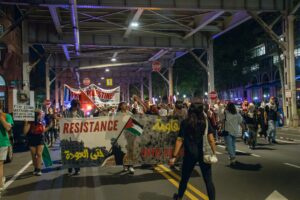
Owolewa called on elected officials to more directly address concerns of the citizens, explaining that he sees “community protests, yet very few councilmembers” with them.
“I know we’re vulnerable because we’re not a state, but what leadership can we have when some of our leadership is too scared to lead?” Owolewa said.
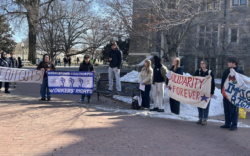
Within the Georgetown neighborhood, federal authorities patrolling the streets have caused confusion among residents and economic repercussions, including staff shortages in local businesses and even the closure of Los Cuates, a Mexican restaurant.
Izzy Volpe (SFS ’27), co-director of the outreach and mobilization committee for Hoyas for Immigrant Rights, said that while being at Georgetown offers students protection, students face similar risks of federal authorities targeting them due to their race, ethnicity, or language. She explained a recent Supreme Court hearing that allowed federal authorities to use these factors as reasonable suspicion to detain them.
There are also limits to policing, Volpe said. Interim Chief Carrol occupies a role within the government that is not fundamentally transparent nor on the side of communities. Volpe explained that community members have to understand the limitations of policing and emphasized the importance of knowing one’s rights, especially in a city where federal and police authority intersect.
“The over emphasis on demanding accountability from public officials, which is incredibly important, can also detract from our own sense of agency,” Volpe said. “Maintaining a balance of both and understanding the limits of both is important. That’s not to say that you can’t demand better. You absolutely should demand better, but don’t let that take up all your energy.”
In this challenging moment, Volpe notes that there are direct actions, like supporting facility workers as they fight for better wages, that students can focus their energy on to support immigrants rather than becoming overwhelmed with feelings of hopelessness.
“That’s like a very tangible way through supporting that you can actually contribute to the collective good,” Volpe said. “The most important thing you can do right now is educate yourself and continue to build community.”