

I grew up in Caracas, Venezuela and moved to Washington, D.C. almost three years ago. Now, as a junior at Georgetown, I am studying Finance, Accounting, and Entrepreneurship. While on paper this all sounds very straightforward, the path to getting here was anything but that.
For international students, coming to the U.S. is not only an academic opportunity but also a personal transition into uncertainty and sudden independence. Behind every acceptance letter is a story of families letting go and students learning to build a life from scratch.
Coming to the U.S. was not simply a personal decision; it was only possible because of my parents’ sacrifice. Given the current political state of Venezuela, economic opportunities are limited and uncertain. Honest work—legal, socially productive work—is very scarce right now; most thriving businesses back home are corrupted by government ties, while honest companies are barely surviving. Thus, my parents worked day and night to be able to provide me the chance to escape and pursue something bigger.
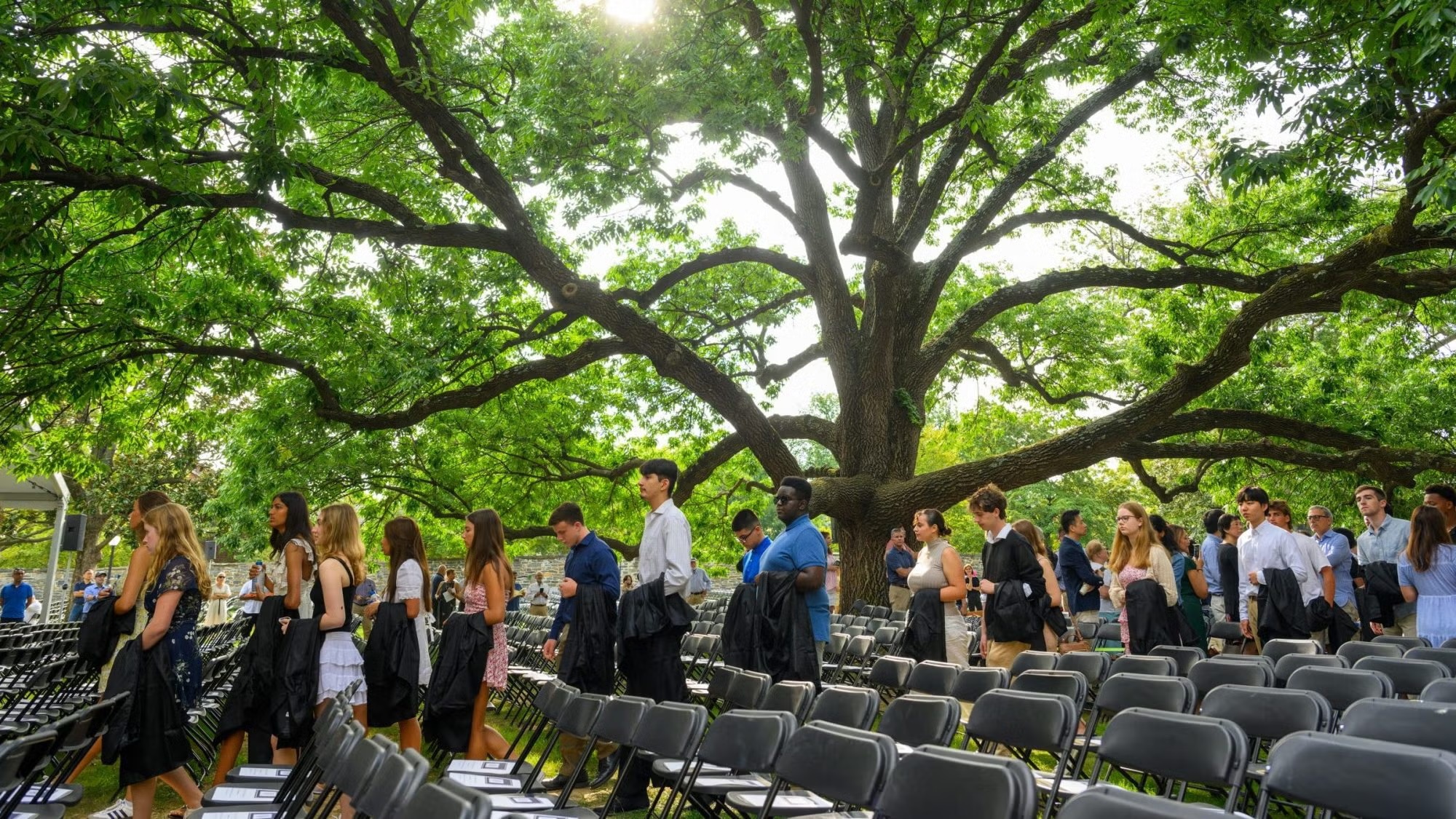
I carried that responsibility to honor my parents from the start. I still vividly remember New Student Convocation, walking down Old North Way, and watching a long line of students wearing matching convocation robes. There was something striking about how uniform we all looked, as if we already belonged to the same world. Yet, despite wearing the same robe and walking the same path, I felt completely disconnected from the people around me. I was overwhelmed by the feeling that everyone else had already found their friends, their place, and their life at Georgetown.
Walking down the aisle, I saw my family. It suddenly dawned on me that once the ceremony ended, they would return home to their normal lives, while I would stay behind in a new life I did not yet know how to navigate. I felt isolated from my two lives: from the students around me, who already seemed to belong, and from my family, who would soon no longer be beside me. It was then I realized that studying abroad was not just about academic ambition, but standing on my own much sooner than expected.
It was overwhelming to me because I grew up in Caracas, a city that can feel very big and chaotic, but for the privileged few, it functions like a bubble. My own world felt very small. I attended a small international school and was raised within a tight circle of longtime family friends, where everyone seemed to know one another’s families, habits, and histories. My second grade class had around 60 students from all over the world, many of them children of expats, ambassadors, and multinational executives. But as those institutions and companies pulled out of Venezuela, their employees and families relocated abroad. By the time I graduated, there were only 9 of us in the whole grade.
I was used to knowing everyone—not just their names—but also their habits, personalities, and even families. I still remember that Assil always had Cocothai Sushi delivered on Tuesday, and Francesco brought his grandma’s pasta ragu that same day. We were so accustomed to each other that even our lunches felt predictable. There was comfort in that closeness. It made going to school feel predictable, intimate, and easy to navigate.
Georgetown was overwhelmingly different from what I was familiar with. I was suddenly in a class of 1,600 whose faces I could not recognize and whose names I had never heard.
During my first night, I remember lying in a hard, plastic bed, hyperaware I was sleeping less than a foot away from a stranger. Everything about my previous life—the people around me, the places I went every day, even the bed I slept in—seemed to be rapidly shifting out of place.
Walking into Leo’s, I had to adjust to food that was different from my home. I grew up eating arepas for breakfast—a traditional Venezuelan dish that is warm, fresh, and comforting. At Leo’s, eggs were scooped from a meal container; they were cold and foreign. Although it sounds trivial, it forced me to confront that even the routines I had once taken for granted were no longer mine. I had to adjust, whether I liked it or not. Over time, I learned to accept those changes. Every dining hall breakfast reminded me of how much I missed home, my parents, and my old life.
Over time, the unfamiliarity became normal. The roommate who was once a stranger became someone I confided in and enjoyed spending time with. The students at convocation that I was so sure had their life figured out turned out to be just as unsure as I was. Conversations that began awkwardly while at Leo’s turned into real friendships.
These friendships have transformed my experience. I’ve become close friends with people who come from countries I had never heard of before arriving. I’ve learned about cultures that I had barely encountered before, sometimes in small but memorable ways. Over a plate of chicken shawarma, my friend Tamer explained that Petra in Jordan is one of the Seven Wonders of the World.
Being an international student forces you to adapt quickly. I’ve learned to navigate paperwork, banking systems, healthcare, and cultural differences, often without the built-in familiarity that many domestic students take for granted. Even routine tasks felt intimidating. Healthcare was especially complicated. I was suddenly expected to understand insurance plans, co-pays, referral, and coverage limits in a system that felt bureaucratic and unfamiliar. I learned that independence is not optional, but a necessary skill to navigate an uncertain world.
I also had to learn to explain where I’m from and answer difficult questions about my country. When American forces captured Nicolas Maduro on January 3rd, I often had to explain to classmates that, while no one was happy with foreign troops entering their country, many Venezuelans still viewed his removal as the end of a dictatorship that devastated the economy and suppressed basic freedoms. We were hopeful that this was a first step towards democracy and recovery. I learned how to express my views on Venezuelan politics not as a distant foreign affair, but as the country that raised me.
For international students, the discomfort you feel at the beginning is not a sign that you made the wrong decision, but rather it is proof that you are changing and growing. During this transition, at times you will feel out of place, uncertain, and even sometimes completely alone, but that is part of building a life from scratch. The key is to lean into that uncertainty rather than trying to resist it. Here at Georgetown, that can mean going to Lau to study even when it feels easier to stay in your room. I met many of my friends that way, by asking to sit down next to someone I recognized, and taking a few too many Mug breaks in between. It can also mean to lean into your interests. For me, that was tennis. After hearing a student in my class say that he enjoyed playing tennis, I asked him to play at Yates. Over time those late night games brought me my closest friends. Slowly, the unfamiliarity will become routine, and the people who once felt like strangers will be the ones who make Georgetown feel like home.