

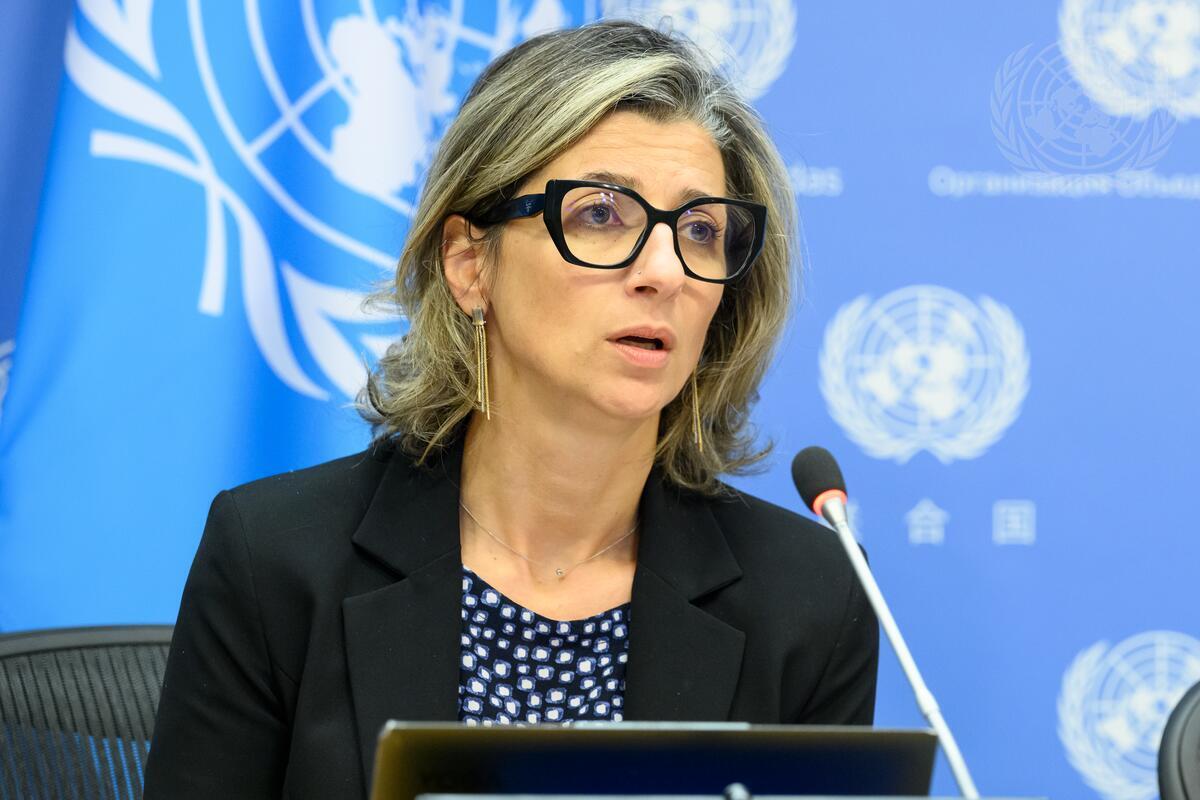

On the eve of the new year, pro-Israel groups launched a new campaign against Italian legal scholar Francesca Albanese, the United Nations’ (U.N.) Special Rapporteur on the Occupied Palestinian Territories. The groups’ attack was directed at her new book, “When the World Sleeps,” a memoir and collection of Palestine-related stories due to be released on April 28. The collection is more accessible and personal than her formal U.N. reports, but just as biting in its criticism of Israel’s abuses of Palestine and its people. Groups including U.N. Watch and the National Jewish Advocacy Center (NJAC) have argued that the sale of her book within the United States should be restricted, as Albanese has been subject to a U.S. sanctions designation since July 9, 2025—the sanctions themselves being a subject of considerable controversy.
Albanese was sanctioned in July 2025 under President Trump’s Executive Order 14203, “Imposing Sanctions on the International Criminal Court” (ICC). In a press release, Secretary of State Marco Rubio explained that he had imposed sanctions on her for engaging with the ICC “in efforts to investigate, arrest, detain, or prosecute nationals of the United States or Israel,” neither of which recognizes ICC jurisdiction over their citizens. Rubio specifically highlighted her role in the arrest warrants issued against Benjamin Netanyahu and former Israeli defense minister Yoav Gallant for crimes against humanity and war crimes. Albanese filed a lawsuit arguing that the sanctions against her violate the First Amendment on February 25, 2026.
The complaints of U.N. Watch and NJAC are not well-supported by U.S. sanctions laws, which carve out specific protections for constitutionally protected speech, books, and other kinds of information. Moreover, we should be alarmed by such a flagrant attempt to abuse the power of the U.S. federal government, with the aim of restricting the American people’s free access to information. The purpose of U.S. sanctions are to promote legitimate foreign policy interests and protect national security, not to deprive the American people of their right to read a book—which is protected under the First Amendment.
This is not the first time these organizations have come after Albanese. Although they represent themselves as a U.N. watchdog organization dedicated to human rights, U.N. Watch is a lobbying group primarily dedicated to zealously defending Israel. They have been trying to get Albanese removed from her position as Special Rapporteur ever since her appointment in 2022. In their most recent disinformation campaign against her, they posted a video of her which they had deceptively spliced to make her appear to describe Israel as the “common enemy of humanity.” NJAC sued Albanese in September 2025 on behalf of two pro-Israel Christian charities based in the U.S., alleging that she had defamed them by accusing them of enabling an Israeli-led “genocide.”
The thrust of the pro-Israel organizations’ argument is simple: U.S. persons are generally prohibited from engaging in financial transactions with a sanctioned party. But U.N. Watch and the NJAC each articulate distinct visions for how exactly sanctions-related restrictions should apply to this book sale. Hillel Neur, the Executive Director of U.N. Watch, has a simple desire: for Amazon to just ban the book altogether. The NJAC does not want the book to be banned or delisted: instead, they are calling for Amazon to block and freeze any funds destined for Albanese. NJAC hopes that those frozen proceeds could then be distributed to their clients in their defamation suit against Albanese.
Neither argument stands on particularly firm legal ground.
There is little to no legal basis for Amazon to block the sale of Albanese’s book. Congress has expressly forbidden the U.S. government from using sanctions to block the sale of books through the Berman Amendments to the International Emergency Economic Powers Act (IEEPA). The Berman Amendments prevent U.S. sanctions from blocking the import or export of “informational materials,” including books, with the express intent of protecting the right of free access to information. Even in cases where financial transactions with Albanese may be regulated, the sale of her book itself would remain protected. This means that U.N. Watch’s demand that Amazon immediately stop selling the book has no real basis in U.S. law.
Given their narrower legal argument, the NJAC seems to be aware of the Berman Amendment. Yet their demand is also flawed, as it is not clear that there are any real grounds to block the earnings from the book. For the earnings from a book sale to be blocked due to U.S. sanctions, the book must meet OFAC’s 50% Rule. Under the rule, a sanctioned person must have a 50% or greater ownership stake in property for it to be blocked. But Albanese’s book is distributed by Other House, an imprint within Penguin Random House, and it would be very unusual for Albanese to retain a 50% or greater stake in her book with a publishing deal. It is therefore likely that payments could still proceed without being blocked under U.S. law.
But to fixate too narrowly on the exactitudes of U.S. sanctions law misses the bigger picture.
U.N. Watch’s attempt at tattle-telling represents a flagrant attempt to misuse U.S. sanctions in order to prevent the American public from accessing information, based solely on the belief that such information may reflect poorly on the State of Israel. This kind of censorship is antithetical to the rights enshrined in the First Amendment, and would make for a deeply un-American start to our 250th anniversary. It would not be in the Spirit of ‘76 to sign away our fundamental rights for anything, let alone to protect the reputation of another country—especially one trying to keep people from reading about its own systematic violations of the rights of others.
The NJAC, meanwhile, appears to be attempting to weaponize U.S. sanctions as part of a broader lawfare campaign to shield the State of Israel from accountability for its human rights abuses. In doing so, it seeks to divert funds, potentially owed in part to a U.N. representative, and redirect them towards pro-Israel charities. At least one of these charities, the Christian Friends of Israeli Communities, provides support for Israel’s illegal settlements in the West Bank.
In any case, the ICC-related sanctions imposed on Albanese and others should not be viewed as if they were normal U.S. sanctions. Sanctioning a U.N. official because they have made fact-based assessments that embarrass a U.S. ally—or a world-renowned ICC judge—lays the groundwork for an alarming abuse of the United States’ coercive economic leverage. These spurious designations have garnered broad international condemnation and damaged an institution serving the rules-based international order, and have thereby also diminished the United States’ global soft power.
The sanctions against Albanese have also affected Georgetown University directly. From 2015 until the university cut ties with her in 2025, she was an “affiliated scholar” with Georgetown’s Institute for the Study of International Migration (ISIM). Nader Hashemi, Director of the Alaweed Center for Muslim-Christian Understanding (ACMCU) at Georgetown, confirmed on X that the university had been “forced” to distance itself from Albanese due to her sanctions designation.
But while the designation of Albanese undeniably put Georgetown in a tough spot, insofar as it had to choose between either cutting ties with her or risking conflict with the U.S. government, they were not truly forced to choose the former. The Berman Amendments protect more than just published materials; they also protect “telephonic, or other personal communication, which does not involve a transfer of anything of value,” as well as collaboration with overseas academics in sanctioned countries. And in November 2024, OFAC issued a guidance letter determining that sanctioned individuals could speak as guests at overseas conferences, so long as the U.S. parties involved did not provide them with any payment or services, such as transportation or lodging.
U.S. law therefore did not require Georgetown to end its relationship with Albanese altogether, as long as it met these conditions. While it would not be able to host Albanese for an event on U.S. soil without special authorization, it could host an event where Albanese dialed in by phone or through the internet, or invite her to an overseas conference. But excessive risk-avoidance, or “overcompliance,” with sanctions is common, especially in the private sector. Even if Georgetown was not actually violating any sanctions regulations, retaining any kind of relationship with Albanese could mean running the risk of a burdensome OFAC investigation. Cutting ties was arguably the most prudent way for the university to de-risk.
But Georgetown is not like any other company in the private sector, and should balance its principles as a major American university against its business interests in avoiding sanctions risks. The university had legal protections at their disposal that they could have taken advantage of to remain in full compliance with US sanctions laws. It could have taken remedial steps on the back-end to cut off access to any goods or services Albanese would be entitled to as an affiliated scholar, while also remaining publicly supportive of her and recognizing that the sanctions against her are a coercive censorship campaign. If Georgetown claims to be an institution committed to academic freedom and free expression, it should have done more to stand up for the free speech rights of one of its affiliated scholars. Instead, they have chosen to give into the U.S. Government’s censorship campaign against her.
Our government’s ICC-related sanctions have already caused significant harm, both at home and overseas. We should not allow them to hurt us more by serving as a pretext for curtailing our constitutional rights. The American public, including U.S. book sellers, must be prepared to resist the chilling effects of these sanctions at home. And we should all keep in mind that groups like these exist: those who would like nothing more than to sell out our rights to further their special interests, and manipulate our own government into doing it. We should be wary of these kinds of attacks, and stand up to them when they come.