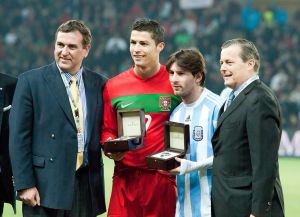



On Dec. 18, 2022, the world sat perched on the edge of their seats, waiting to see if Lionel Messi could lead Argentina to their first World Cup title since 1986—and he did. With greats like Messi, Cristiano Ronaldo, and Luka Modrić inching their way towards retirement, the international football scene is at the dawn of a new era, one to be shaped by the World Cup in June. As an avid fan myself, the following is a brief summary of my field notes and predictions for what’s to come.
Hosted jointly by Mexico, Canada, and the United States, the 2026 World Cup will be the first to include 48 teams. Previously, the tournament had a 32-team, eight-group layout, but in 2017, the FIFA Council voted to implement the new format to expand representation—although some speculate the decision also reflected a desire to increase tournament revenue.
This year’s expanded format has created tectonic shifts in the tournament base. First, it has opened space for Curaçao, Jordan, Cape Verde, and Uzbekistan to strengthen their reputations on the international stage during their first-ever World Cup appearances. Other teams such as Qatar, Panama, Bosnia and Herzegovina, the Democratic Republic of the Congo, Iraq, and Haiti are all seeing their second-ever World Cup pitches.
Second, and perhaps more dramatically for global fan bases, a 48-team tournament eliminates the so-called “power groups” from previous years. Groups are formed randomly through drawing teams from pots arranged based on their FIFA world rankings. In 2022, Canada found itself in Group F stacked against tournament favorites Belgium, Croatia, and Morocco, with the latter two later reaching the semi-finals. Only the first two teams in each group would reach the Round of 16, meaning that Group F specifically experienced highly competitive matchups from kickoff. I’d argue the closest parallel that we will see this year would be Group C with No. 6 Brazil and No. 8 Morocco, or Group L with No. 3 England and No. 11 Croatia.
Still, I don’t believe the excitement within each group will boil over as much as it did during the age of the “power groups.” Such a large pool of teams to pick from drastically reduces the chance that any three top teams fall into one of the 12 groups of four and simply won’t manufacture the same competitive base as seen within the 32-team format.
When looking at individual success stories, the World Cup always brings a few drastic upsets. The 2022 tournament alone saw multiple headline-worthy outcomes, including Saudi Arabia’s win over Argentina in the group stage and Japan taking down both Spain and Germany. In June, I expect similar showings from Bosnia and Herzegovina and Türkiye.
If Spain’s 2024 Euro win taught us anything, it’s that teams living outside of the limelight are perhaps the best suited to shake up bracket predictions. Until their dramatic win over Italy on penalties in March, Bosnia and Herzegovina hadn’t drawn much attention. Despite its subsequent qualification, the team is still largely building its future in the shadows.
Algorithms predict outcomes using game records—not Bosnia’s strong suit—but they don’t consider work ethic. The team’s qualification run demonstrates their relentless playing style, driven by a disappointing football history and strong national pride. The young blood on the squad—namely, midfielder Esmir Bajraktarević—typically drives the team’s energy. However, their youth could pose a challenge against the long duration of this year’s tournament. Thus, I see them reaching the Round of 16, but not the quarterfinals.
With a far less dramatic entrance into the tournament, Türkiye has a high chance of advancing because of its relatively weak Group D, which consists of the U.S., Paraguay, and Australia. Alexi Lalas, a former U.S. Men’s National Team defender turned soccer analyst for Fox Sports, hailed the group as very favorable to American success. I’d counter that it’s more so for the Türkiye team. With major talent from Inter Milan’s Hakan Çalhanoğlu, Real Madrid’s Arda Güler, and Juventus’s Kenan Yıldız, there is no reason why Türkiye can’t fully dominate its Group D opponents. I am, however, cautious to predict that they will avoid elimination in the Round of 16.
In terms of coming away with the trophy, it’s safe to say that multiple countries all have a chance to reach the final. A win for Argentina would solidify its reign in football, placing it alongside Italy and Brazil as the only teams to win two consecutive titles. With uncertainty around Messi’s return, it’s still unclear how Coach Lionel Scaloni will pivot the team strategy to compensate.
The Portuguese team faces a similar learning curve with Ronaldo’s diminishing attacking role, but it still possesses depth—think Bruno Fernandes, Vitinha, and João Félix—on its bench capable of compensating for that loss. Their chances of reaching the final will depend on whether they can efficiently capitalize on their opportunities and form stronger build-up sequences—two downfalls that led to their elimination in 2022.
Lastly, Spain’s showing in the 2024 Euros, coupled with strong performances by its players on both the international and club stages over the recent months, gives me hope that they could pull off a victory this summer. One major downfall of the Spanish team, however, is that they often find themselves in a cycle of possession without converting their opportunities. Should their talent—such as Mikel Oyarzabal, Lamine Yamal, and Rodri—withstand the pressure to perform, it’s safe to say they very well have a chance to emerge on top.
The World Cup will open on June 11 at Estadio Azteca in Mexico City between Group A’s Mexico and South Africa, with the final taking place on July 19 at New Jersey’s MetLife Stadium.