



Four years ago, with the 32-team format, the World Cup’s final Group Stage matches often lacked drama. Only from time to time would viewers get the third-place versus second-place matchup they hoped for, or perhaps a well-fought battle between group giants for the first-place slot. This year’s 48-team format, however, feels different.
Group Stage
June 26 and June 27, the final two days of the Group Stage, turned into a carnival for sports analysts. Nearly every game led to either a shift in the first-place standings or a reconfiguration of the third-place rankings—both scenarios impacting which side of the bracket teams landed on. In some cases, teams knew who they would avoid playing based on a win or a loss, since nine countries had already earned their spot in the following round. Specifically, certain teams knew exactly what outcome they needed to secure their preferred position in the Knockout bracket, and no game exemplifies that better than Austria against Algeria.
The two sat in second and third place, respectively, in Group J. The team that finished second after their Saturday fixture would face Spain, whereas the loser would play Switzerland. With many fans putting Spain in their brackets all the way through to the final, it’s safe to say that neither Algeria nor Austria wanted to end up in second. Their 3-3 stoppage time tie left Austria to play Spain and Algeria to play the more preferable Swiss, although neither won their subsequent matchups.
Sixteen teams were eliminated during the Group Stage—three of which had their first World Cup experience and four participating in their second. The most notable departure was Türkiye, who dropped five places in the FIFA World Rankings since the start of the tournament.
Knockout
The Round of 32 is a sentimental time for fans, as it’s the last week of the tournament during which they have at least one chance a day to avoid any responsibilities for the sake of soccer. Between June 28 and July 3, three games went to penalty kicks, a red card scandal began, and multiple heavy-weights among 16 total teams exited the tournament.
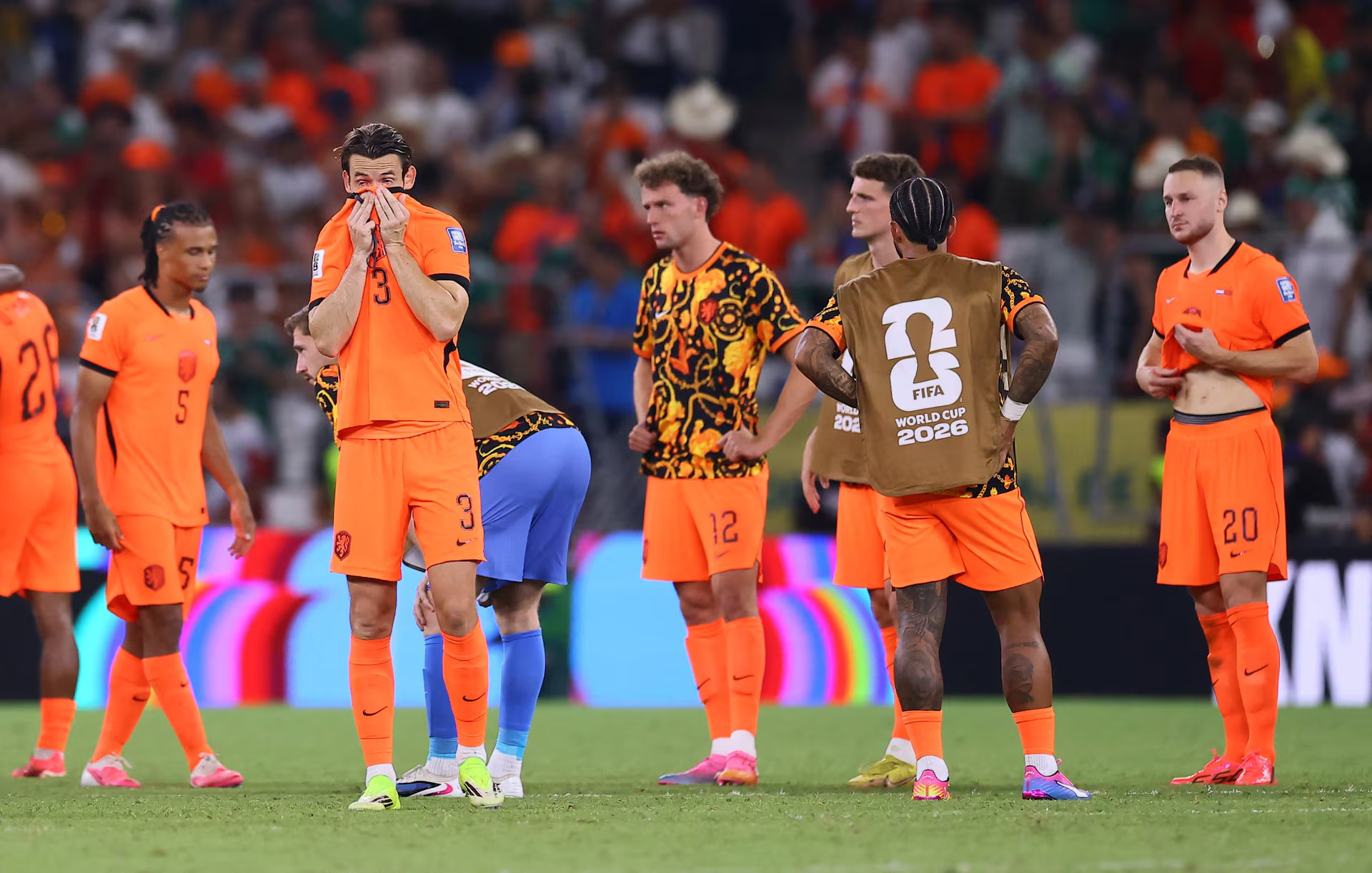
To add to the intrigue, an early intense matchup between Morocco and the Netherlands on June 30 promised a tournament shakeup. Joachim Klement, an economist, grew famous for correctly predicting the winners for the past three tournaments. In April 2026, he officially chose the Netherlands to take home the trophy. Unfortunately, Morocco broke his prediction streak with a 3-2 penalty victory.
Another heavy-weight to go out on penalties was Germany. Their successful appearance against Côte d’Ivoire on June 20 had strengthened expectations for their performance in the first knockout game of the tournament. Nonetheless, the game against Paraguay on June 29 proved otherwise. Germany’s lackluster 4-3 loss on penalties is not so much a reflection of technical skill as it is of a poor mental approach to playing a team ranked 31 places below them at the time. Apart from the work of central midfielder Jamal Musiala, who encouraged a deeper reliance on the midfield, the Germans failed to take their chances to build offensive momentum.
German social media filled with memes in the following days about this seemingly fearful playing style, and, unsurprisingly, the penalties. Previously, center back Jonathan Tah had never taken a penalty in his career nor had participated in a World Cup. Nevertheless, he still volunteered to take Germany’s deciding penalty shot, but poorly missed. The nature of Germany’s loss underscores the often-overlooked mental nuances that influence those rankings and statistics. When we analyze performance while keeping the humanity of the players in mind, we can build perspectives more efficiently than by focusing only on shots, possession statistics, or VAR decisions.
VAR, or Video Assistant Referee, is a digital system implemented by FIFA in 2016 that assists the central referee in confirming on-field calls or making calls on its own. Those decisions typically include offsides and determining when the ball has left the field of play.
This year’s tournament has already featured multiple game-deciding VAR-ruled decisions, but the issue of their correctness is far from settled. In 2022, Japan faced Spain in a Group Stage match whose result directly led to Germany’s elimination. The Japanese scored a winner off of a last-ditch effort on the Spanish endline. While the ball appeared to have fully crossed the line—no longer in bounds—VAR called it otherwise, and the Japanese topped Group E as a result.
As technology has improved over the past decade, so have VAR decisions—or so FIFA claims. On July 3, Portugal took down Croatia 2-1 in a highly-contested Round of 32 match. Croatia scored a tying goal in the 90+9 minute, which would have bought them more time to keep their World Cup dreams alive. The VAR system, however, overturned the goal with an offsides call. It’s safe to say that such calls are difficult for players, coaches, and fans alike to reconcile with, as their experience or images often don’t align with precisely tuned VAR technology.
In historic news this week, Egypt beat out Australia to take home their first-ever World Cup Knockout Round win. Captain Mo Salah has won hearts over the years in the Premier League as a member of Chelsea and Liverpool. Egypt’s recent success is a manifestation of his positive and long-lasting contribution to the sport.
Cape Verde also became the only team this week in its first World Cup appearance to play—and might I say put on a clinic—in a knockout round game. Overall, they have only jumped three spots in the rankings since the start of the tournament. Although they went out against Argentina on July 3, losing 3-2 in overtime, their showing this year has certainly set them up exceptionally for Spain 2030.
If you are devastated by the dwindling number of fixtures, you are not alone. Here is my list of the top three best rewatches from the Round of 32: (1) Morocco vs. the Netherlands; (2) Belgium vs. Senegal; (3) Brazil vs. Japan.
Don’t want to miss a single game? Download our World Cup game Google Calendar here! The Round of 16 matches take place from July 4th until July 7th, after which the long-awaited quarterfinals will commence.