


In a 2-1 decision on July 23, the United States Court of Appeals for the Fourth Circuit court upheld an earlier district court ruling that Georgetown postdoctoral fellow Badar Khan Suri should remain out of detention while awaiting his immigration proceedings. Judges Pamela Harris and DeAndrea G. Benjamin affirmed the lower court’s ruling, while Judge J. Harvie Wilkinson III dissented.
The case was heard by federal judges on March 17, 2026 and Wilkinson, a Reagan appointee, seemed sympathetic to the government’s arguments based on his line of questioning, while Harris, an Obama appointee, and Benjamin, a Biden appointee, seemed skeptical of their case.
Benjamin’s opinion sought to affirm the District Court’s orders, referring to the initial Suri v. Trump case in the Eastern District Court of Virginia. Judge Patricia Tolliver Giles ordered, in March 2025, that Dr. Suri “shall not be removed from the United States unless and until the Court issues a contrary order.”
Khan Suri was detained outside of his Rosslyn, Virginia home last year while traveling back from campus. Khan Suri, an Indian national, is in the U.S. legally on a J-1 exchange visa given to students, scholars, and teachers. He was detained for 58 days in five separate locations, spending the majority of his incarceration at Prairieland Detention Center in Alvarado, Texas. In May 2025, Giles ordered Khan Suri’s release on bond.
Khan Suri is currently undergoing two different court cases. He has an immigration case, which will determine whether he is deported—courts most recently ruled that Khan Suri is deportable, though he is appealing this decision through the Board of Immigration Appeals, with a hearing scheduled in September. This ruling pertains to a separate case about whether his detention was illegal and in retaliation for his support of Palestine and marriage to a Palestinian.
The March 17 hearing was a response to the government’s motion to appeal Giles’ decision to release Khan Suri on bond. A different 4th U.S. Circuit Court appeals panel ruled during an initial hearing in July 2025 that Khan Suri should not be immediately returned to detention, as they found no reason to disturb Giles’ ruling.
A central point of contention in the case has revolved around the unknown custodian exception, which is an exception allowing a detained person’s lawyer to file a habeas corpus petition at the person’s last known location if they are held in a secret location.
At the March 17 hearing, Drew Curtis Ensign, an attorney for the Trump administration, argued that the unknown custodian exception doesn’t apply as Dr. Suri’s lawyers knew where he was at the time of filing. The district of confinement rule would then apply, which states that a habeas corpus petition must be filed in the federal judicial district where the prisoner is held.
Judge Benjamin’s opinion disagrees. The opinion noted that Dr. Suri was rapidly moved to three locations within eleven hours and was, at many points, denied his requests to inform his wife about his location transfers.
“Such opaque and unpredictable conduct by the Government left Suri’s counsel with no meaningful way to comply with the district of confinement rule,” Benjamin wrote. “We hold that these circumstances warrant the use of the exception to the default district of confinement rule.”
Benjamin also wrote that Khan Suri’s detention followed a common pattern set by the Trump administration’s DHS. In March 2025, Immigration and Customs Enforcement agents arrested and detained Columbia University activist Mahmoud Khalil for his involvement in pro-Palestine activism. Following his arrest, Khalil was transferred from a New Jersey immigration facility to a Louisiana detention center.
“This case is one of several that have arisen over the past year and a half presenting the same basic fact pattern: A student or scholar, in the United States on a valid student or exchange visa, is detained by DHS on the stated basis of his or her political speech, beliefs, or associations; shuttled across jurisdictions rapidly and often in secret; and detained for allegedly unconstitutional reasons and under allegedly unconstitutional conditions pending removal,” Benjamin wrote. “And in each case, the Government insists that judicial review of the allegedly unconstitutional detention can come only after removal proceedings that can last for months or years.”
In his opinion, Judge Benjamin disagreed that detained noncitizens have no judicial recourse.
Meanwhile, Wilkinson wrote in his dissent that the majority opinion weakens the powers of immigration enforcement.
“Today’s holding may be a victory for Suri, but it is a loss for the immigration system Congress carefully designed,” Wilkinson wrote. “I respectfully dissent.”
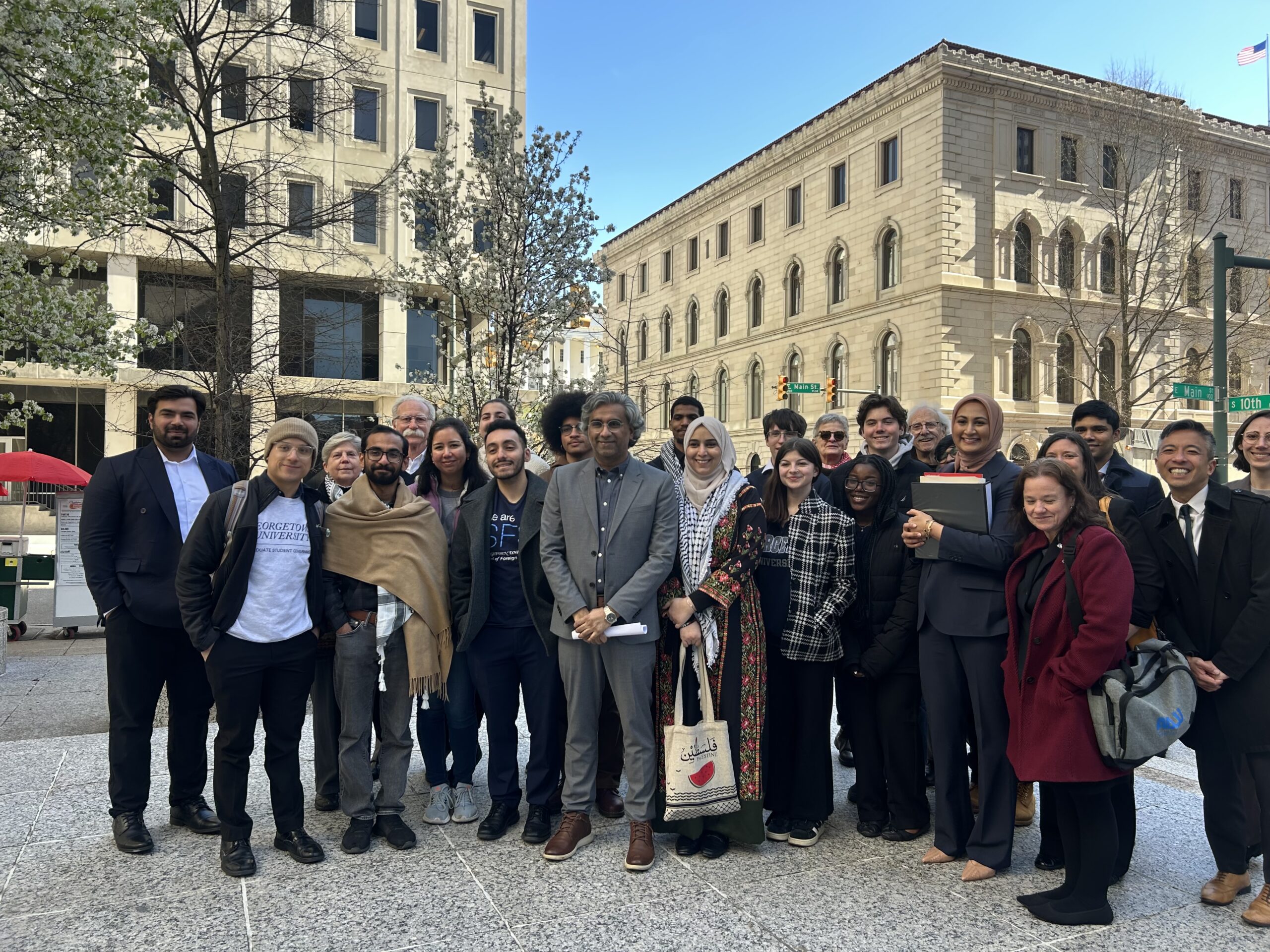
After his March 17 hearing, Khan Suri told a crowd of supporters at a press conference that he hoped the courts would rule in his favor. He emphasized that the impacts of his case stretch farther than just his fate.
“The questions before the court today go beyond law. They touch the core principles of academic freedom and freedom of expression,” Khan Suri said. “A confident democracy does not fear debate. It protects it. The true test of democracy is how it reads those who dissent peacefully.”