


Last spring, Abigail Henkel (CAS ’28) was ready to start her summer study abroad in Florence, Italy, before she encountered one problem: she would have to fund her plane tickets herself. Finding out that the summer stipend from the College of Arts and Science’s (CAS) First Fellows program could cover those costs, however, meant that she could
“It [has been] my favorite part of Georgetown so far, and I only got on the plane to Italy because of the stipend that First Fellows gave me,” Henkel said. “So, it’s both monetarily supportive and there’s also a lot of community that happens from it.”
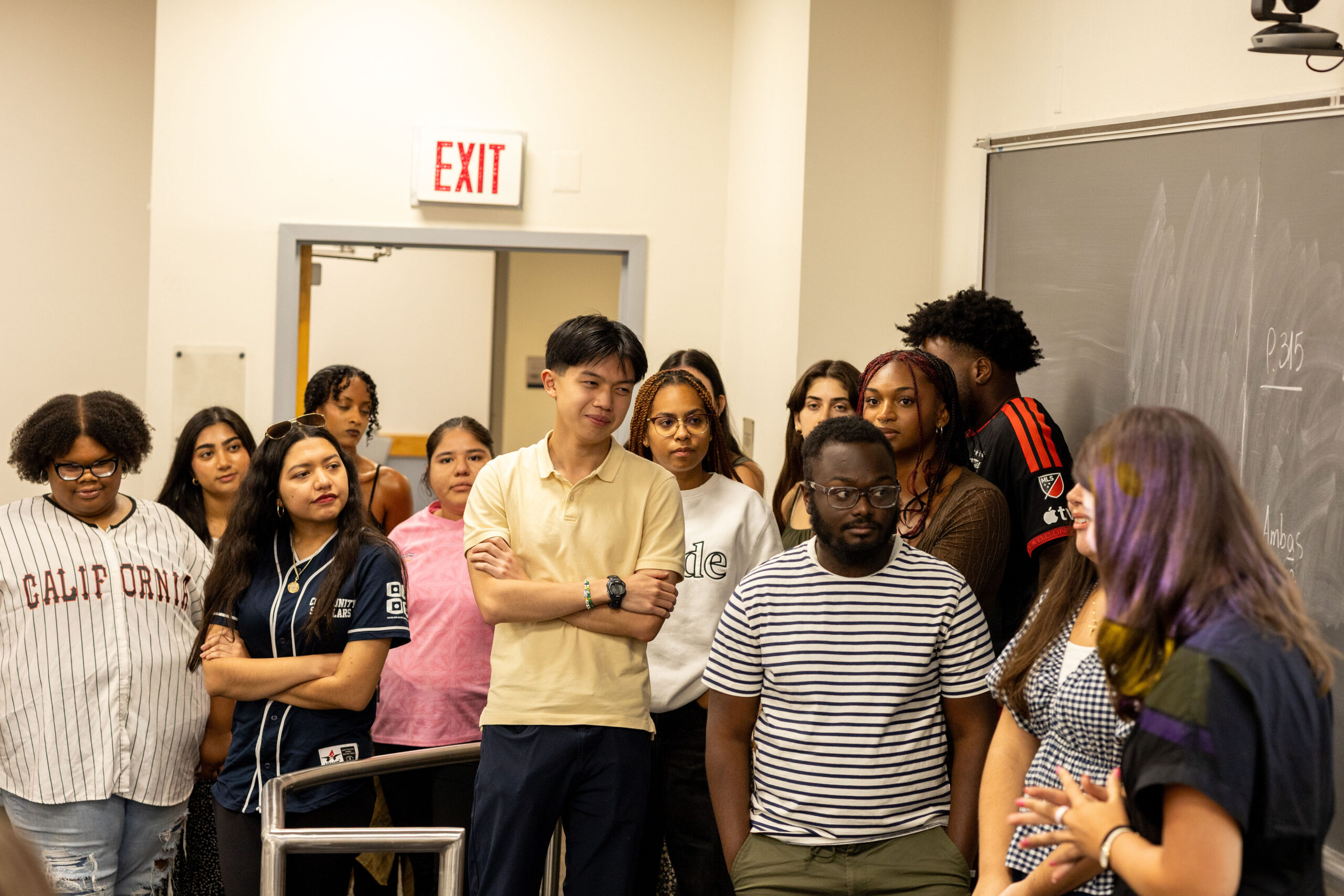
The 2026-2027 academic year marks an exciting milestone for the First Fellows program. As the first cohort of Fellows (the class of 2027) sets off into their final year on the Hilltop, administrators and students from three different cohorts shared what the program means to them and their hopes for the future with the Voice.
The First Fellows program kicked off in Fall 2024 with the goal of providing academic, social, and financial support for first-generation college students in CAS. After acceptance at the end of their freshman year, students enroll in a one-credit course each semester to build academic and career-focused skills, as well as community, starting during their sophomore fall.
After completing their two sophomore year courses, Fellows are eligible to access their $6,000 stipend which can be used during their sophomore and junior summers. This stipend can go toward supplement costs for extracurricular activities, including housing, food and transportation. For students like Henkel, the stipend can be a deciding factor for participating in activities that might lack financial accessibility.
Connections and Community
On campus, First Fellows has been facilitating connections between first-generation students through classes and events.
The program experience has been valuable for Lisa Ibarra (CAS ‘29), who highlighted the role first-generation spaces have played in her time at Georgetown so far. In addition to First Fellows, Ibarra is in the Community Scholars Program (CSP); an initiative managed by the Center for Multicultural Equity & Access (CMEA) that begins with a five-week summer program for first-generation students prior to their freshman fall.
“It’s been really nice to have a consistent meeting where I can interact and have a community outside of my regular classes,” Ibarra said.
Despite having met several first-generation peers through CSP prior to joining First Fellows, she credited the latter with solidifying existing connections through a formative space.
“I think I already know a lot of people because the Community Scholars Program is deeply connected to being a first-generation student,” Ibarra said. “I think it helps that we already know each other kind of, but now we’re given a formal space to talk about some of these things that are unique to being a first-generation student at Georgetown.”
The Curriculum
For juniors, the lessons learned in their first year as Fellows—spanning from how to format a cover letter to exploring personal values—lays the groundwork for what Nikki Harris, the program’s primary director and Assistant Director for First Generation Student Initiatives, referred to as the “Choose Your Own Adventure Model.” The framework, engineered with student input, gives juniors greater control of their own learning by focusing on specific areas of interest.
“There’s some assignments that everybody completes, and then students have a menu of options that they can really sort of pick and choose what to do based on their interests,” Harris said.
Such options include a “grad school matrix,” where prospective graduate students are tasked with researching ten different schools to compare their financial aid packages and costs of living.
Henkel is among the first-generation Hoyas who have found the program useful in their post-graduate endeavors. As a junior, his seminar experience has been centered around career development.
“I’m getting a lot of support for Law School Admission Test (LSAT) prep because I plan to go to law school after undergrad, and so I’m getting a lot of support in terms of what applications look like as a first-gen student,” said Henkel.
The program also provides books at no cost to help students study for graduate program admissions like the LSAT and the Medical College Admission Test (MCAT)—resources that Henkel has felt to be a helpful “starting point” as the cost of post-graduate preparation continues to rise across the board.
Mentoring
Inter-cohort relationships are another point of focus, especially as the program’s first cohort will become alumni after the spring 2027 semester, according to Harris.
“I think the students are really hoping to build out an alumni network,” Harris said. Students, according to Harris, look forward to having “a network of First Fellows who can be mentors to other cohorts, or just be a sense of support.”
This year, mentorship has been more direct for Scottie Vandy (CAS ‘27), whose First Fellows cohort sometimes collaborates with the new sophomore cohort to share their experiences.
“The seniors are with the sophomores, and we’re paired with like a group of maybe three to six different sophomores, and they ask us questions about Georgetown, about careers, about clubs, really anything Georgetown experience-related, and it’s been super great in the two classes that we’ve done it,” Vandy said.
The impacts of this collaboration have been felt on the other end of the spectrum as well.
“I had a ton of Government questions that I had answered, whether that be pre-professional or academic,” Ibarra said, referring to her mentorship group. “I think it’s been really cool to learn from my peers, as they’re people who are still going through the process but are just a little bit older.”
Fellows for Fellows
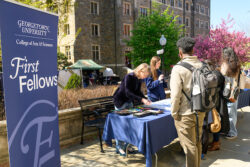
Beyond the classroom, Vandy said the highlight of his Fellows experience has been the ability to form connections through the various tabling events the program hosts throughout the year.
“[First Fellows] every so often will table outside of White-Gravenor with like Cinnabon or coffee or sandwiches, and it’s always just really fun to go say hey to some of my classmates, and then of course to Nikki and the supporting like student staff because they’re also awesome and also it’s really good food,” Vandy said.
The program also aims to build a support system through open and honest dialogue. Harris and the Student Advocacy Board, for instance, regularly check in with Fellows across cohorts to offer perspective or simply a willingness to listen.
“We’re talking about our stories, we’re talking about our wins, we’re doing different activities, and I’ve seen, particularly with the seniors, how close they’ve gotten,” Harris said.
Harris’s words ring true for the Fellows as they grow with one another throughout this experience.
“It’s just nice to know that if I’m having trouble on campus or if I’m really frustrated with something, I have someone to talk to,” Henkel said.
It is through this tight-knit network that First Fellows hopes to provide its students with the space to work through challenges, make mistakes, and feel comfortable embracing setbacks as opportunities for improvement.
“Last semester, we did accountability groups, so we were grouped together by our interests and our majors and what we wanted to do post-grad, and then we set goals for ourselves and for each other,” Vandy said. “And then the point of the semester was to hold each other accountable to those goals.”
Looking Ahead
While much of the program’s initiatives have been successful, students and leadership alike are on the lookout for ways to take things further.
Henkel, for one, hopes to increase engagement between students outside of the classroom, referencing events like Signing Day where students accepted to the program sign their contracts and meet each other.
“First Fellows does a really good job of community building inside the classroom, but I feel like they’re also making a lot of efforts right now to build that community outside of the classroom with study breaks and signing day where they have us meet each other outside of the classroom,” said Henkel.
As a program that tries its best to cater to student needs, First Fellows remains flexible to feedback.
“Me being a first-gen student myself, I’m always leaning on students to really give us ideas, give us things that we can do to shape the program,” said Harris. “Overall, it’s been a good experience so far.”
Reflecting on his time with First Fellows, Vandy emphasized its success in building community and helping him through academic difficulty.
“I think this is a great example of what Georgetown can do when things are built with intention and with a goal behind them,” Vandy said.