

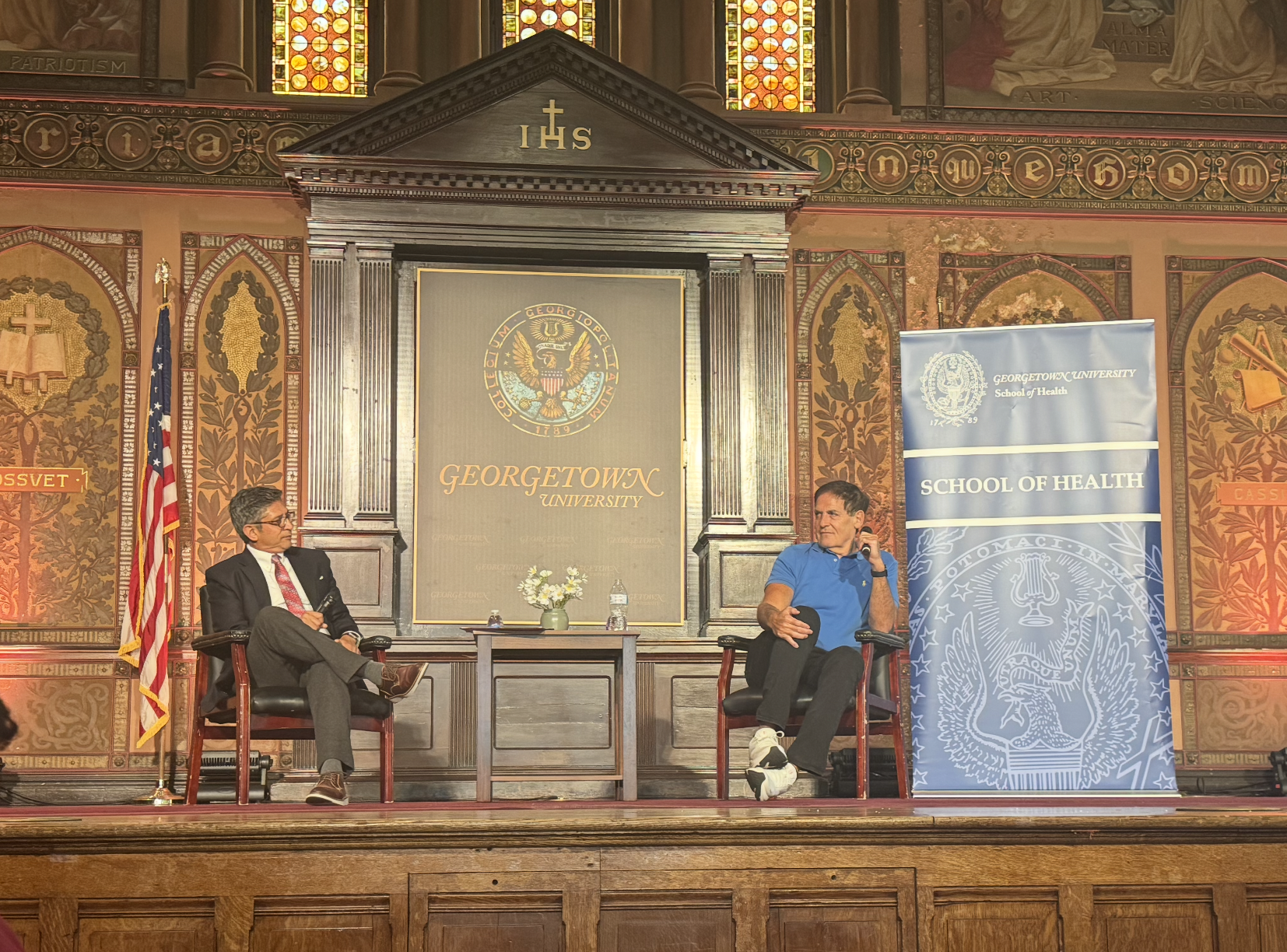
On Sept. 28, The Georgetown University School of Health (SOH), SOH Academic Council, and the McDonough School of Business (MSB) Business of Health Initiative jointly hosted businessman and entrepreneur Mark Cuban in Gaston Hall for a discussion on affordable and transparent healthcare reform.
The talk was moderated by Professor Sandeep Dahiya, chair of the Business of Health Initiative. The conversation opened with Professor Dahiya asking Cuban why he, an entrepreneur who is best known for building technology companies, had decided to enter the pharmaceutical industry. Cuban linked the decision to the growing attention to the pharmaceutical market after Martin Shkreli’s widely criticized price increase of Daraprim.
“I’m like, okay, how can somebody do this, right?” Cuban said. “Who’s going to put money that far ahead of people living or dying? And this must be a screwed-up industry.”
Cuban said the episode pushed him to examine how a generic drug like Daraprim could move from costing patients around $7-14 to roughly $750, leading him to think that prescription-drug pricing was fundamentally unclear and someone needed to do something to fix it.
“And so I started looking into the drug industry, the pharmaceutical industry, and it became very apparent that nobody ever knows the price of a medication,” Cuban said. “You literally don’t know what you’re going to pay nine out of ten times.”
In 2022, Cuban co-founded the Mark Cuban Cost Plus Drug Co., an online pharmacy that sells generic medications. The company uses a pricing model that displays the company’s acquisition cost and applies a 15% markup, with transparent pharmacy and shipping fees, to ensure price transparency.
Cuban criticized pharmacy benefit managers (PBMs), which are third-party companies that act as intermediaries between health insurance plans, drug manufacturers, and pharmacies to administer and manage prescription drug benefits. He also called out insurers and other large healthcare companies for creating ambiguous pricing arrangements that can leave patients paying more than they expect for medications.
“They’re all vertically integrated, all part of single companies.” Cuban said. “They control what’s called the formulary, the list of drugs that you’re able to have access to with your insurance plan. Whichever drug they put on that formulary is going to make a lot of money.”
Cuban emphasized the significance of transparent pricing when making healthcare choices.
“The more transparent we are, the more information you have, the better decisions you will make, and the more I’ll be able to help,” Cuban said. “So we started with drugs. We have costpluswellness.com now, which allows employers to directly contract with hospitals.”
The discussion focused heavily on PBMs. Cuban argued that the companies’ relationships with insurers, drug manufacturers, and pharmacies can obscure where the money moves in the prescription-drug supply chain.
He said large insurers and PBMs use their control over drug formularies (the lists of medications covered by insurance plans) to negotiate rebates and fees with manufacturers.
“There’s a brand drug that costs $600 at this price, but the net revenue to the manufacturer is $300; that money in the middle goes to the pharmacy benefit manager, the middleman, and they can do whatever they want with that money,” Cuban said.
According to Cuban, the message to drugmakers is clear: “Either you pay me a lot of money, hence the rebates and free, or you’re not going to be there.”
Cuban argued that those arrangements can distort prices and create incentives that do not always align with patients’ interests.
“They (PBMs) might send some to an employer; they’ll keep it, whatever it may be,” Cuban said. “Well, if they didn’t keep all that money as margin or incentives for something else, they could pass it through to the patient. And the difference between the price of 600 or $325 could be life or death.”
Cuban’s criticism extended to self-insured employers that pay medical claims directly while hiring third-party administrators to manage benefits. He encouraged employers to use artificial intelligence (AI) tools to analyze lengthy contracts, arguing that technology that anyone can access can help identify provisions that may increase costs or obscure where healthcare dollars go.
While he warned that AI technology “is not always right,” he said it can help people work through complex documents more efficiently as long as they verify the information and check the sources.
Cuban repeatedly returned to trust as the central problem in U.S. healthcare. He outlined that patients are asked to make life-altering decisions without knowing the price of a prescription, the terms governing their insurance coverage, or the financial incentives shaping those decisions.
“We don’t trust anything about healthcare economics,” Cuban said, “Nobody does. And you know, I would look at my medical bills and say, ‘oh yeah, it’s no big deal.’ And they just all keep on coming and coming and coming. And so if you’re going to start a business, the number one thing you need is trust. Now, how do you get trust plus drugs? It’s really just a formula for us.”
His company tries to build that confidence between customers and Mark Cuban Cost Plus Drug Co. by highlighting its price markup and additional charges, which Cuban believes is a level of disclosure that matters.
“Nobody ever knows the price of medication,” Cuban said regarding the conventional system, where patients do not know whether they are getting “a good or a bad price” when costs are hidden. “What makes us different is we show you our actual cost, literally what we pay for. Then we show you that we only mark it up 15%.”
Cuban framed the path to rebuilding confidence in health as more than lowering a bill at the pharmacy counter. For Cuban, It requires giving patients clear information before they make decisions and making companies’ financial incentives visible.
“Trust equals transparency divided by self-interest,” Cuban said.