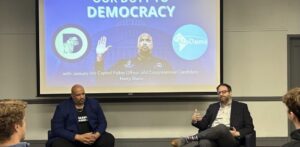


A packed house in Georgetown’s Riggs Library listened as two decorated investigative reporters, Carol Leonnig and Aaron C. Davis, spoke about their reporting regarding the Department of Justice (DOJ) during an event titled “Inside a Justice Department in Crisis” on Nov. 17.
Long-time The Washington Post reporters Leonnig and. Davis co-authored the recently released book Injustice: How Politics and Fear Vanquished America’s Justice Department, which details how executive pressures and a growing climate of fear weakened the DOJ’s independence, especially during the first Trump administration, when officials were pushed to bend the norms to shield the president and pursue his rivals. The journalists sat down with former Assistant Attorney General Mary McCord, who moderated the discussion, in an event co-hosted by the Journalism Program and the McCourt School of Public Policy.
The book, built on hundreds of insider interviews, chronicles how President Trump’s first term changed the country’s top law-enforcement agency into what Leonnig called a “defensive crouch.” She described the DOJ as inward-looking, cautious, and concerned about shielding itself from interference from the executive branch, rather than confidently carrying out its prosecutorial tasks.
Davis, who teaches investigative journalism at Georgetown and shares two Pulitzer Prizes for The Post’s coverage of the Jan. 6, 2021 insurrection, told the audience that the “fake-elector scheme” in the 2020 election raised early concerns. The effort by Trump allies to submit illegitimate electors in swing states was flagged to federal officials as potential fraud as early as December 2020.
Instructing on investigating power with rigor and precision, Davis was troubled that the referral sat untouched for more than a year.
“We knew there was a slowdown in investigating Donald Trump and his campaign’s efforts to overturn the election,” Davis said.
Davis illustrated the point by recalling how one senior official later described the significance of the overlooked fake-elector certificates.
“Somebody in the orbit of the attorney general later said that when they realized how they were connected to the fraud and the pressure on Pence, they said, ‘We realized then that these were the weapons left at the crime scene,’” Davis said.
Leonnig, who helped uncover the timeline, described how prosecutors and FBI agents were “convulsing” over Trump’s open disregard for the rule of law, while the department’s leadership tried to follow its normal procedures. The result, she said, is an institution that “never fully recovered.”
Most of the conversation focused on current events, including mass firings, unresolved questions about the fake-elector scheme, and the disarray reported by current and former staff, as the speakers recognized that these concerns of government accountability and interference in the DOJ’s enforcement of the law are both immediate and ongoing. With Trump’s return to power, mass firings of Jan. 6 investigators have already begun. One attendee shared that she recently left the DOJ due to the lack of organization and support within the department.
Leonnig noted that sources still inside Main Justice, the Justice Department’s Washington headquarters, are speaking anonymously to the authors of the book. Though employees are concerned about the professional risks of speaking out, Leonnig believes they continue to recognize the gravity of the situation and feel a responsibility to share their insider knowledge.
The event drew many students as well as older community members, as attendees were encouraged to ask questions. Among them was Abby Grizzle (SFS ’29), a student interested in the DOJ’s recent challenges in upholding the rule of law, who heard about the event from a friend and decided to attend. She wasn’t shocked by the revelations.
“It feels very consistent with the character of the Trump administration,” Grizzle said.
However, she was worried about the field of journalism’s ability to break through public exhaustion. Grizzle agreed with what the authors are currently wrestling with, as they think about how to follow up their book: how the DOJ can revive itself despite being compromised by political pressure, and how future leadership can restore norms like impartiality and independence even as political polarization continues to deepen.
“There’s this giant haystack of atrocities,” Grizzle said. “How do we cover them in ways that actually spur people to action instead of just adding to the pile?”
Claire Fenton (MSB ’29) believes the discussion serves as a reminder of the weakness of democratic frameworks.
“Only norms have prevented presidents from taking similar action in the past,” Fenton wrote in an email to the Voice, referring to Trump’s influence on the judiciary. “With the current political climate, I’m fearful for [sic] how fragile our democracy is, and with this new information I am surprised that this is not something we have encountered sooner (at least on this scale).”
For Fenton, Jan. 6 is personal. A family friend of Fenton and senior FBI official who worked on Jan. 6 cases was forced out of their job shortly after Trump’s inauguration.
“I find it very sad that you can give decades of your life trying to make the world a safer place for your children and be forced out for authoritarian reasons,” Fenton said.
An interesting trend that stood out to Grizzle was the age of people in attendance.
“It was also intriguing to me to see so many older people there,” Grizzle stated. “The nature of that institution has changed, and I wonder if that’s maybe what drew those kinds of people from older generations to an event like this about the Justice Department.”
The authors were deliberate about timing, deciding to hold off on finishing the manuscript until after the 2024 presidential election as they knew the result would shape the book’s final chapter.
“If we publish this now, it’s gonna look like a cliffhanger. We’re not going to know of all the things you guys uncovered and wrote about if they had any consequence,” Davis said. “It’s about reaching this place where politics and prosecutions are mixed in a state of real injustice.”
By releasing the book at a moment of political transition, Leonnig and Davis hoped to connect past events with the challenges the department is facing today. The authors said they wanted the book to encourage reflection and discussion, not just retell history.
“The subsequent administration [following the 2024 election] gave them that ending that they were needing to show what we can expect from the DOJ in the future,” Grizzle said.
By the end of the talk, the mood was far from celebratory. Leonnig and Davis left the audience with a clear message that the story is no longer about one presidency, but about whether the DOJ designed to outlast any single leader can survive the strain.
“This is fundamentally different than [sic] anything we’ve ever experienced as a country,” Leonnig said.
Davis spoke of career employees still “holding on by their fingernails,” determined to see the department return to its role as the chief defender of American democracy. He warned that the current political environment and the politicization of the DOJ, including pressures from the executive branch and partisan conflicts, are threatening that sense of duty.
“We are at a point right now where the person in the moment is overwriting that historical sense of responsibility to the office,” McCord, the event moderator, said.
The larger question that many in the justice department had was whether any institution can survive a president who treats the office as an extension of his own grievances and desires. Davis reflected on the consequences.
“Think about how weird it is now to be in a place where federal judges can no longer presume that regularity,” Davis said. “They can no longer assume that prosecutors know what they’re doing, and that they do it carefully and in honor of their oath to the Constitution.”
However, Grizzle argued that rather than adding to public despair, the revelations that these authors shared about the DOJ unraveling should be used to motivate public servants.
“It begs the question, how do we approach covering issues like this in the future in ways that actually catch peoples attention and spur them onto action,” Grizzle said.