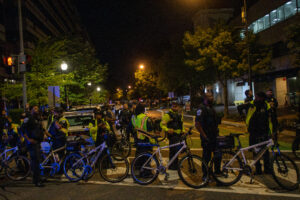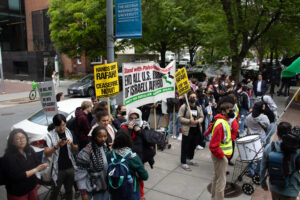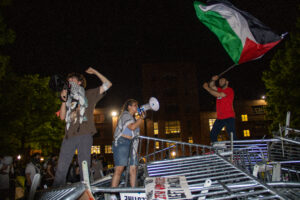




The second annual Gaza Lecture Series commenced on Sept. 9, consisting of 10 lectures scheduled through March 2026. The series welcomes distinguished academics to discuss the Israeli occupation of Gaza amid concerns about free speech regarding Palestine on college campuses.
The Gaza Lecture Series is organized by faculty from six different Georgetown programs, including the Alwaaleed Center for Muslim-Christian Understanding (ACMCU), the Center for Contemporary Arab Studies, the African Studies Program, the Department of Theology and Religious Studies, the Department of English, and Georgetown University in Qatar.
ACMCU Director Nader Hashemi is one of the lead organizers. He said that he was compelled to organize programming to educate students on what he views as the most pressing global issue.
“I personally view this crisis as a watershed moment in global affairs, as the preeminent moral issue of the 21st century,” Hashemi said. “It behooves us as faculty who study this topic at this moment in time in the United States, that we organize a lecture series to speak to this crisis moment.”
Israel’s attacks on Gaza, which has been described as a genocide by the United Nations’ Independent International Commission of Inquiry on the occupied Palestinian territory, has killed more than 69,000 Palestinians since the Oct. 7, 2023 attack by Hamas, that killed around 1,200 people and ignited the ongoing conflict.
A recent ceasefire brokered by the United States between Israel and Hamas was enacted on Oct. 10. According to the Ministry of Health in Gaza, 240 Palestinians have been killed in attacks from Israel since the ceasefire, including a series of airstrikes that killed 104 Palestinians, including 46 children on Oct. 29. The Trump Administration has reaffirmed the validity of the ceasefire as both sides accuse each other of violations.
Hashemi said that the lecture series plays an important role in educating students on the Gaza occupation.
“The devastation of Gaza is seven Hiroshima bombs on one of the most congested populations of the world,” Hashemi said. “Those are U.S. weapons. Those are U.S. airplanes, U.S. drone fighters, the pilots just happen to be Israeli. But without American support, this genocide would not be possible.”
Hashemi emphasized the unique position Georgetown students have as they receive an education from the top university for international relations.
“We’re at a school of international affairs that is supposed to be about engaging with the preeminent issues of our time that matter,” Hashemi said. “Students need to be exposed to important perspectives on the premium issues of our day, and the Gaza crisis is one that obviously is at the top of the global agenda.”
A variety of perspectives
Faculty organizers select the speakers based on their academic credentials and research surrounding the occupation of Gaza and other adjacent issues like rising facism in the United States, according to Hashemi. One of the selected speakers was philosopher and professor Jason Stanley, who provided insight on the history of genocide from a Jewish perspective.
“He is an expert in the study of fascism, and the son of Holocaust survivors,” Hashemi said. “And also very outraged over what’s happening in Gaza in the name of the Jewish community.”
However, the series’ top priority remained highlighting Palestinian voices and scholars in order to expose students to the Palestinian perspective of the occupation of Gaza, Hashemi said.
As the occupation of Gaza continues, the lecture series adapts its content to match the current moment, according to Hashemi. Diana Buttu, a practitioner-in-resident at Georgetown University in Qatar, was welcomed by the series to provide the perspective of a Palestinian lawyer.
“With the event that we had on Oct. 23 with Diana [Buttu], we discussed the details of this peace plan,” Hashemi said. “We are constantly addressing different aspects of the genocide in Gaza. We always want to deal with issues that are topical and relevant and that are happening in real time.”
A medical focus
The first speaker of the series included Mehdi Hasan, a British-American journalist and owner of media organization Zeteo. The event was held on Sept. 9 and titled “Public Screening of Film BBC Refused to Air,” where Zeteo aired its documentary “Gaza: Doctors Under Attack,” followed by a question-and-answer session with the speakers.
Hasan explained that the documentary was originally supposed to be on the British Broadcasting Corporation (BBC), but after they chose not to air it, he bought the film without watching it because he knew that the story was an important one to tell.
“The BBC decided, under pressure from all sorts of institutions, individuals, groups, that they couldn’t run this film because it might look like they’re not partial on this conflict,” Hasan said. “This is an absurd and offensive idea, and I think journalists need to stop with this fake impartiality when it comes to the killing of children, women, doctors, healthcare workers.”
The second guest of the event was Feroze Sidhwa, a doctor from the United States who has volunteered as a physician in Gaza. He conducted a survey of 65 doctors, including himself, that was published in The New York Times. The survey reported that 85% of doctors regularly found children with bullets in their heads and chests.
“Everyone who works in Gaza who is working when Israeli soldiers are in the vicinity of the hospital see children shot in the head on a regular basis. And we’re talking about small kids,” Sidhwa said.
Sidhwa recounted the story of 16-year-old Ibrahim, who he treated in a hospital in Gaza after he was injured by a bombing.
“He was actually ready to go home. On my way down the stairs [of the hospital], his room was blown up by the Israelis,” Sidhwa said. “I’ll just be honest, I was furious.”
Sidhwa said that the conditions are taxing on doctors, who are also trying to survive themselves.
“You’re physically uncomfortable, you’re hungry, you’re tired. The hospital is quite literally rocking back and forth most of the time you’re there,” Sidhwa said.
M.N., a second-year Georgetown medical student that helped organize the lecture series and spoke to the Voice on the condition of anonymity, said she believed that the first event was necessary for preparing medical students interested in doing similar work to Feroze.
M.N. said that programs like Doctors Without Borders attract a lot of attention from medical students who hope to use their expertise in conflict zones, but M.N. urged students to consider the reality of these kinds of aspirations.
“Those types of initiatives are not for the faint of heart because you’re going to see a lot of things that you wish you hadn’t. So the event is giving us context,” M.N. said.
M.N. said she feels that she has a duty to speak out against the atrocities in Gaza derived from the hippocratic oath to do no harm that she took as a medical student.
“I think as physicians, especially the ones that want to make a difference for our patients in the long run, we can’t afford to take a neutral stance because there is no such thing as a neutral stance,” M.N. said. “It’s either you’re helping the people who are the victims, or if you don’t help the victims, then you’re on the side of the oppressor.”
Telling human stories
Shemaiah DeJorge (CAS ’27) has attended three of the lectures and found the discussion with Hasan and Sidhwa on doctors in Gaza most impactful. DeJorge was one of the participants selected to ask a question to Hasan and sought out his advice on how to address people who support Israel’s actions in Gaza.
Hasan’s answer to the question highlighted his belief in the value of telling human stories over sharing jarring statistics to connect with people’s humanity.
“Gaza is a human story. This is why it’s so important to elevate the voices of Palestinians who are actually on the front lines, and let them speak for themselves,” Hasan said. “It’s not about facts and figures, it’s about connecting with people in their hearts.”
Hasan said that he believes the “hardcore minority” who still defend Israel are “irredeemable” and he does not think it is worth the time attempting to change their minds. He instead explained that he is motivated to participate in debates with conservative voters that have gained millions of viewers online because of the videos’ large audiences.
“It’s because I’m trying to get through to maybe the one person who’s happened to come across this show who didn’t know what’s actually happening on the ground,” Hasan said.
Informing the Georgetown community
As a supporter of Hasan’s work, DeJorge said that he found the event both personally enlightening and important for transparency on issues like Israel’s war. DeJorge said he had known about the Israeli military’s history with targeting hospitals, but not how these attacks had become more systematic until watching the documentary. He said he believes that the best way for the U.S. to maintain its democratic values is to continue to hold forums that make knowledge like this accessible.
“The opportunity to ask [Hasan] something was just incredible. How many times in your life are you going to have access to someone of that status?” DeJorge said. “But it’s also important for America because the foundation of democracy is that open dialogue, that opportunity to sort of go out there and see what’s happening in the world.”
DeJorge, like Hashemi, said that he believes that Georgetown students are uniquely positioned to serve our country, and that attending the Gaza Lecture Series is necessary to ensure that they can adequately address global injustices.
“Georgetown has the second most alumni in Congress and in the federal government as a whole,” DeJorge said. “What these students at our campus think, what they understand, what their perception of the world is matters, because they’re the people who are going to grow up and have careers that shape not just our nation but our world.”
Free speech concerns
Hashemi also shared that the Gaza Lecture Series was organized as a response to growing concerns about free speech and protests on campus, specifically on the topic of Palestinian genocide.
“We have organized this lecture series because the First Amendment matters, freedom of expression matters, academic freedom matters,” Hashemi said.
Georgetown’s Interim president Robert Groves cited the Gaza Lecture Series in his July congressional testimony when discussing open dialogue happening on campus.
“In addition to the Gaza Lecture Series, which brought a number of high profile Palestinian scholars to campus, our Center for Jewish Civilization and Center for Security Studies also hosted a range of high-profile speakers to discuss the Israeli perspective on the conflict, to examine the dynamics of terrorism in the region, and to explore the roots of increasing antisemitism around the world,” Groves said.
Hashemi explained that there is a “mood on campus” caused by the hearing, which has forced the university’s academics to walk on pins and needles to avoid confrontation between the university and the federal government.
“I was informed by senior university officials that there is still ongoing communication between that congressional committee and leaders of the university,” Hashemi said. “We have to be careful what we say, what we do, because we don’t want to draw the wrath of the Trump administration.”
The university declined to confirm whether or not this communication has continued since the July 5 hearing.
Hashemi believes that the motivation for the hearing was to silence university staff and students who speak out against Israel.
“That’s what the motive of this is. It has nothing to do with anti-semitism or fighting bigotry,” Hashemi said. “Our [interim] president had to both walk a very fine line between not trying to be the next Columbia where we would suffer financial penalties, and at the same time, defend the fundamental values and principles that Georgetown is built on.”
Columbia University reached a $221 million settlement in a lawsuit brought by the Trump administration for allegations that it mishandled anti-semitism complaints from students amid protests against Israel’s occupation of Gaza.
In a letter to the Georgetown community before the hearing, Groves explained that, despite the hearing being about anti-semitism, the university deplores all forms of hate like Islamophobia.
“Our mission states: ‘Serious and sustained discourse among people of different faiths, cultures, and beliefs promotes intellectual, ethical, and spiritual understanding.’ This is what Georgetown constantly aspires to achieve. My remarks attempt to convey this mission,” Groves wrote.
Pushing Georgetown’s administration
Hashemi said that he hopes that the Gaza Lecture Series and faculty efforts can push university administration to speak out against the genocide, calling on its unique identity as a Catholic institution with strong Jesuit values.
Georgetown Faculty & Staff for Justice In Palestine have written an open letter to Groves petitioning him to make a public statement about the genocide in Gaza.
“We have a moral responsibility to care about the world, to care about our fellow human beings,” Hashemi said. “So the big question is what do Jesuit values mean in the age of genocide? Are those just words, or is there any substance to it?”