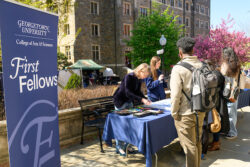




While attending George Washington University’s 2023 Admitted Students Day, first-generation college student Laura Alcalá Penelas (CAS ’28) and her mother took a trip to the Hilltop.
Prior to this visit, Alcalá Penelas knew that her high school had not attached her transcript to her Georgetown application, so she met with an admissions officer. Alcalá Penelas then learned that without her inquiry, her application would have been considered incomplete and automatically denied.
After remedying this error, Alcalá Penelas received admission to Georgetown University’s Class of 2028. Her experience inspired her to create a club dedicated to helping students like herself navigate convoluted application situations.
The Georgetown University First-Generation Experience Mentorship (FEM) aims to provide first-generation high school seniors with resources and collegiate mentors as they apply to college, including, but not limited to, Georgetown.
First-generation college attendees, students whose parents did not receive a college degree, often face challenges beyond academics—from loans to navigating complex higher education systems—when thinking about college.
When attending college, first-generation students disproportionately have to take out student loans, according to a study by the Pell Institute. At least two-thirds of first-generation college students reported feeling high levels of stress and anxiety due to the “combined pressures of academic performance, financial strain and family obligations,” the study found.
Even before arriving at university, many first-generation students feel added amounts of pressure while applying. During an interview with the Voice, Alcalá Penelas said she felt lost and overwhelmed during her application season.
“Everything was on me. My mom didn’t have the resources or understand what was going on,” Alcalá Penelas said. “If I struggled so hard, I can’t imagine the experience of someone who has an even worse situation.”
As a freshman, Alcalá Penelas found community and support through the Georgetown Scholars Program (GSP). GSP aids first-generation and low-income Hoyas as they transition into campus life, providing a safe space to bond over shared experiences.
Yaritza Filpo Luna (MSB ’27), co-events coordinator of FEM, said that resources like GSP were critical to her successfully navigating university as a first-generation low-income student.
“Today, I recognize how lucky I am to go to a school like Georgetown with resources like GSP, [the] Community Scholars Program, the different centers in the Office of Student Equity and Inclusion, and the amazing professors that I have had the privilege of taking classes with,” Filpo Luna said.
FEM seeks to add additional support for first-generation students before they even set foot on campus. Though the club is still in its planning phases, it has already conducted two general body meetings and has a 16-person board. Board members said they welcome any support as they get off the ground.
“[We are] not excluding anyone that wants to help. I feel like anyone that wants to donate their time is always an active resource,” Alcalá Penelas said.
The board is now beginning to curate their group of mentors, she said. Instead of pairing one high school student with a set person, all mentors will host their own office hours, and mentees will be able to make appointments as they wish.
FEM is also in the process of launching a website with resources, including guides on writing the Common App personal statement and help with financial aid forms like the Free Application for Federal Student Aid and College Scholarship Service.
Taliyah Williams (MSB ’27), the club’s co-events coordinator, said that helping students with financial management can be critical during the college application process.
“Through tutoring and mentoring in financial literacy, I’ve seen how powerful it is when someone simply says, ‘I’ve been where you are,’” Williams said.
FEM has also started conversations with GSP and the Cawley Career Center to schedule professional development and networking workshops. These will be open to the public and posted on their website.
Alcalá Penelas said she plans to turn FEM into a non-profit, with the goal of being replicated at other college campuses. She said she will begin reaching out to establish potential chapters after they earn their nonprofit certification.
In interviews with the Voice, FEM board members expressed their excitement and pride to be a part of this growing organization. Many of them identify as first-generation students and said that these kinds of accessible resources would have been incredibly helpful when they were applying to college.
Mentorship coordinator Paris Coleman (CAS ’28) said that the application process is full of structural barriers for first-generation students.
“Even though I went to a public high school that was well-funded, information regarding the SAT and the ACT and the college application process was structured for students whose parents already knew the information or had the money to receive it,” Coleman said, referencing the two main exams students take when applying to U.S. colleges.
For Alcalá Penelas, she said she’s found joy in cultivating a community that cares about the success of first-generation students and can empathize with her experience.
“The rewarding part is being in meetings, telling my story and having people resonate [with it],” Alcalá Penelas said. “It’s a very hard thing to talk about, and seeing so many people interested makes me happy because I know that there is a community at Georgetown that really does care.”
Alcalá Penelas encouraged first-generation students currently in the college application process to “keep pushing” and ask for help.
“Even if you are alone, you are never truly alone,” Alcalá Penelas said. “It may feel like that in your mind, but as soon as you open up, it does get better once you find that safe space and community.”