


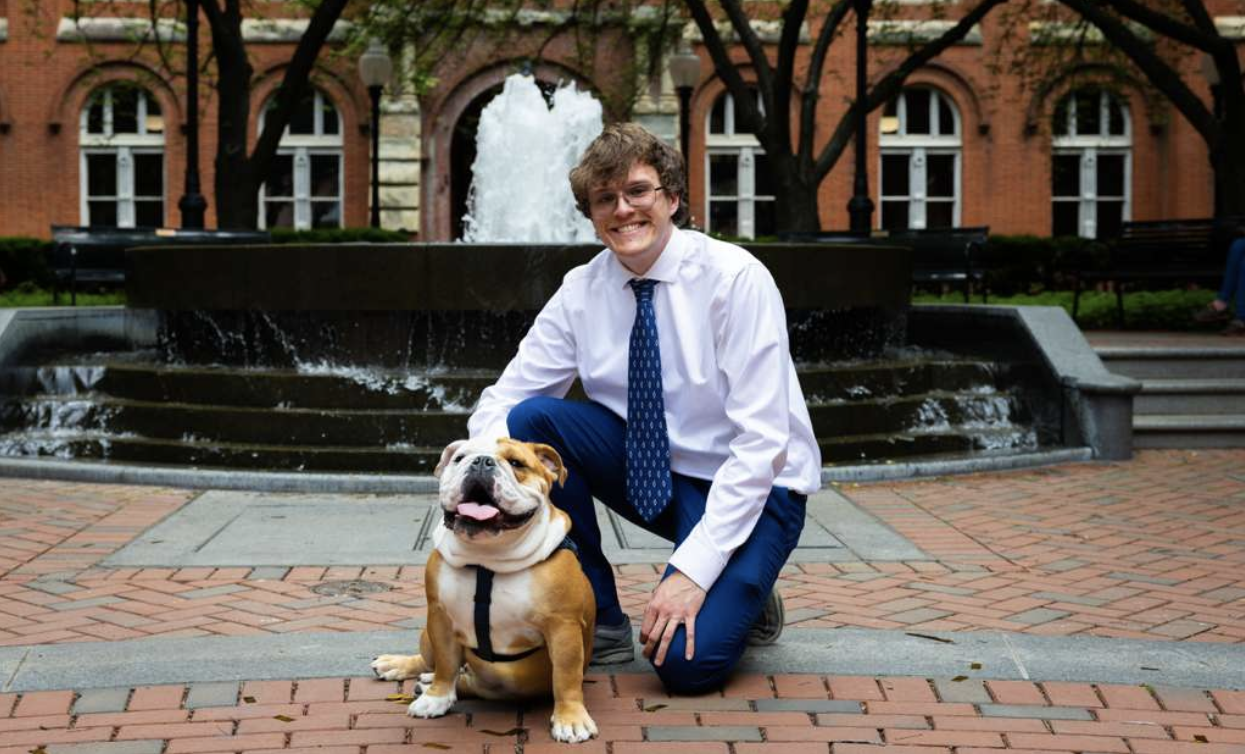

What does a campaign need? For Tony Labranche (CAS ’25), the answer is 16 days, a roll of duct tape, and the free time to knock on several hundred constituents’ doors.
Two weeks before the November elections, Labranche launched a write-in candidacy for city council in his hometown of Nashua, New Hampshire. Despite his eventual loss, his campaign was marked by extraordinary tenacity, ambition, and dedication.
Despite being 24 years old, this was not Labranche’s first foray into politics. At 18, Labranche became the youngest ever New Hampshire official, and one of the youngest ever LGBTQ+ elected officials in the United States. He spent two years in the New Hampshire House of Representatives, where he served on the State-Federal Relations and Veterans Affairs Committee. According to Labranche, during his two years as a representative, he sponsored 39 pieces of legislation, seven of which passed through the House.
Labranche had planned to go back into public service after college, but his first summer after graduation threw him a curveball. Two weeks after signing his post-graduate lease in Nashua, Labranche was diagnosed with oral cancer.
“At the time, the prognosis was pretty bad,” he said. “That was when I definitely was like, ‘Yeah, I probably can’t run this year.’”
In October, Labranche received good news from his treatment team; immunotherapy and surgery had killed the cancer in his mouth. Fresh out of recovery, Labranche started to hear rumblings that his city council was considering criminalizing homelessness.
“That is a topic that I feel really passionate about,” Labranche said. “To see the dehumanization of homeless individuals, and how they are treated, and how many people don’t even see them as people at all…really drove me up the wall.”
So on Oct. 19, just 16 days before the election, Labranche launched his campaign for Nashua City Council. By then, the Sept. 5 filing deadline had long passed, and Labranche’s name would not appear on the ballot for constituents. Instead, voters would have to write—with correct spelling—Labranche’s full name on the ballot, while filling in a bubble designated for write-in candidates.
Write-in votes are not a new concept to many New Hampshire voters. In the 2024 primaries, 79,000 New Hampshirite voters wrote in then-U.S. President Joe Biden on their ballots.
To help voters adhere to the rules, Labranche distributed information cards that included instructions as well as the correct spelling of his name.
Then, from Oct. 19 through Nov. 3, Labranche embarked on an ambitious door-to-door campaign. In this time period, Labranche personally knocked on around 85% of all the doors in the district.
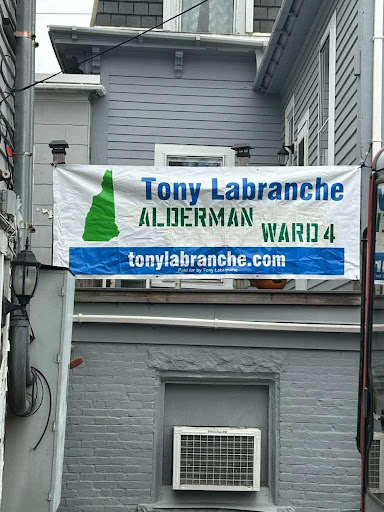
Photo courtesy of Labranche.
Due to the time crunch, Labranche did not have time to create new campaign materials or fundraise. Instead, he repurposed old materials from his 2021 Souhegan Cooperative School Board campaign and his prior state representative campaign. Using duct tape and Sharpies, he edited his old materials to reflect his new election. At the local public library, he printed out flyers to be distributed in neighborhoods.
In total, Labranche spent a simple $160 on the campaign.
Labranche’s desire to truly help and connect with voters and constituents in his district kept him going, despite the roadblocks.
“To run for office, you just need to knock on some doors and shake some hands,” Labranche said. “Look people in the eye and tell them what you want to do and what you offer.”
Labranche based his campaign on the promise to work on homelessness and housing, which he thought his city council was failing to do. In October 2025, the Nashua City Council passed Ordinance O-25-079, which banned camping on public land in response to growing numbers of individuals camping in RVs, tents, and other temporary structures in public parts of the city.
“Instead of providing services and actually helping [homeless people], it’s easier to just villainize them and criminalize them, and that’s what the mayor and his friends on the city council decided to do,” Labranche said.
Labranche had a different view on tackling homelessness. In his Housing Policy in America course at Georgetown, Labranche studied the history, formation, and context of American housing policy. The course focused on zoning ordinances and housing vouchers, and all the aspects of public policy that go into building housing and getting people housing.
“[The course was] eye-opening to see just how convoluted American housing is and how much better we could be doing,” Labranche said.
At the end of his two-week campaign, Labranche had won the hearts of many in his district.
“A lot of people on Election Day said that me knocking on their door is what brought them out to vote,” Labranche said. “I had a couple come up to me and say that it was their first time ever voting, but because I had knocked on their door and I actually took the time to listen to them, that’s why they came out.”
Labranche fell short with an unprecedented but insufficient 25% of the vote in the district. Despite his loss, Labranche found pride in reaching constituents and campaigning despite his treacherous health journey.
“There were people who didn’t vote for me who explicitly said, ‘I’m not voting for you, I’m voting for Tom [Lopez], but I want you to run for State Representative next year,’” he said.
Labranche doesn’t plan to give up on local politics any time soon. He has thrown around the idea of running for one of the newly vacant state house seats in his district next year.
For Labranche, getting involved is key to creating change that one wishes to see.
“If you’re not running, or if you’re not having a seat at the table, someone else has a seat at the table, and they’re probably doing a terrible job at representing you and your interests,” he said. “So you’ve got to do it yourself.”