

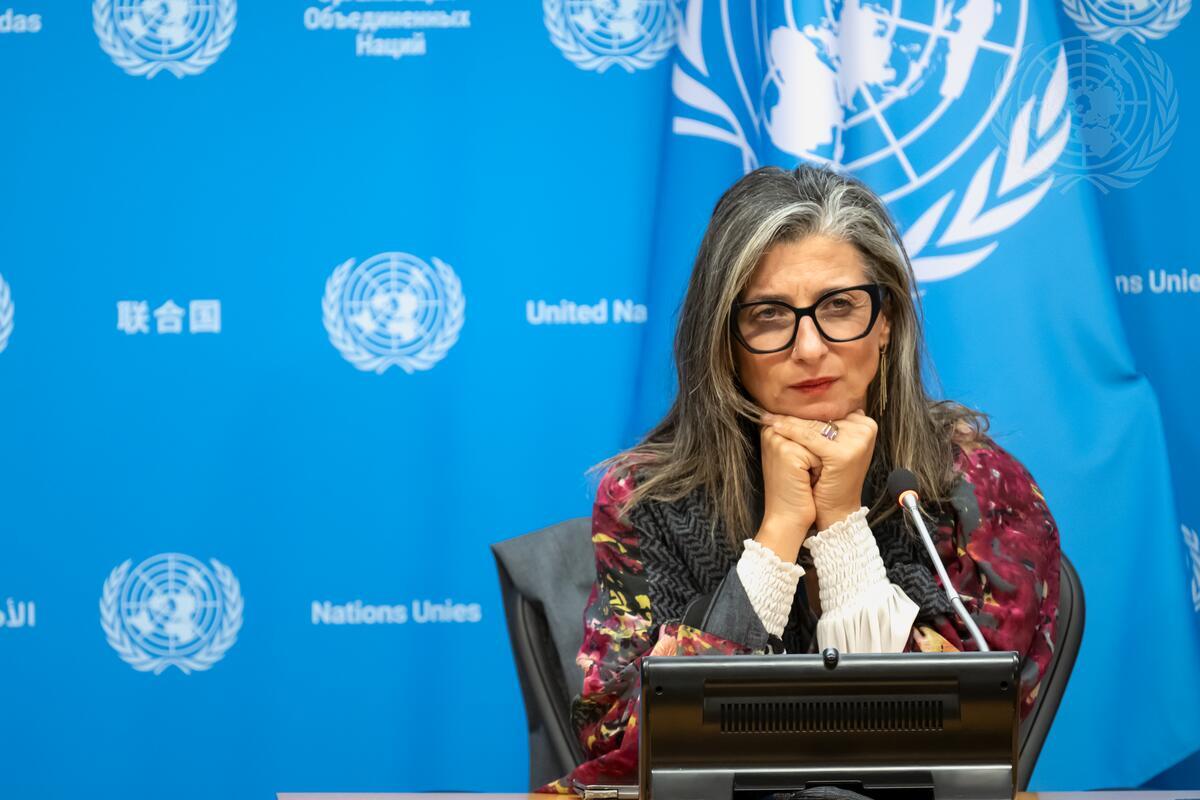
United Nations Special Rapporteur on the situation of human rights in the Palestinian Territories, Francesca Albanese, is no longer officially affiliated with Georgetown, a university spokesperson confirmed in an email to the Voice.
Albanese was officially sanctioned by the U.S. government in July and barred from entering the United States and engaging with U.S. institutions, as a result of her work with the International Criminal Court (ICC) “to investigate, arrest, detain, or prosecute nationals of the United States or Israel, without the consent of those two countries.” Israel and the United States are not members of the ICC, however the ICC issued arrest warrants for two Israeli officials in 2024.
Previously, Albanese was listed as an “affiliated scholar” on the webpage for the SFS Institute for the Study of International Migration (ISIM). According to the page, she became an affiliate in 2015. In October 2024, ISIM partnered with the Alwaleed Center for Muslim-Christian Understanding (ACMCU) to host Albanese for a talk on her 2024 report “The anatomy of a genocide” for the ACMCU’s Gaza Lecture Series.
The page was deleted in 2025.
“Ms. Albanese has no official affiliation with Georgetown and was never a member of our faculty or staff. Institutions are prohibited by federal law from affiliating with individuals subject to U.S. sanctions,” the spokesperson wrote.
The university also said that the removal of Albanese’s profile was not specific or targeted, but part of a 2025 university-wide removal of more than 200 expired or inactive affiliate listings.
Albanese and her office declined the Voice’s request for an interview or comment, but highlighted a December X (the platform formerly known as Twitter) post by Albanese which read, “@Georgetown’s decision to end my 10-year-old affiliation is yet another fallout of the sanctions the U.S. imposed on me last July for exposing Israel’s genocide and the complicity of U.S. businesses.”
At a press conference before the Italian Senate in September, Albanese emphasized that the loss of university affiliations is not due to personal issues, but the impact of the sanctions against her.
“In the United States I used to collaborate with universities, professors, NGOs,” she said. “But now no one dares to have any relationship with me. Not because they don’t support me, but because at this moment the U.S. administration poses such a threat to everyone that no one feels safe.”
In December, ACMCU director Nader Hashemi wrote on X that Georgetown was “forced” to react to the sanctions by “removing” Albanese’s affiliation in order to comply with federal law.
“As soon as the sanctions are lifted on Francesca, we plan to host her again at Georgetown University. I’m certain her affiliation will also be restored,” Hashemi wrote. “When she does return to campus, I suspect there is not a room large enough to accommodate all the people who want to meet her.”
This is seemingly the first time that an individual closely affiliated with the U.N. has been subject to U.S. sanctions. A special rapporteur is an independent expert “appointed to monitor and report on human rights issues worldwide,” according to the U.N., particularly in places where there are significant human rights concerns. While Albanese is not financially compensated for her work as a special rapporteur and not considered U.N. Staff, she does regularly report to Geneva and New York for U.N. business.
The Convention on the Privileges and Immunities of the United Nations, which the U.S. has a legal obligation to, is meant to ensure that experts like Albanese receive “immunity from legal process of every kind” for “words spoken or written and acts done by them in the course of the performance of their mission.” The U.S. has played a role in enforcing these very conventions in past cases at the International Court of Justice.
The U.N. has denounced the sanctions against Albanese, with U.N. High Commissioner for Human Rights Volker Türk calling for their “prompt reversal.”
When Secretary of State Marco Rubio announced sanctions against Albanese, he also pointed to past alleged antisemitism, writing that “Albanese has spewed unabashed antisemitism, expressed support for terrorism, and open contempt for the United States, Israel, and the West.”
Albanese has come under fire in the past for antisemitic comments, including in a 2014 Facebook post.
“America and Europe, one of them subjugated by the Jewish lobby, and the other by the sense of guilt about the Holocaust, remain on the sidelines and continue to condemn the oppressed — the Palestinians — who defend themselves with the only means they have (deranged missiles), instead of making Israel face its international law responsibilities,” Albanese wrote.
Albanese has since apologized for the post.
“Some of the words I used, during Israel’s offensive on the Gaza Strip in 2014, were infelicitous, analytically inaccurate and unintendedly offensive,” Albanese wrote to the Times of Israel in 2022. “I distance myself from these words, which I would not use today, nor have used as a UN Special Rapporteur.”
Georgetown’s interim president Robert Groves was questioned about Albanese’s connection to Georgetown during a July congressional hearing on antisemitism in higher education, which took place just weeks after her sanctions were announced. When Groves was asked whether Georgetown had considered terminating their relationship with Albanese in the past decade since the Facebook posts, he said that he could not speak to whether her termination had been considered.
“She is not at Georgetown, she is not on the payroll, and she is not present on campus,” Groves said. “She is still listed as an affiliate but she’s not present on campus nor is she participating in [ISIM].”
Georgetown’s chapter of Students for Justice in Palestine (SJP), who condemned the university’s decision to cut ties with Albanese in a December Instagram post, told the Voice that they believe the university has not been transparent in their decisionmaking.
“Removing Ms. Albanese’s affiliation, whether it is framed as a form of legal compliance or as an attempt to align with repugnant zionist claims that her documentation of Israel’s violations of international law is antisemitic, contradicts Georgetown’s assertion that it can’t engage in institutional disaffiliation when doing so would challenge Israeli academic institutions implicated in an illegal occupation and apartheid,” SJP wrote in a statement.
“We demand accountability and explanation for how and why Georgetown conditionally cherry picks whose voices are rendered too politically costly to remain affiliated with our university,” they finished.