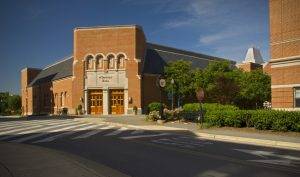





As the contract between Aramark, Georgetown’s dining provider, and the university, is set to expire in 2027, a university spokesperson confirmed to the Voice that it is exploring various dining contract options. Administrators are currently conducting a request-for-proposal (RFP) process to solicit bids from food service providers, including Aramark, though nothing has been decided yet.
“This process includes student representatives – representing GUSA, GradGov, the Law Center and the Medical Center – who will have input into the selection of the provider,” a university spokesperson wrote.
As potential providers submit proposals, students gave the Voice their thoughts on how to improve the dining experience at Georgetown. For over a decade, students have expressed concerns regarding Aramark’s treatment of workers, citing their resistance to employee unionization, low wages, limited benefits, and dangerous working conditions.
Georgetown’s Aramark workers unionized in 2011, advocating for better pay and protections of their rights. In 2015, workers again raised concerns about unequal treatment and sought to include workers at new Aramark campus dining locations in the union, prompting student advocacy and further calls for accountability from the university. Most recently, in 2024, students demonstrated solidarity with dining workers as they negotiated a new contract with Aramark, arguing that the university’s commitment to social justice should extend to its workforce.
Those concerns, however, are not limited to Georgetown. Aramark has faced criticism from nationwide for labor and ethical violations, particularly in their treatment of incarcerated workers.
The university plans to seek student input, and according to a university spokesperson, there is a real possibility that these voices will help shape what comes next in 2027.
Welcoming Change
Some Hoyas see the transition as a chance to fix everyday frustrations with dining on campus. For students with dietary restrictions, this shift creates the opportunity for a wider (if any) variety of on-campus dining options. Mia Lumpkin (CAS ’29), who has allergies to dairy, tree nuts, and peanuts, believes that student involvement in selecting the new provider would be beneficial to Hoyas like her.
“[Students] are the ones primarily consuming the food and affected by the decision,” Lumpkin said. “I think it is important to give us a sense of the possible options and allow us the opportunity to give feedback on which is best.”
Lumpkin added that she’d appreciate for the new provider to make specific changes to better support students with allergies day-to-day.
“It would make the biggest difference if Leo’s had more dairy-free options,” Lumpkin said. “While I can usually work around my allergies with chefs, I struggle to find quick grab-and-go items, such as yogurt, that accommodate my allergies.”
The Voice has reported multiple instances where students with severe allergies or conditions like celiac disease have encountered cross-contamination risks, mislabeled ingredients, and conflicting safety guidance from dining staff and dieticians. These issues turn what should be a routine meal into an unreliable, stressful, or even hazardous experience.
Gianna Ascoli (SOH ’29), who eats at Leo’s and Epi’s on almost a daily basis, said that she hopes to see more overall variety so meals don’t feel repetitive from week to week.
“Adding more fruit options, especially berries, would help meals feel fresher and more balanced,” Ascoli said.
Ascoli noted that earlier breakfast and later dinner hours would also benefit students who have classes or activities at unconventional times. More flexible hours, she said, would make dining more accessible to a wider range of student schedules and help align dining offerings with how students actually use them. Ascoli also highlighted an evident drop in quality on weekends.
“Another important change would be more consistency in food quality from weekdays to weekends, since the difference can be noticeable,” she added.
Ascoli believes that students, more than any other group, should be included in choosing the next provider because it directly affects them.
“It would also give dining providers clearer insight into what students actually want and need,” said Ascoli.
Lingering concerns about ethical issues and worker treatment
Students believe that their feedback is imperative for a change in dining provider, but some are wary that their thoughts will not be taken into account. One such student is Fiona Naughton (SFS’ 26), a student representative of Georgetown University Student Association (GUSA) on the Advisory Committee for Business Practices. Naughton is also a member of Georgetown Coalition for Workers’ Rights (GCWR), a group of undergraduates, graduate student workers, and staff coming together “to end the exploitation of labor at the university and beyond.”
Naughton highlighted Aramark’s In2Work Program, which reportedly involves 6,000 incarcerated people working in prison kitchens. These workers are classified as “students” rather than employees, allowing the company to avoid paying them standard wages.
In 2024, The Guardian reported that incarcerated workers in Florida prisons received no compensation for their labor and the same year a California court heard claims that pretrial detainees were forced to work without pay in facilities contracted with Aramark. The company has also faced repeated lawsuits over unsanitary food conditions in prisons.
“Aramark provides a lot of their food services for a lot of prisons in the United States, and now for ICE facilities,” she said, pointing out that the company still has ties to these operations even though Aramark has tried to obscure them through subsidiaries and other companies. She referenced past lawsuits alleging Aramark of serving inmates inadequate, less nutritious food, violating their 14th Amendment rights.
Larger providers like Aramark can handle the demands and scale of a campus like Georgetown’s, but Naughton said other companies could also handle Georgetown’s appetite. She contrasted that with smaller potential bidders like Thompson Hospitality, the largest minority-owned food service company in the United States and the ninth-largest overall, serving at least 25 historically Black colleges and universities. The company has not been linked to prison or ICE operations, though it has faced past labor disputes, including a dismissed harassment and retaliation lawsuit following layoffs at Howard University in 2016.
However, according to Naughton, university administrators have suggested that Thompson “doesn’t have the capacity to meet the amount of people that Georgetown feeds every day,” during their meetings.
“They want someone who they believe is going to fulfill the needs of that contract,” Naughton said.
Referencing complaints and anecdotes shared by workers themselves during GCWR meetings, Naughton highlighted a “recent crackdown” on dining workers this summer.
“There have been reports from workers about unsanitary conditions, as well as really strenuous working conditions,” Naughton said.
Many students remain unaware of these issues, especially given that most are on meal plans and thus, according to Naughton, unknowingly “complicit in a broader system,” largely due to the lack of choice.
“Georgetown has so many skeletons in its closet,” Naughton said “When you start digging, you realize how much they have to hide and how much this university relies on a cheap exploited workforce, as well as a company that provides services to prisons and ICE detention centers.”
Ultimately, Naughton believes that the most powerful thing for students to do is use their voices and demand action and accountability from the school. As the selection process unfolds, the transition offers the possibility of more inclusive dining and demanding accountability for workers and ethical practices.
“And they have to listen to us,” Naughton said. “If we really raise our voices, they have to listen.”