


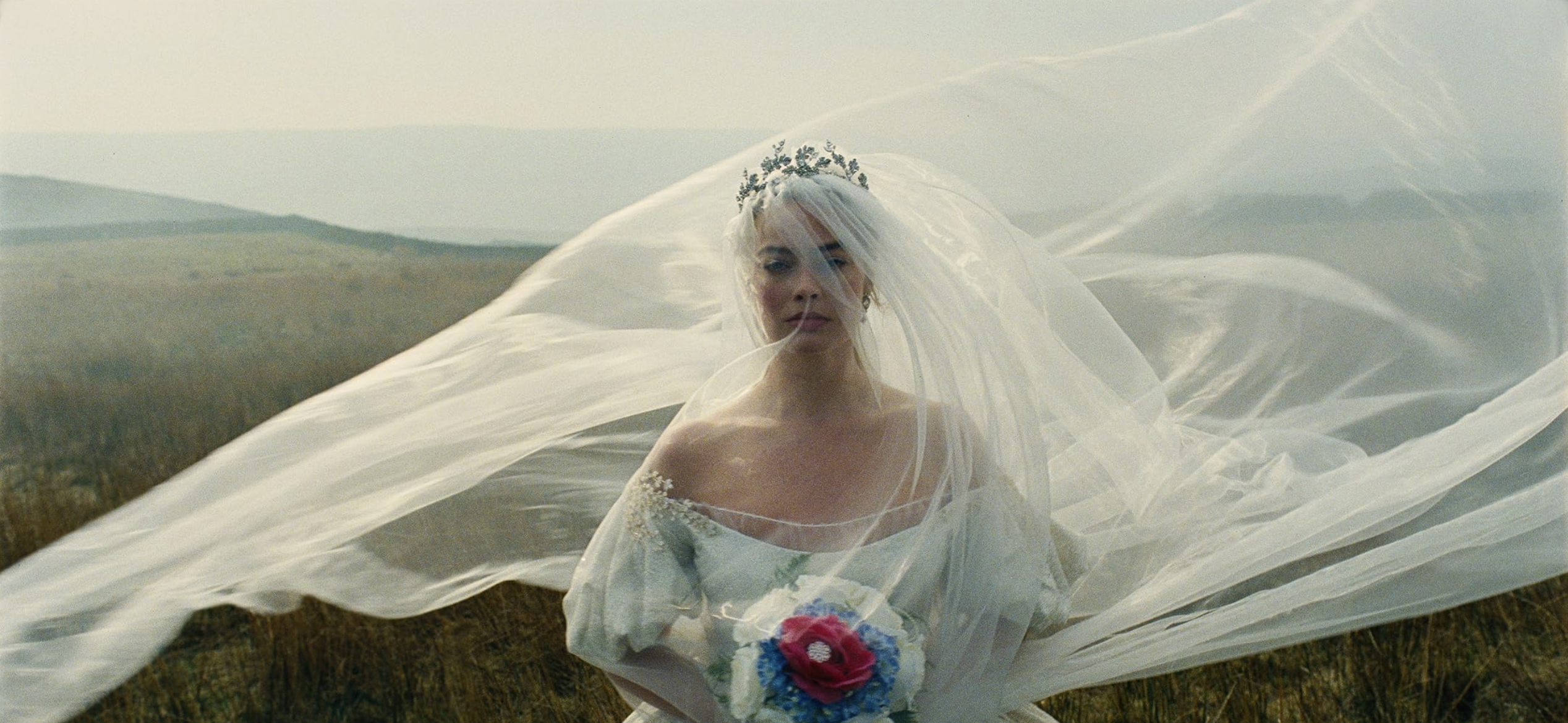
Lately, prestige cinema seems to prefer invention over canon. Look no further than Guillermo del Toro’s Frankenstein (2025), the recent adaptation of Hamnet (2025), and now, to the dismay of many, Emerald Fennell’s “Wuthering Heights” (2026). Dressed to the nines? Absolutely. Faithful to the book’s political machinery? Not remotely. Fennell has unequivocally built a sumptuous film of texture and eroticism—but an adaptation must answer its source’s questions, not merely echo its most marketable images.
First, to give credit where it’s due, this is filmmaking at an almost obsessive level of craft; as a collaborative exercise in texture, Fennell and her team have assembled an impressive arsenal. Linus Sandgren’s camerawork practices what can only be called facial archaeology: extreme close-ups that carve sorrow into cheekbones and long, distant pans that withdraw that ache into the landscape. Jacqueline Durran’s costumes are just as breathtaking, from a translucent wedding-night ensemble to a high-fashion, latex-effect gown that collapses Victorian restraint into modern fetish. Suzie Davies’s production design flirts with metaphor, with dollhouse shots that literalize entrapment and a dining table groaning under opulence. The soundtrack only accentuates these elements as it toggles between lush strings and Charli XCX’s synth intrusions.
That is precisely the rub, however; Wuthering Heights is not a romance to be beautified. Emily Brontë’s 1847 novel traces Heathcliff, an outsider taken in by the Earnshaw family, and his ruinous, generational entanglement with Catherine (Cathy) Earnshaw. The book’s power is accumulative: cruelty compounds across generations through familial hierarchies, inheritance, and social othering. Fennell’s film narrows that sweep, concentrating almost exclusively on Cathy (Margot Robbie) and Heathcliff’s (Jacob Elordi) erotic orbit while excising or compressing the very mechanisms through which Brontë stages social consequence.
Proponents of Fennell’s adaptation may call this a deliberate choice, a modern, affect-first reimagining that privileges erotic intensity over Brontë’s sprawling chronicle. That’s a defensible artistic impulse—adaptations are interpretations, not museum exhibits. But interpretation still requires engagement. When a text’s class scaffolding and racial politics are not reimagined but removed, what remains risks feeling less like bold revision and more like aesthetic evacuation.
The costs of that narrowing become clear in the film’s most consequential omissions. Hindley Earnshaw, the eldest sibling whose sustained humiliation of Heathcliff in the novel is essential to the latter’s formation, is erased by Fennell. With Hindley physically and thematically gone, the household hierarchy and domestic power dynamics that convert Heathcliff’s humiliation into revenant rage collapse. The film also omits the novel’s second-generation figures (such as Hindley’s son Hareton and Heathcliff’s son Linton), through whom Brontë demonstrates trauma’s metastasis. The movie substitutes a tidy, fatal punctuation (spoiler alert: Cathy miscarries and dies) for Brontë’s long, vindictive tail, in which that generational pain unfolds. What was once a multigenerational indictment becomes an enclosed loop.
Heathcliff: in the novel his appearance and origins are described in politically operative terms—“dark,” and “a little Lascar,” a 19th-century label for non-European (often South Asian) seamen—ambiguities that fuel the Earnshaw family’s distrust and justify his systematic degradation. In contrast, Fennell’s Heathcliff as embodied by Elordi is a handsome, white, Old-Hollywood archetype: sulky, lithe, defiantly lit. He is magnetic, and he and Robbie generate incandescent chemistry. But stripped of the novel’s racial freight and the domestic layers that explain his formation, that magnetism loses gravity. It becomes an image of outsider status without its social engine, brooding without the bruise.
The film’s appetite for eroticism compounds this problem. Sex is presented in numerous forms, all for virtually no reason. A vividly staged and wildly confusing masturbatory sequence during which Cathy gets caught fingering herself behind a rock, for instance, startles and titillates but never accrues meaning. In Brontë, intimacy is spare and therefore devastating; its rarity is an accelerant. The film displays with questionable ease what once needed to be earned by the reader.
Supporting players suffer even more radical attenuation. In the novel, Nelly Dean, a servant to the Earnshaw family, is not merely a witness but the organizing intelligence. Her narration largely shapes what we trust, whom we pity, and where moral culpability settles. In Fennell’s adaptation, Nelly (Hong Chau) is transformed from an epistemic anchor to a cool-eyed presence. Without her framing, the moral topology flattens. Other women are similarly marginalized—reduced to propulsion for Cathy’s sexual arc or Heathcliff’s mystique—undercutting any claim the film might make to feminist revision.
A good deal of online criticism has reduced this complaint to a facile retort: that dislike of the film can be directly attributed to its refusal to serve the male gaze. That misses the point. The problem here is not sexual frankness; it is context and consequence. In Brontë, secondary figures like Isabella Linton survive domestic and sexual abuse, and they carry consequential storylines as mothers and witnesses that complicate sympathy and agency. Isabella, effectively tricked into marrying Heathcliff, endures his verbal and physical cruelty and escapes Wuthering Heights to give birth to their son Linton. In Fennell’s film, Isabella is stripped of that arc—staged instead as an infantilized, humiliated figure, collared and literally groveling at Heathcliff’s feet—robbed of any narrative purpose other than to intensify eroticism. That reduction is not feminist revision.
And yet, the film knows how to arrest the eye. A bedchamber veined in blue like living skin; outstretched planes of green that swallow the frame; a corridor so lavishly red it reads as a runway of doom. Fennell’s mise-en-scène will furnish your memory; there are moments of genuine astonishment.
But interior decorating is not adaptation, and erasure is not divergence. To adapt a canonical work is to enter into argument with it and wrestle publicly with its politics, not to merely reupholster its surfaces. Fennell’s visuals often pay off aesthetically, but they rarely do the symbolic work the story requires. When that framework is quietly removed, although it may be beautiful, what remains is no longer accountable. By softening Heathcliff’s racial ambiguity and largely excising Brontë’s class critique, “Wuthering Heights” retreats from the very tensions that make the novel endure—the tensions that serve as the story’s engine.
If you go to see “Wuthering Heights,” go for the craft: see what camera, costume, and design can do at full tilt. But don’t mistake that dazzling surface for the moral labor the novel demands. Once you notice what’s been smoothed away, the ache the film sells feels less like tragedy and more like a very, very expensive consolation prize.