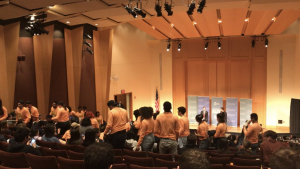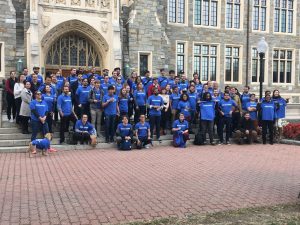


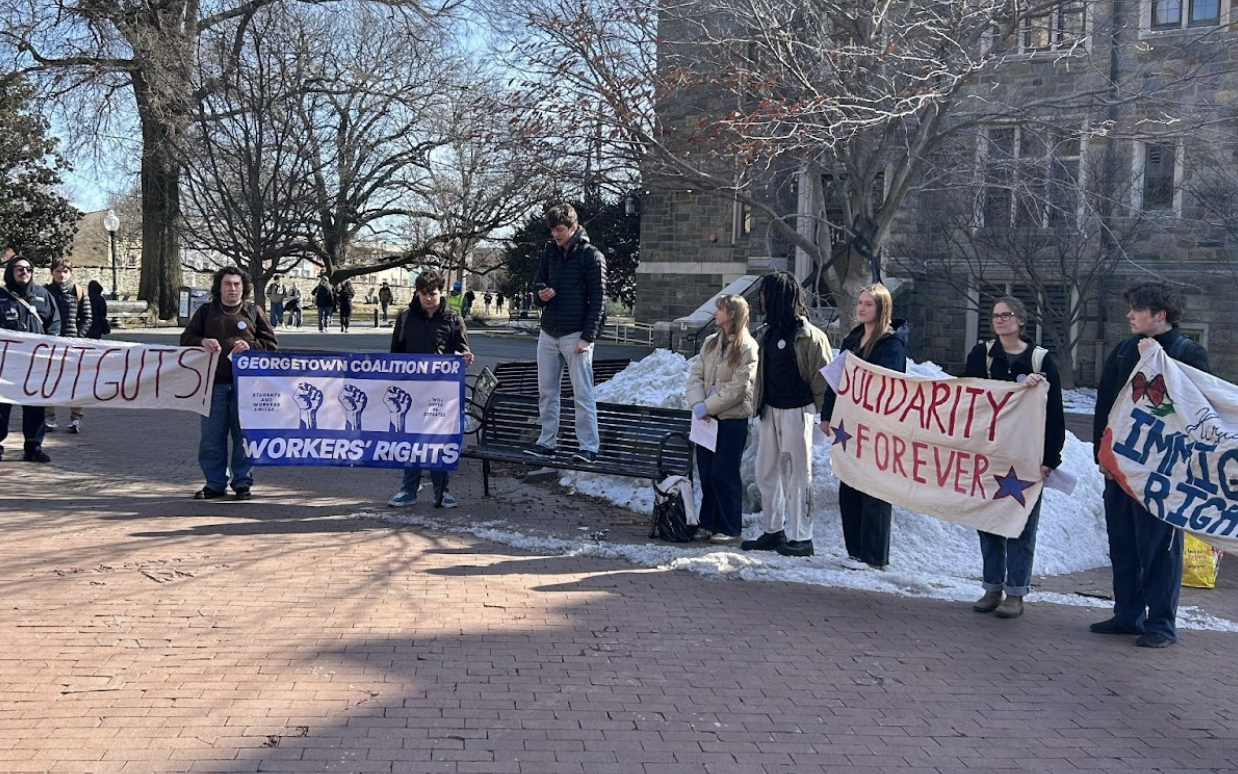

Over 50 students, faculty, and staff gathered in Red Square in solidarity with Georgetown’s facilities workers on Tuesday Feb. 24, alleging unjust treatment by the university.
The rally was hosted by Georgetown Coalition of Workers Rights (GCWR) in partnership with the Georgetown Resident Assistant Coalition (GRAC), Georgetown Alliance of Graduate Employees (GAGE), Georgetown’s Students for Justice in Palestine (SJP), Hoyas for Immigrant Rights, and the Georgetown University Student Association (GUSA).
The event brought together students from all five clubs.
“We’re starting to build a cross-campus coalition. Events like this contribute to this building up of power, of consciousness of workers on this campus, of acknowledgement that whatever happens to the facilities employees could happen to them too,” Fiona Naughton (CAS ’26), student representative of the Advisory Committee of Business Practices (ACBP) and a GCWR organizer, said in an interview with the Voice.
On July 1, 2025, the university hired Georgetown custodial workers, who were previously employed by third-party contractor Aramark, as university employees. The facilities team was made aware of this change during individual meetings, in which the workers were re-interviewed by the university for their position, according to GCWR’s conversations with facility workers.
Since the transition went into effect, the approximately 400 Georgetown facility workers are now considered “new employees” of the university.
Naughton said that this change reduced their salaries by $4 an hour—from around $22 an hour to $17.97 an hour, just two cents above D.C.’s minimum wage. With their new employee status, they have also lost seniority, which allowed them to choose preferred shifts.
“We deeply appreciate the contributions that University staff make to the Georgetown community,” a university spokesperson said in a statement to the Voice. “Georgetown is committed to upholding our Just Employment Policy, which affirms employees’ rights to freely associate and organize.”
After conversations with facilities workers on campus, GCWR also alleges wage theft of accrued paid time off and vacation time, increasingly strenuous work conditions, and increased fees for parking and health insurance.
As a result of the pay cut, Naughton said that almost all custodial workers have had to take on a second job, if they already didn’t have one. The living wage in D.C. for an adult with no children is $26.72.
“Georgetown does not care about its workers,” Naughton said. “If it did, it would pay them a living wage. It would pay them a living salary.”
Naughton said that some of the custodial workers have been Georgetown employees for decades, even as long as 40 years.
“What we’re seeing is the complete devaluation of the years of service that people have given to the university,” she said. “Imagine being at Georgetown for 40 years, and then this change occurs that you know nothing about, and you’re considered a new employee. How degrading is that? It makes you feel like you are not a human being.”
Tomas Emch (SFS ’27), a GCWR organizer, shared quotes from Georgetown’s facility workers about the hardships experienced as university employees. Emch read the quotes in both Spanish and English to highlight the struggle facility employees have had with the lack of translation services provided by the university.
“They don’t value us. We feel undervalued, looked down upon,” an employee said in a statement Emch read. “They treat us as if we came to work here from somewhere else, as if we haven’t worked here for years, for decades.”
“I don’t feel free to take off,” Emch said on behalf of a facility worker. “I can’t go to my son’s medical appointments because I fear I am going to lose my job. I didn’t feel this way before, when we had seniority.”
“Why do they cut our salaries?” Emch said on behalf of an employee. “After so many years of work, they come and take away our salaries and our seniority? It is unjust that they don’t recognize us. We feel discriminated against.”
“And now I’m going to read the last one, which is a very simple question—but I’d like to see [Chief Operating Officer] David Green, [Vice President of Planning and Facilities Management] Lisa Belokur, or any of the other vampires in this university answer it,” Emch said. “‘If we’re earning less, why are they making us work more and more?’”
 Photo by Sophia Jacome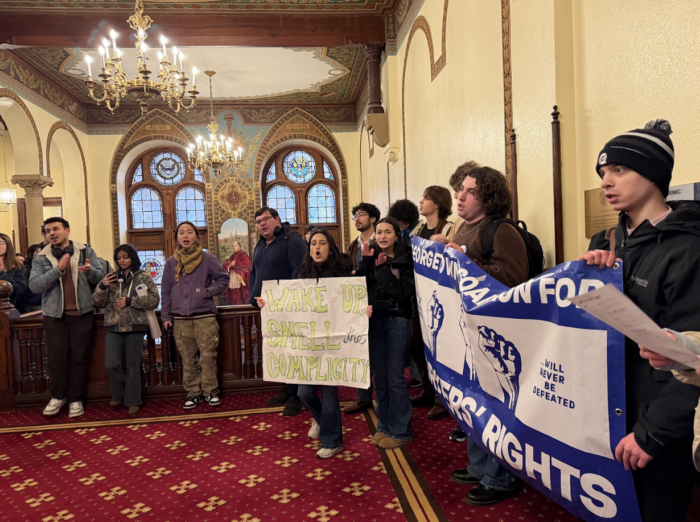
At the end of the rally, students marched to the office of Georgetown interim President Robert Groves to present the Georgetown administration with a petition, calling for fair contract negotiations with facility workers.
Contract renegotiations between the university and Georgetown’s facilities workers union, SEIU 1199, take place every four years. With the next session set to begin on Feb. 25, Elinor Clark (CAS ’27), the facilities lead at GCWR, emphasized the university’s responsibility to “bargain in good faith.”
“The facilities workers do not currently make enough money,” she said in an interview with the Voice. “They’re not treated with the respect they deserve. Georgetown needs to live up to their value of cura personalis [care of the whole person] and ensure that when they are looking at facilities workers’ compensation that they are accounting for everything.”
On the heels of a successful negotiating campaign for the Georgetown University Transportation Shuttle (GUTS) drivers last semester, Clark hopes that the university will continue to pay attention to GCWR’s demands.
“The GUTS campaign showed Georgetown that when students fight, we win,” Clark said. “Georgetown knows, now more than ever, that they need to listen to us, hear the demands of the workers, and if they don’t, we’ll fight until they do.”
In a statement to the Voice, a university spokesperson explained that the university intends to engage with fair contract negotiations.
“The University has a long history of working collaboratively with unions representing its employees. We will continue to negotiate in good faith with 1199SEIU as we work together to reach an agreement on a new union contract.”
“The University has a long history of working collaboratively with unions representing its employees. We will continue to negotiate in good faith with 1199SEIU as we work together to reach an agreement on a new union contract.”
Georgetown University Student Association (GUSA) President Darius Wagner (CAS ’27) also spoke at the rally. He began by reflecting on the importance of facilities workers to the Georgetown community.
“Our workers are the backbone of our campus and they’re some of the kindest souls that I’ve met here,” Wagner said. “They brave winter storms, they get here in the dead of night, and they often arrive before the sun rises. They have given us their all and the university owes it to the workers to give them their all.”
Wagner went on to highlight GUSA’s commitment to supporting the campaign and ensuring facilities workers don’t “get anything less than what they deserve.”
“We will be tirelessly relentless in our advocacy for our workers,” Wagner said. “GUSA will use all of our powers and leverage to ensure the full cooperation and the utmost respect for our workers.”
After his speech, Wagner elaborated on GUSA’s role, and more specifically his role as president, in the campaign in an interview with the Voice.
“One of GUSA’s main jobs is to frequently engage with administrators and to share with them the student perspective and to tell them how we’re feeling and share where the state of the student body is,” he said. “I’m here as a representation of that today.”
Wagner said that reductions in wage may be motivated by financial challenges experienced by the university. Due to cuts to federal research funding cuts and decline of graduate tuition revenue, the university is poised to lose $52 million in anticipated revenue.
“I think our university is going through a period where we’re undergoing financial challenges, and the university is trying to find ways to balance their budgets, balance their sheets, but it cannot be done off the backs of our workers,” Wagner said.
Crystal Luo, an assistant professor of Asian American History, spoke on behalf of Georgetown’s Chapter of the Association of American University Professors (AAUP), a union that supports academic professionals. She said that she is only able to do her job because of the work of the facilities team.
“I benefit directly from the work that Georgetown facilities workers do,” Luo said. “When I came to work this morning, I took a shuttle that got me here on time. I walked on sidewalks that were cleared of ice and snow. I sat down in an office that’s cleaned and heated.”
Luo also said that solidarity with the facility’s workers is imperative to holding their shared employer accountable.
“When will our employers be compelled to sacrifice their seven figure salaries, their costly AI initiative?” Luo said. “Only when we have the power to make them. Your working conditions are our working conditions, and your power is our power.”
Alongside student demonstrators stood Greg Afinogenov, an associate professor of History, who has participated in GCWR organizing last semester and emphasized the continued importance of “standing together in this moment.”
“The university, right now, and its cutbacks, is harming everyone across the university, from bus drivers, to custodial staff, to faculty, to graduate students,” Afinogenov said. “I think the workers need to get their seniority back and not have to work second jobs to work here.”
As a professor, Afinogenov described GCWR’s recent organizing efforts as “heartening to see.”
“It’s wonderful to see how many people have shown up to these things and how active it’s been,” he said. “[It is] wonderful to see that people think of the university as a place that they can fight for.”