


Georgetown’s facilities workers voted to approve a new contract with the university on March 10. The contract includes a 15% pay increase over the course of two years and a $5 increase in meal voucher payments when working overtime, while most other components of the previous contract remain the same.
Negotiations began on Feb. 25 with the guidance of 1199SEIU, the union that represents the approximately 400 Georgetown facility workers, including custodial workers, bus drivers, and maintenance staff. The contract negotiated will retroactively apply to January 2026, and will end on June 30, 2028.
In a statement to the Voice, a university spokesperson wrote that the university is pleased to have reached an agreement.
“We deeply appreciate the contributions that university staff make to the Georgetown community,” the spokesperson wrote. “We are also grateful for the leadership and collaboration of the parties as we worked in good faith to reach an agreement. The University has had a long and respectful relationship with 1199SEIU and looks forward to maintaining this relationship.”
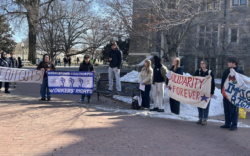
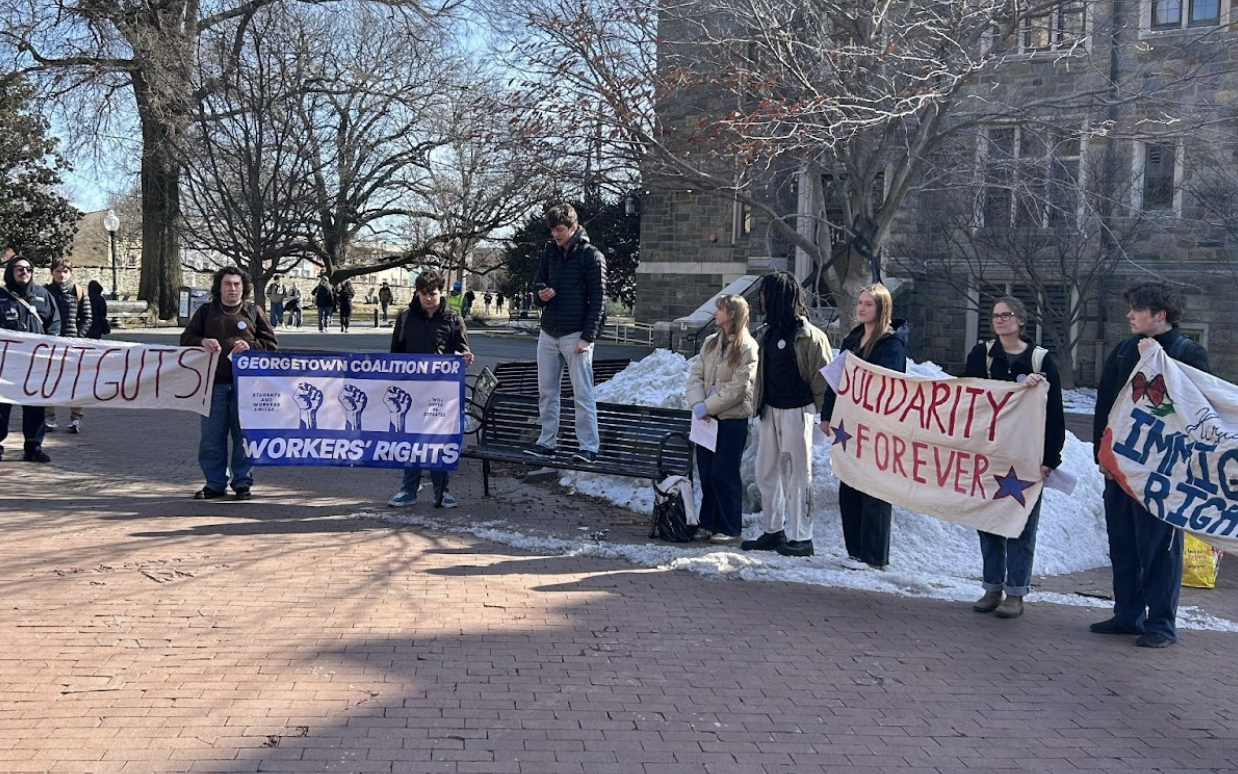
The Georgetown Coalition for Workers Rights (GCWR) were present outside of the bargaining room in solidarity with the workers throughout negotiations. They organized a petition and rally to advocate for fair bargaining ahead of the Feb. 25 negotiations.
At the rally on Feb. 24, students protested against the custodial workers’ $4 pay cut and loss of seniority as a result of becoming university employees instead of outsourced workers on July 1, 2025.
This follows a successful campaign for the Georgetown University Transportation Shuttle (GUTS) drivers after the university-employed drivers were informed that Georgetown planned to terminate their contracts and outsource to third-party Abe’s Transportation in an effort to limit university spending. This move would have reduced their pay and limited their access to benefits, according to GCWR. After months of advocacy, the university agreed to maintain GUTS drivers as university employees.
Elinor Clark (CAS ’27), GCWR’s facilities lead, said that she is disappointed in the results of the contract.
“The Coalition does not feel that this contract gives the workers the respect that they deserve,” Clark said. “A 15% pay increase over the life of the contract doesn’t even amount to a $3 difference on the paychecks of workers here at Georgetown.”
Georgetown’s custodial workers are now making $17.97 as “new employees” of the university after Georgetown brought custodial workers in-house off of a contract with Aramark, who paid them approximately $22 per hour. The living wage in D.C. for an adult with no children is $26.72. The Voice spoke with a custodial worker on the condition of anonymity out of fear of retaliation from their employer, who said that the increased wage is not enough to live on.
“I don’t feel satisfied because the salary is not fair,” the custodial worker said. “Because of the economy, what we earn does not cover our expenses. We have to pay for parking, we have to pay for health insurance.”
During the Feb. 24 rally, GCWR and workers demanded that Georgetown restore custodial workers’ seniority lost after they became “new” employees of Georgetown, resulting in the inability to pick preferred shifts and loss of accrued vacation time. The parties in the contract negotiations did not discuss the restoration of custodial worker’s seniority because, given the limited amount of seniority benefits available, they did not want to disrupt the seniority of other facilities workers who might have lost seniority if custodial workers regained it.
“Our seniority was left out,” the custodial worker said. “We feel bad because of the effort we made to reach the point of working daytime shifts. Many of us worked 10 years or more on night shifts. It wasn’t easy to earn those years of seniority so we could get more vacation time.”
While the contract resulted in a pay increase, the custodial worker fears that it won’t be enough.
“So where do we stand?” the worker said. “On paper everything looks good, but when you look at the reality for the employees, it’s very different.”
In addition to the pay increase, facilities workers will also be given a $20 dollar meal voucher, instead of the current $15 voucher, to pay for meals when working overtime. The contract also keeps parking and health care costs the same.
“Parking rates staying the same, rather than rising, is a win. Healthcare coverage remaining the same, rather than rising, is a win,” Clark said. “But at the end of the day, workers should not be paying for parking on campus. They should not be having to pay thousands of dollars out of pocket for healthcare, and they should not be having to worry about how they’re going to put food on the table and a roof over their heads.”
The contract will also guarantee adequate materials and safety protections for snow clearance. After record snow in the D.C. area, workers deemed essential were asked to sleep overnight on or near campus to shovel the snow without these precautions.
“I would not say that that is a concession on Georgetown’s part, that guaranteeing the basic safety of facilities workers is not something that should need to be fought for or bargained for,” Clark said.
The recent decrease in custodial workers’ pay comes amidst university’s ongoing financial challenges due to federal cuts on higher education. After federal research funding cuts and a decline of graduate tuition revenue, the university is poised to lose $52 million in anticipated revenue. Clark said that the university is using this as an excuse for applying cost-cutting measures to employee salaries.
“Georgetown University acts like they don’t have enough money to pay workers a living wage, while at the same time, they pay their administrators hundreds of thousands of dollars in salaries, they have just invested in a massive capital campus project,” Clark said. “So for them to say that they don’t have the money to pay facilities workers is frankly B.S. Georgetown, fix your priorities.”