


The editorial board is the official opinion of The Georgetown Voice. The editorial board operates independently of the Voice’s newsroom and the General Board. The board’s editorials reflect the majority opinion of the editorial board’s members, who are listed on the masthead.
When given the choice between behaving as a corporation that treats its workers and students as commodities and purporting Jesuit values, Georgetown time and again finds itself drawn to profit.
The school praises its own history of student activism for workers’ rights. Georgetown’s freshman Race, Power, and Justice class includes a film about a 2005 student hunger strike that pressured the administration to enact Georgetown’s Just Employment Policy. Yet, hypocritically, Georgetown continues to commit labor abuses today just as it did then.
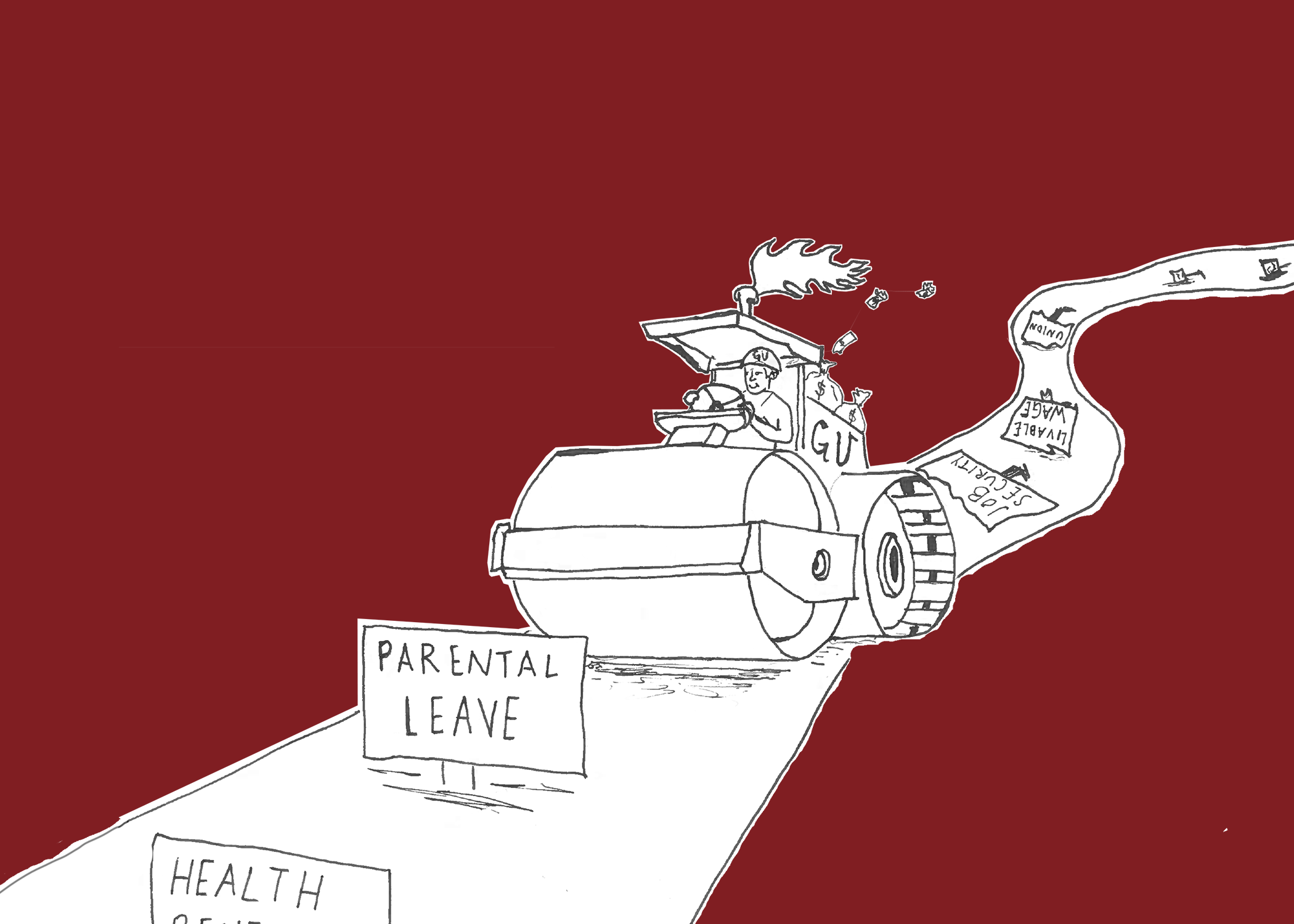
Last summer, Georgetown decided to hire current custodial staffers as Georgetown employees rather than as subcontractors, cutting employees’ pay by $4 per hour and stripping them of seniority benefits accrued over as many as four decades of loyal service to the university. Employees were given no advanced notice of the policy change and its implications, putting them in a precarious financial situation in a single moment.
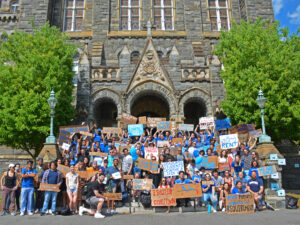
Students have protested this action, with a Feb. 24 protest in Red Square and a petition that garnered over 300 signatures and support from 19 campus organizations.
However, the fact that workers’ rights remain under university attack, two decades after the hunger strike, is a shameful blight on Georgetown and a sign of its misguided priorities. For any invested members of Georgetown’s community, from Jesuit clergy members to alumni, continued support for the university must be contingent on labor justice. This editorial board wants no part in an education that rests on worker exploitation and greed.
New advocacy on behalf of custodial workers follows a months-long campaign against Georgetown administrators’ outsourcing of Georgetown University Transport Service (GUTS) shuttle drivers. This organizing enjoyed a brief moment of success in December 2025. However, the university promptly responded in January 2026 with what can only be described as a retaliatory and punitive policy change, forcing GUTS employees to start and end their days thirty minutes from Georgetown University in Hyattsville, Maryland. Over 1,100 students signed a petition in support of the drivers—yet, evidently, that did not stop the university from continuing to treat drivers contemptuously.
Although these abuses are some of the most egregious and well-known on campus, examples of carelessness and hostility towards workers are prevalent across departments. Adjunct faculty, who make up nearly half of Georgetown’s instructional employees, continue to fight with the university for a livable wage. This reflects a similar challenge made by graduate student employees to get fair compensation in 2023, which the university also fought. Meanwhile, the university introduced unexpected policies for resident assistants (RAs) at the beginning of the 2025-26 school year, which had significant implications for their work schedules and responsibilities, such as requiring more RAs to remain on campus during holidays.
These groups’ ability to unionize and bargain with the university is a minimum. The real question is why must employees negotiate with Georgetown for a living wage and fair working conditions at all?
The university will try to justify its abuses by citing its own financial troubles, but this is entirely inappropriate and counterfactual. Georgetown’s spending does not reflect a university that is floundering. As long as Georgetown’s executive leadership is earning seven-figure salaries, no one employed by the university should be experiencing financial insecurity. Students, faculty, and staff are the foundation of any educational institution—they must be the priority.
Rather than investing in an artificial intelligence program with dubious benefits, Georgetown should ensure its employees are treated exceptionally. After Georgetown’s fifth tuition increase in five years, this editorial board believes many students would rather see their tuition dollars fund the salaries of those who work to make our college years great, not a Google Gemini subscription or even a substantial investment into the Capitol Campus.
Any acquiescence by the university should never be taken as a sign of graciousness. Just treatment for workers is not a privilege but a right, and it should not take the action of students and workers to compel the university to uphold its end of the deal. Georgetown must not only meet its employees’ demands in various ongoing negotiations but also adhere to policies of just employment in perpetuity.
If Georgetown is to improve its treatment of workers, it must stop seeing itself as a company, even if that means removing administrators who cannot see it otherwise. Executives have proven time and again that they do not see Georgetown’s staff as equals. Chief Operating Officer David Green was the architect behind GUTS’s outsourcing. Vice President of Planning and Facilities Management Lisa Belokur oversaw the custodial staff’s pay cuts and custodial workers have identified her as responsible for policies that created hostile work environments. Unless they can learn to stop treating workers as resources, they do not belong at this university.
Labor abuse cannot be tolerated at Georgetown. The university cannot act as a moral and intellectual leader in the District and the country while simultaneously treating those it employs with disdain. The community of students, alumni, Jesuits, donors, and other stakeholders should repeatedly remind the school that it cannot have it both ways. Georgetown, we are watching.