

After WGTB Georgetown University Radio’s equipment failed unexpectedly last semester, Georgetown’s only student-run radio station went silent. After four months of troubleshooting, the station returned to the air in mid-February, ready to prove its importance on campus as both a club and a community.
For members of the station, the revival marks the return of a space for student creativity, connection, and pre-professional opportunities in the arts.
“Radio is really important within the Georgetown community because music is something that I think a lot of people listen to, but they don’t have an opportunity to engage with it all that much,” WGTB Board Member Cristina Gomez (SFS ’27) said. “I think radio is a very low-stakes way to sort of tap into that part of yourself that you may not be able to anyway.”
The station values the support it has received from the Georgetown University Center for Student Engagement (CSE), Georgetown University Student Association (GUSA), and the Media Board. Still, current WGTB leadership believes the university’s overall support for radio is lacking.
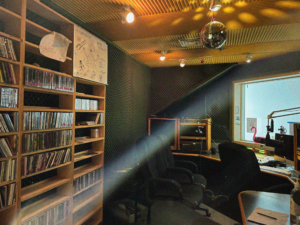
When the station’s 20-year-old Windows desktop computer failed and the server malfunctioned last semester, WGTB relied on alumni donations to purchase tech upgrades and had to enlist a live-sound expert from George Washington University to diagnose and repair the setup due to the station’s lack of technical support.
“It certainly would have been nicer if [WGTB] had someone dedicated at Georgetown who could have helped us,” Paulk said. “There are a lot of hoops you have to jump through to get someone from outside of the university to come in and fix it.”
Thanks to WGTB radio alumni donations, the station plans to pursue a studio-wide revamp over the summer, including buying a new $8,000 soundboard to prevent future broadcasting disturbances.
Over its 80-year run, WGTB’s presence on campus has been a source of controversy. Founded in 1946 by Rev. Francis J. Heyden, S.J., as an AM station broadcasting Latin Mass to shut-ins in the District, it transitioned to FM in 1960 after the university obtained a license.
In the 1960s and into the 1970s, the station built a following across the D.C. area for its alternative rock programming and progressive political leanings. These positions frequently placed the station in conflict with university administration, alumni, and even the Federal Communications Commission (FCC).
In 1971, the station shut down for eight months due to complaints from Georgetown’s Physics Department that the station’s transmissions were interfering with their equipment and experiments. That same year, the station’s radio tower was blown down due to “inclement weather”—however, DJs at the time suspected administrators had tampered with the equipment to disrupt its programming. In 1973, the station’s broadcasting of John Lennon’s song “Working Class Hero” led to its first of six complaints from the FCC due to the song’s mentions of religion, sex, and explicit language. Georgetown’s termination of the station’s manager, along with WGTB’s license remaining unapproved by the FCC, led the station to shut down in March of that year.
In 1979, then-Georgetown President Rev. Timothy Healy, S.J., donated the station’s 6,700-watt signal and license to the University of the District of Columbia for one dollar. WGTB staff attempted to block the transfer but failed, ending WGTB’s original broadcast run.
Students revived the station in 1982 as WROX-AM, and by 1985, it reclaimed the WGTB name. The studio moved from the basement of Copley Hall to the Leavey Center in 1996, where it has remained for the past 30 years.
Following the semester-long break, audience engagement on the station’s Instagram page declined compared to previous semesters. Still, WGTB has launched several collaboration initiatives to rebuild its presence on campus.
“We are working on a collaboration with Hoya Hospitality,” WGTB General Manager Lucy Johnson (SFS ‘27) said. “We’re also working with some Corp locations, like we’ve been playing in Uncommon Grounds a lot.”
Beyond expanding broadcasting locations, Johnson mentioned that the station is working with Echo Stage to secure free concert tickets for student giveaways, including shows by Two Friends, Gryffin, Alan Walker, Subtronics, SIDEPIECE, Timmy Trumpet, and Galantis, and discussions about an interview with the Philadelphia Phillies.
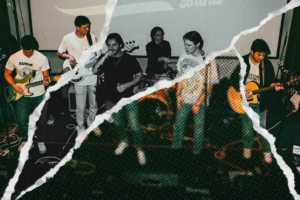
Through Instagram, the station promotes its events and opportunities. WGTB is currently preparing to host its annual Spring Concert on Sunday, March 15, with Georgetown indie band m.e.n opening for indie rock artist Eliza McLamb.
At a university where it can often feel like finance recruiting, coffee chats, and the race to the ideal resume dominate daily life, WGTB says they offer a way to combine creative pursuits with transferable skills.
Cawley Career Center data from the class of 2024 shows that the top three post-grad industries, financial services, management consulting, and healthcare, accounted for 36.57% of graduates. With more than a third of students going into finance or healthcare post-graduation, WGTB bridges a gap for students interested in pursuing a career in the arts while offering a low-pressure creative outlet.
For those interested in deeper involvement, the station offers writing workshops, DJ training, and behind-the-scenes roles such as logging physical media, creating entry points for students with varying levels of interest in radio or the arts.
“It may not be consulting, but we’re also pre-professional in a way,” Paulk said. “We are press passing for Union Station and the Anthem, we’re talking to so many people in artist management right now about our Spring Concert, and so there are opportunities for pre-professional careers in the arts, you just have to be involved.”