


On March 17, 2025, Badar Khan Suri, a postdoctoral fellow at Georgetown, finished a typical day of teaching. After staying behind in the classroom for a while, he went to the dining hall for iftar, the meal where Muslims break their fast during the holy month of Ramadan. He then took the GUTS bus to his home in Rosslyn, Virginia.
On his walk home, a car started following him. He kept walking. As he reached his doorway, a man with his face covered got out of the car.
“Are you Badar?” the man asked. Confused, Khan Suri told him yes.
“You’re nervous,” the man noted. Khan Suri was.
Then the masked figure told him he was under arrest, and that his “student visa” was revoked. Khan Suri wasn’t a student, he told the man, and as he asked why he was under arrest, more men arrived. He snuck his phone from his pocket and called his wife, Mapheze, who was upstairs with their three kids.
“She came running,” he recalled in an interview with the Voice. He asked her to get his passport. By the time she came back, Khan Suri was in handcuffs, being put into an unmarked vehicle.
“I didn’t dare to look at the windows of my apartment. Maybe my kids were seeing their father getting taken off and arrested,” he said. “I taught them that the police [are] for protecting good people. It is for punishing bad people, criminals and others. What will they think, that their father is going handcuffed with the police? Because they would not understand who these rogue abductors are.”
Khan Suri would not see his children for 58 days.
Khan Suri’s story
The Georgetown postdoctoral fellow’s story became national news after he was detained while in the U.S. legally on a J-1 exchange visa, issued to teachers, students, and scholars. A year later, after being released on bond in May, Khan Suri is still embroiled in a legal battle, as the U.S. government attempts to send him back to India.
In the year since his arrest, the lives of Khan Suri, his family, and those around him have fundamentally changed amid a backdrop of the Trump administration’s retaliatory immigration policies. Separated from his family for 58 days and thrust into the national spotlight, Khan Suri now fights for his ability to remain in the United States and his right to free speech.
Khan Suri was one of several non-citizen students and scholars across the country detained for speech critical of the U.S. and its relationship with Israel. Two weeks before Khan Suri’s detainment, ICE officials arrested Mahmoud Khalil, a Columbia University graduate and pro-Palestine organizer, with the Trump administration advocating for his deportation.
Two days after Khan Suri was detained, then-Department of Homeland Security (DHS) spokesperson Tricia McLaughlin wrote on X that Khan Suri was “deportable” because he was “actively spreading Hamas propaganda,” seemingly referring to pro-Palestine social media posts Khan Suri made on his personal accounts. She also wrote that he has “close connections to a known or suspected terrorist, who is a senior advisor to Hamas.”
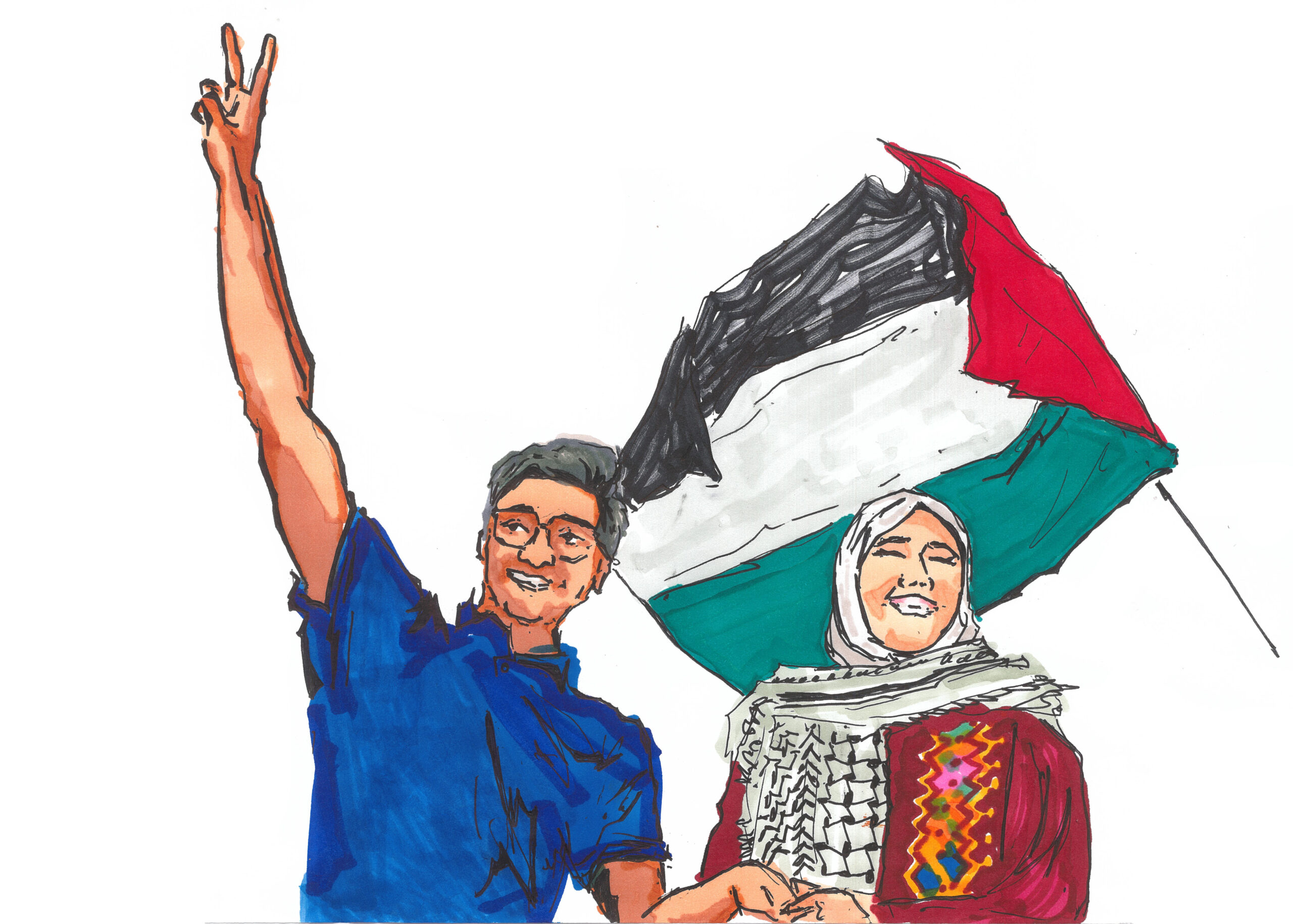
Khan Suri’s legal team alleges he was detained as retaliation for his support of Palestine and his marriage to his wife, Mapheze Ahmad Saleh (MSFS ’26), which fall under the freedoms of speech and association guaranteed by the First Amendment. Saleh is an American citizen who was raised primarily in Gaza. According to a 2018 interview with the Hindustan Times, Saleh’s father was a “senior political advisor” to Hamas. In late 2023 and early 2024, the couple was targeted online by pro-Israel groups like Canary Mission and CAMERA.org because of Saleh’s father, in what Khan Suri’s legal team has said amounted to “doxxing and harassment.”
In a legal filing in April last year, the U.S. government said it revoked Khan Suri’s J-1 exchange visa because they believe his “presence or activities in The United States would have serious adverse foreign policy consequences.”
Khan Suri’s legal team continues to deny any association between Khan Suri or Saleh and Hamas. His lawyers said in court documents that Khan Suri has only met his father-in-law twice in person, and that their telephone conversations were “infrequent.”
Khan Suri said that he was told by Immigration and Customs Enforcement (ICE) officials during his detainment that “someone very high at the Secretary of State’s office did not want [him] to be in the country.”
Khan Suri’s lawyers, family, and other community members said that his detention raises questions about the erosion of free speech under the Trump administration and highlights attacks on pathways for international scholars.
The immediate aftermath
The night Khan Suri was detained, Nader Hashemi, the director of Georgetown’s Alwaleed Center for Muslim-Christian Understanding (ACMCU) where Khan Suri works, got a call from Saleh. She was panicking, saying “they took Badar,” he recalled in an interview with the Voice.
“It took me a few seconds to click in what she was trying to say, because we already had the arrests of Mahmoud Khalil, and I believe before that, Rümeysa Öztürk, and there were other students who were on visas, or people who were not full citizens who had been arrested. So it just hit me: ‘Oh my God, he’s been arrested,’” he said.
Hashemi spent the next 48 hours securing legal representation for Khan Suri. Two days after he was detained, Khan Suri’s lawyers filed a petition alleging that the Trump administration violated his free speech rights under the First Amendment and right to due process under the Fifth Amendment.
Meanwhile, on the night ICE detained Khan Suri, he was moved to the ICE Washington Field Office in Chantilly, Virginia, then to the Farmville Detention Center in Farmville, Virginia.
Even amid the transfers, teaching was front of mind. At Farmville, an officer told him that the facility had internet, tablets, and a library.
“Will I be able to call and teach my students for two and a half hours a week?” Khan Suri asked in response.
It wouldn’t matter, because ICE moved Khan Suri to a facility in Richmond, Virginia, before flying him to a detention center in Alexandria, Louisiana the next day.
Two days after Khan Suri was detained, the news broke online. Komal Samrow (SFS ’25), who had sat in his class just hours before he was arrested, was stunned.
“I remember just the pure shock of finding out,” she said in an interview with the Voice. “It was really, really hard to believe because again, we had just seen him a few hours earlier, you know, laughing, smiling, joking around in class, having these great discussions like we always do.”
A day after his arrest went public—March 20—a federal judge ruled that Khan Suri could not be removed from the U.S. Still, he was soon moved to Prairieland Detention Center in Alvarado, Texas. He would not leave until May 14.
“I couldn’t get what was happening,” Khan Suri said. “A few moments back, I was with community enjoying an iftar, and before that, I was at Georgetown University teaching my students.”
In Alvarado, his lawyers alleged he was not given a bed or a pillow, and was also not provided proper religious accommodations like halal food options or a Quran. The detention center was crowded, he said, and people were “coming and going” every day.
In the months following, Khan Suri’s legal team submitted hundreds of pages of filings, attempting to get him released on bond. For his lawyers, this case was unique.
“I have never represented somebody who was directly retaliated against in this manner with immigration detention,” Sophia Gregg, an attorney with the ACLU of Virginia, told the Voice. “I have represented many people who are unlawfully detained for other reasons, but not because of their protected First Amendment speech or association.”
As Khan Suri sat in detention in Texas, Saleh was at home with their three children, now a single parent.
“I tried to hide the truth from our children because I did not know how to explain something so painful to them. Whenever they asked where he was, I told them he was traveling,” she explained in an email to the Voice. “They would look up at the sky and ask me, ‘Is Baba missing in the sky?’”
Eventually, their then-nine-year-old son overheard a conversation between Saleh and one of Khan Suri’s lawyers. That was when he realized that his father was in jail.
He stopped talking after, and would cry in his sleep.
“As a mother, watching your child struggle like that is incredibly painful,” she wrote.
A school grappling with his detention
On campus, Hashemi, the director of the ACMCU, was tasked with restoring a sense of security in the department that had been lost with Khan Suri’s arrest. Locks on the doors of the department were changed, and a camera was installed outside.
He also needed to find someone to teach Khan Suri’s students, trying to make sure that his departure didn’t disrupt their education.
Samrow and her classmates continued to go to their class, Majoritarianism and Minority Rights in South Asia, on Mondays, now taught by SFS Chair of Islamic Civilization Jonathan Brown.
“We were a class of only five students. And you inevitably become tight-knit,” she said. “We were all pretty jarred.”
While learning about repression of freedom of speech and minority rights in India, Samrow was struck with anxiety that her professor could be sent back if his trial did not go in his favor. Khan Suri had originally moved to the U.S. from India out of fear of retaliation for his research, his students said.
“To be constantly living with the idea that he could potentially be deported to India, where his freedom would be under threat for the research he engages in, was a really troubling thought, because it made a lot of the implications of what we were studying that much more real,” she said. “There is a reason why he doesn’t go back to India. There’s a reason why he doesn’t feel safe there.”
As Khan Suri was on Samrow’s mind, she and her classmates were on his.
“Even when he was in the detention center, he used to ask about his students and how they were doing,” Saleh wrote.
In April, Hashemi boarded a plane to Texas to visit Khan Suri. He had had no visitors yet. Speaking to Khan Suri through a glass barrier, he tried to comfort him.
“[I] just tried to reassure him that we’re doing everything that we can to help him. Told him about what’s going on at the university, reassured him that his wife and kids are being taken care of,” Hashemi said.
Khan Suri also told Hashemi about what he was doing in jail. He’d earned himself the nickname “Ghandi,” as he spent his free time explaining Ghandi’s teachings to other incarcerees.
In an interview with the Voice, Khan Suri compared his time in prison to the story of Joseph in the Abrahamic religions, who was imprisoned in Egypt after his brothers abandoned him. His salvation was his faith in God, who rewarded him with great fortune and the ability to save his family.
Khan Suri prayed often. Still, he questioned why God would give him this fate:
“Why would God have wanted this for me?” he recalled asking. “I have done nothing bad.”
Khan Suri’s release
Federal judge Patricia Tolliver Giles delayed her ruling during Khan Suri’s May 1 hearing, requesting more information from the federal government regarding his detainment.
During the hearing, Trump administration lawyers had alleged Khan Suri’s case should not be filed in the district court for the Eastern District of Virginia, as Khan Suri was detained in Texas. The Trump administration likely advocated for this in order for the case to go before judges more sympathetic to their case.
On May 6, Giles ruled that Khan Suri’s case should stay in Virginia, as prior cases set the precedent that when a detainee’s location is unclear, the case should be tried where the petitioner was detained.
On May 14, as Saleh, Hashemi, his lawyers, and many of his students sat in the courtroom, Giles ordered Khan Suri’s release on a $0 bond. Giles ruled that his release posed no risk to those around him and that he was likely to succeed in his argument that his detention was an unlawful retaliation for free speech. His lawyers were waiting outside Prairieland Detention Center in Texas to bring him home.
It had been 58 days since he had been detained outside his Virginia home.
After reaching an agreement with the federal government to reinstate his legal status while his case continues, Khan Suri returned to campus in fall of 2025 to teach again. Having been reunited with his family, getting to teach was a huge part of returning to his daily life.
“Georgetown became like a home for him. He cared deeply about his work and his students. I remember how dedicated he was. He would wake up early and often stay late at his office because he truly loved what he was doing,” Saleh wrote.
His new group of students became incredibly tight-knit, just like the spring cohort, a fact they say is due to Khan Suri’s teaching style.
“He really is just such a nurturing person, I would say he feels almost like an uncle or a father to us in that regard,” Nick Hasburn (CAS ’28), one of his fall semester students, said.
At the end of the semester, Khan Suri invited his students to his house for dinner with his family. Saleh cooked dinner, and they played with his kids. There, the class presented Khan Suri with a “Best Hair” trophy that he still has in his apartment.
His students aren’t afraid to poke fun at him, though, and he is not afraid to poke back. Izzy Volpe (CAS ’28), who became close with Khan Suri and his family after taking his class this fall, said that she always begs him to “slow down” because he’s “so smart” that she can’t always grasp what he’s saying. When she eats dinner at their house, he makes fun of her for “eating like a bird.”
“He laughs a lot,” Volpe said. “He will sit down with us while we color with his kids; he’ll laugh with his kids.”
Student support
Wanting to help their professor, his students have organized a series of events to support a GoFundMe started by Hashemi for Khan Suri’s legal fees. In February, Hasburn, who is a part of several bands on campus, helped host a solidarity concert to fundraise. Beyond raising over $3000, Hasburn said the event was an important way for Khan Suri to interact with the community.
“People got to actually meet him and put a face to a name,” Hasburn explained. “Being able to connect with this person and put a face to a name […] that is all the more important.”
Volpe has been helping run bake sales to raise money. Currently, the GoFundMe has raised $46,000 of its $70,000 goal.
“Between legal fees, consultations, and the ongoing work required to defend his case, the expenses continue to grow,” Saleh wrote. “Without the financial support of others, it would be incredibly difficult for our family to keep up with the legal costs required to defend him properly.”
Reflections, a year later
A year to the day after he was detained, Khan Suri sat before a panel of judges in Richmond, Virginia, as they heard his case. The debate between his legal team and the Trump administration’s lawyers still has to do with whether he can have separate hearings regarding the legality of his detention and his immigration status.
“Even though he was released, the case isn’t at its conclusion,” Gregg, one of his lawyers, said. “We didn’t reach the actual final decision on whether or not his detention was illegal.”
Khan Suri’s case has been incredibly rewarding for Gregg, in part because she believes he is someone who truly believes in the ideals of freedom and liberty that the case is about.
“It made the work that we do on behalf of him so much more rewarding, because it feels like we are helping somebody who’s in lockstep with our ideals on a more peaceful society,” Gregg said.”Unfortunately, sometimes the most educated, intellectual, movers for change and thought leaders, are the ones who are targeted by the government in order to suppress those ideas.”
Looking back on the past year, Saleh said that her experience has taught her to lean on her community and continue speaking out, even in the face of grave threats.
“The support we received from friends, neighbors, and members of our community reminded us that kindness can make an enormous difference during moments of crisis,” she wrote. “Most importantly, I would tell myself not to allow fear to create silence. Everyone has the right to speak about justice, dignity, and human rights. Even in difficult circumstances, I believe it is important to hold on to those values and continue believing that fairness and truth will eventually prevail.”
Moving forward, his student, Samrow, says that Khan Suri provides her with a model for resistance.
“I remember even when he taught the class, he was a very infectiously funny and optimistic person, and even in the way he talked about this really difficult stuff,” she said. “And I think he’s someone that understands the value of resisting and pushing back and being vocal, even in the face of these powers who try to silence people like him.”
Despite it all, Khan Suri said he feels overwhelming gratitude.
“I am grateful to be at Georgetown, in the United States, where the people are great, and there is freedom of speech,” Khan Suri said.
A year later, he says there’s no way he could have ever prepared himself for his detention, a separation from his family, and ensuing legal battles. But, he said, it would have brought him comfort to know how many people would be in his corner.
“I would have told myself, you will have a lot of friends, your children will have lots of friends taking care of them, and you will have Hoyas supporting you,” he said.