

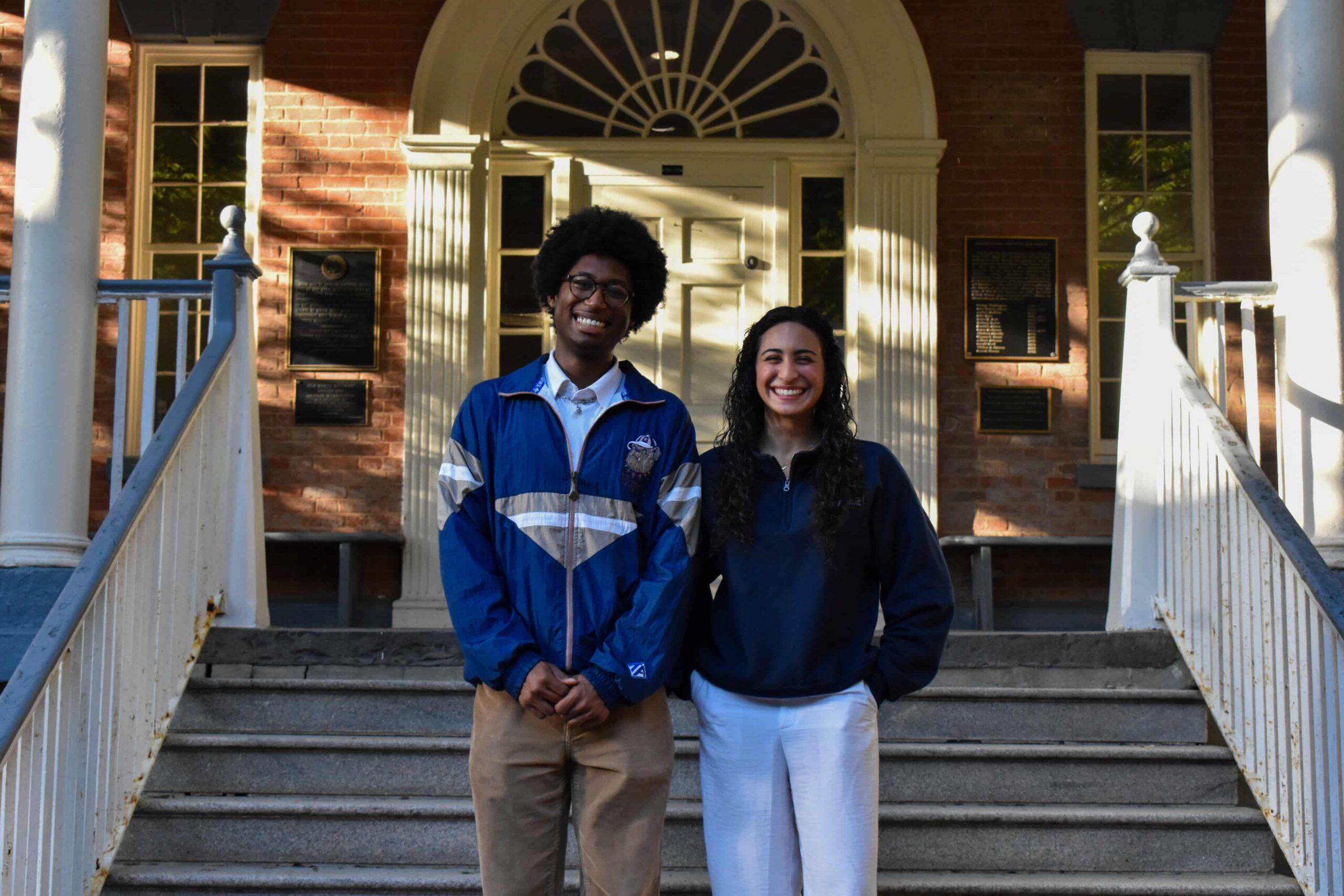

GUSA swore in President Darius Wagner (CAS ’27) and Vice President Nazgol Missaghi (CAS ’28) on Jan. 11. With just over two months of their term down, the team sat down with the Voice to reflect on their accomplishments and look towards their future goals.
This conversation was transcribed and edited by the Voice for clarity.
The Voice: So how have you guys felt jumping back into GUSA?
Wagner: To start, I’ve been surprised, to say the least. I knew coming in, that during my time as vice president, there will be great opportunities to continue some other issues that we’ve built in the past. I’ve been more surprised as to first, how efficiently our team has been able to really adjust and transition to start working on continuing more policy, and second, how some of the restored connections we had with admin are leading to policy successes that we thought might have taken longer, or would take more time to develop. So [we are] cautiously optimistic that we can continue building good progress, but rooted in all this is ensuring that we’re also finding new, innovative ways to inform the student body, to connect with the student body, and ensure that any policy issues that students are facing are being addressed through GUSA. We’re eager to keep continuing that work.
Missaghi: It has been such a joy to step into GUSA, and as we mentioned before, we were ready to hit the ground running. Everyone has been so incredibly welcoming, and the process to get integrated into GUSA and into our university reforms and just continuing forward has been so enlightening, and I am very consciously optimistic as well for all that we have left in the future. Our cabinet is so fantastic, but it’s been so great to get to know them, and Darius and I have taken special initiative to have our cabinet members and their deputies come all together and really get to know the faces behind who is doing what work.
The Voice: You guys have an interesting relationship. One of you is a GUSA vet, and the other is brand new to GUSA. How do you think your relationship works? How have you guys learned from each other and mentored each other?
Wagner: The benefit of our relationship is grounded in the whole spirit of Georgetown. That sounds so dramatic, but in the sense that my ideas of the job don’t become stale, and that Nazgol brings a fresh perspective. One, from a different class year, and two, from a major that’s not often represented in GUSA or student leadership. And so, just the ability to ensure that we’re keeping our diversity points really out there, but also bring someone that has great talent into the fold and to really get adjusted to a lot of the policy and the walks and all the things that come with being in student government that can be exhausting at times. Just getting adjusted before, I think, keeps us on our toes and just keeps one thing really important; it’s just the institutional memory.
Missaghi: With Darius, he has always been very clear that even though he is a veteran to GUSA and was vice president in the past, we are always learning and we are always developing and we are always looking forward. Whenever he and I had our initial meeting, I asked him, “I don’t want to hear about what you guys are going to continue to do. I want to hear what you have done and how you want to continue to move forward.” And he answered every single question I had, and with such assurance and drive, that this is what we are going to do, because this is what we’ve already done. That brought me so much joy. I speak so highly of him, no matter what, no matter where we are, inside or outside of GUSA, because he has shown me what we can do, what the voices of students are able to accomplish. I really enjoy just taking a hold of what used to be his role and kind of make it my own in terms of figuring out new ways to contact admin, new ways to engage with them, especially as someone who was outside of GUSA beforehand, and really use that as a driving factor to connect with our new cabinet members and explain to them that we’re all learning and we’re all here with one common goal.
The Voice: Is there anything you can tell our readers about the new HoyaLift program, which will provide increased accessibility up and down our hilly campus?
Wagner: We’re working with the [Academic Resource Center (ARC)] currently to figure out the official language of how the program works, but certain students with an ARC accommodation will be able to access the program. We’re still figuring out the official details of it, and so I don’t want to say anything too definitively, but the parashuttle transits are there, and now it’s just developing a system to make sure that students with disabilities, and students with injuries—both long term and temporary—are able to access this service. And then, looking forward to the future, OTM wants to sort of create a similar style platform such as LiveSafe, where it’s easier to call something like a SafeRide. So now it’s in the early stages, but we’re pretty excited. Since 2019, this is years of people who’ve been invested, who have done the hard work. With this new OTM director, we’re able to get it going with somebody who’s worked on it at a previous university. So it’s great news. Huge win, you know, just for students with disabilities making this hardly accessible campus more accessible.
That continues on to our policy of working with facilities to find ways to improve communication around elevator outages, particularly around those buildings with single-use elevators. I’ve known many friends who weren’t able to attend class for two weeks because of the elevator outages. We had four days off of school for snow. For some people, that was the reality for any of their classes they have in Walsh, and so working to improve communications with facilities and find more ways to improve accessibility has also been sort of a center of our platform in other ways. Facilities has hired a new communications director, who we’re hoping to sit down with next month. That way they have somebody dedicated to finding ways to continue to improve communications around facility updates. There were some improvements that we’ve seen already with the email to Nevils residents about maintenance times. Small things like that, you know.
The Voice: Are there any short term goals that you guys are excited about?
Missaghi: So, speaking of small things that make a big impact. I know we’ve all heard the recent unrest with all the policies out there impacting our RAs and, in turn, impacting residents and student life as an extension of that. And so we are really utilizing GUSA comms with the Office of Student Conduct. We met Dr. Rowe for an hour, just about how we could have steps to implement clearing up citation procedures and clearing up misconceptions that have been passed from student to student. Because, let’s be real, whenever students hear that they have been written up, they’re not going to directly go to the adults who are at the head of the process. Their immediate reaction is to go to their peers and figure out more information before they even consider going to Dr. Rowe, for example. Dr. Rowe is an incredible person, and she has been so lovely to work with, and so we really are looking forward to coordinating with Dr. Rowe to increase visibility as well as facetime engagement. Putting her face out there so students know that she exists, and potentially bringing her to a town hall with a couple heads of facilities, transport, dining, just so students have a space to ask questions, have their questions be answered, and again, see the faces of the people who are helping us make these changes to make campus better.
Wagner: To give a few more specifics, post November, there have been some practice changes that have dramatically reduced the number of citations. Additionally, the Office of Student Conduct confirmed to us that they had been dismissing other cases of citations that they felt were not applicable to conduct violations. They constantly share with us that students that go into their office often leave with a different interpretation than they have coming in, because of the contents and discussions that they have with the OSC. That’s a huge component of our referendum, so we really want to make sure that we’re finding ways to communicate that to the student body, to make sure that we’re addressing needs.
Long term, we’re still working on pushing back weekend quiet hours, but there’s a few other short term things that I think are also exciting. The provost will be hosting a tuition setting roundtable this March, where students will be able to share notes about tuition setting and how the rates are impacting them. Additionally, the ICC cemetery door will be open Saturday and Sundays from 8 a.m. to 8 p.m. because we have worked with the VP of safety. In Hayden and Byrnes, if you live on campus and try to scan into the elevator you’re not allowed to go. Turns out that was a glitch. And so we’re now going to work with the new residential living director, Chad, to make sure that that glitch is fixed and that students who live in Hayden and Byrnes enjoy the same privileges as students who live elsewhere.
Additionally, we are also in the process of securing a sort of beauty bank machine that is operated by a local D.C. business. More details of that will be shared soon. But they are in the process of submitting a business proposal. This is in response to the Voice article last fall, particularly around access to black hair care in Georgetown. They operate at AU and Howard as well. We just reached out and said, “Hey, what’s it like to get this here on campus?” And so we’re working on that. More long term, especially with transit, we’re working on getting GUTS on tracking systems, there may still be a possibility we can get a queer affinity house by the semester, but I’m very cautious about that, but we’re currently in development of a proposal. So it’s been a pretty busy month.
The Voice: It’s obvious that GUSA is a massive time commitment. What’s it like trying to balance classes, clubs, and career goals while trying to lead student government?
Missaghi: I can kick us off with that, because I am pre-med. I’m President of the Iranian Cultural Society, and there’s been a lot of political unrest in Iran so we’ve been running a bunch of fundraisers for medical kits for those who are injured during protests. I’m an undergraduate research assistant with a laboratory, and I’m taking that research for credit, and that means that I have to dedicate a set number of hours in the lab. I do social media for our College of Arts and Sciences, and so there’s a number of hours for that, as well as being a leader for FOCI, and that has its own set of time commitments. I would like to say that a lot of it is planning ahead, and it’s thanks to our incredible cabinet members that we are able to plan as far ahead as we’re able to. But that’s the keyword, as we’re able to. A lot of these meetings, especially the one with facilities, transport, and dining, were planned the night before. It was 30 minutes, early in the morning, and we had three meetings right after. A lot of it is just, “Darius, are you able to go? If you can’t, I’ll be able to go.” And then if neither of us are able to go—which is very rare—Allie, Ignacio, everyone is willing to put in the work, everyone is willing to put in time. And every little slot in between classes, there is stuff to be done, and we’re ready to do it. Just to end, it’s all about doing what you love, and I lead with that, and I end with that, because every single thing that I’m doing is because I want to, and because it’s bringing you joy, and because it’s bringing joy to the people around you, and that’s what’s the most important.
Wagner: It’s tough. It’s tough at times. Friday I don’t have classes, but like six meetings on a no class day. Like, just to be blunt, yeah, at times it is a bit tough. There are many students out there who do incredible things, balancing life stuff, class work, career work, and so it’s a bit similar. I think one of the more pressing things is that, when in this position, you just care about the community around you and Georgetown. I personally don’t ever feel resolved, because I think there’s something that’s always going on, somebody’s always sharing, somebody who can always benefit. Definitely that stress complied with academic stress at times is tough. I think it keeps bringing me back to the fact that we’re able to see these changes and make these changes to just help students day to day lives. And I think that’s just a good motivator. Yeah, some nights I have squeezed in assignments that I should have actually prepared a little longer for, but it’s worked out so far, so I’m not going to complain about that. Georgetown is a “work hard” campus and so, we’re very keen on ensuring that bottom line, make sure that your personal is okay. We only have college for four years, you have the rest of your life to work. So you also want to balance, make sure I’m having my time with my friends and things like that. And so it’s tough, but I think being vice president helped make it work a little better. After all these developments, there’s progress behind the time we’re putting in, so that gives you gratification.
The Voice: Besides our GUSA news briefs, where can students find information about GUSA’s progress? And how can students get involved?
Wagner: Definitely follow our Instagram, @gusassociation, and check out our bi-weekly newsletter that has a lot of good, detailed information both from us and the Senate. Some of the information is dense, I will preface, but it’s worth reading (thank you Otto and thank you to our communications team for doing that!), and so those are two great ways to stay in touch with us. One of our goals this semester is to keep pumping out content and information as we get more information, but those are the two places you can find us. You can find me on my email, and we also have a GUSA email too. For any collaborations or clubs that are interested, please email GUSA.