

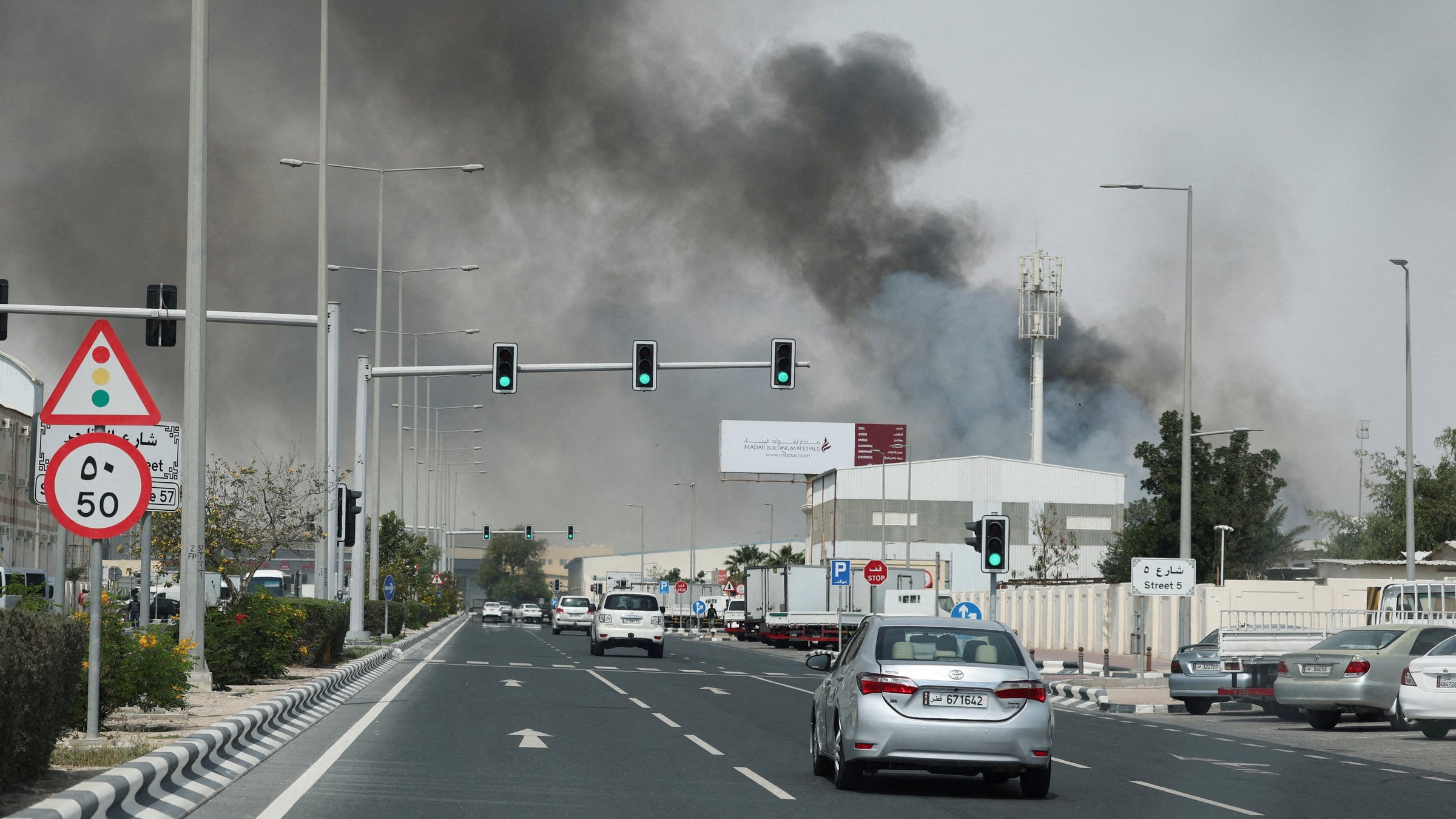
It’s raining in Doha. A rare thing—this city is a desert year-round, other than a few weeks of cold breeze. By this time of year, it is usually already hot, the kind of heat that makes you forget March ever happened. But today, April 2026, the rain is knocking at my window like it has somewhere to be. Part of me realized it’s not an April Fool’s joke, the strike warning on my phone, the third Gulf War, all of it. My phone beeped this morning: not my alarm, but a strike warning. I lay there thinking: Can they not fight this out in the summer? We’d all be inside then anyway.
On Feb. 28, 2026, Trump and Netanyahu launched strikes on Iran without congressional approval, bypassing Article I of the Constitution, which gives Congress the power to declare war, not the president. No vote and no debate, just silence. Iran retaliated with missiles and drones across the region, and what began as someone else’s decision landed in our backyard—in Qatar, in the streets of cities that had nothing to do with this calculation.
I have stopped counting the days since this started. It is just a waiting game now, and we are all standbys.
I am 21 years old. This Gulf War has not chosen to miss me. My grandfather’s generation experienced the first. My father, the second. And now there is a third, and I have inherited the wait. Somewhere on the other side of the world, at the same university’s other campus, someone is grabbing a matcha from Maman, a bagel on the run, and scrolling on their phones without a single notification about where to shelter.
Once, I lived that lifestyle during my exchange semester at Georgetown’s Hilltop campus in the Fall of 2024. Then, I watched classmates grieve Kamala Harris the way you grieve something that was supposed to be yours, a democracy that looked like them, that included them, that meant something for them. I believed in that grief. I was there for it.
Now I am back in Doha, while the same people who wept for democratic norms in November watched those same norms get bypassed in February. Trump decided to wage war with no congressional vote, with no debate, and yet, Americans found a way to look past it. The principle was never the point. To them, democracy is worth mourning when it fails people who look like them. When it fails others, it becomes foreign policy.
Trump later admitted he avoided the word “war” precisely because, as he said: “You’re supposed to get approval.” He knew it was illegal. He chose to do it anyway. Let me be clear: a congressional vote would not have made this right. The illegal process is not merely the problem; it is the realization that this region was collateral before the first missile launched, and would have remained so regardless of what any chamber voted.
This is not the first time Georgetown students have had to reckon with a war their government started without their permission. But it may be the first time that war landed in the same city as their classmates. We are not a distant cause. The geographical distance between Georgetown’s main campus and their campus in Qatar should not be treated as a moral distance. And American students have crossed harder distances before to stand on the right side of history.
During the Vietnam War, campus movements pushed Congress to pass the 1973 War Powers Resolution, a direct legislative check on executive war-making. Those students did not wait for permission to name what was wrong. During the anti-South African apartheid movement, student divestment campaigns swept American universities, forcing institutions to confront their complicity in injustice. In both cases, students acted because some are too wrong to wait out.
Whatever happened to holding truth to power? Historically, Georgetown students have forced their institution to face what it would rather not. In April 2024, Georgetown students marched down M Street to join a solidarity encampment at GW, demanding divestment and an end to complicity in genocide. The faculty locked arms around them. In 2019, students voted to fund reparations for the 272 people the university sold into slavery in 1838. That is the Georgetown I know. That Georgetown also has a campus in Qatar, where its students are waking up to strike warnings on their phones.
The U.S arrives here in many forms: through Netflix, through music, through universities like Georgetown, built on the promise of a school that celebrates being ranked first in the world for its international relations programs. We grew up in your culture. We chose your institutions. America has long enshrined the empire as a value in its foreign policy, in its military presence, in the silence of its institutions when the prices are paid by people far away. Americans at-large did not choose that inheritance. But you benefit from it. And that means you have something we do not: the ability to turn and face it. We can name what is being done to us. Only you can change what is done in your name. This is not a question about what America means. It is a demand that you decide what it will mean, and that you show up accordingly.
The students who graduate from GU-Q and walk into foreign ministries, think tanks, and policy offices will carry with them not just the memory of a place that welcomed them, but the memory of missiles in the sky above, of strike warnings on their phones at 7 a.m., of a war that arrived without anyone’s apology. A war was launched illegally, targeting a region where your own classmates live. Where is Georgetown in this war?
And even if you will not march, even if this region feels too distant or complicated to be your problem, consider what is being done in the name of your country. Your democracy is being jeopardized. Wars are now launched without your vote and without your consent.
The world has watched the genocide in Palestine, the systematic killing, the forced displacement, the weaponized starvation. This genocide is not a conflict, but a colonial project, decades in the making, that has always relied on the erasure of Palestinian humanity. Zionism as a political movement has functioned from that erasure—the logic that one people’s return requires another people’s removal. International law has named these acts as crimes. The ICC has issued warrants for Benjamin Netnyahu’s arrest and Yoav Gallant.
Yet on Feb. 28, the United States chose to go to war, illegally, maintaining their colonial project. That is what this war is: when superpower nations are complicit in ethnic cleansing. Israel’s immunity from accountability is not America’s burden to carry. And yet American lives, dollars, and constitutional norms have all been sacrificed to maintain it. You were not consulted. Neither were we. The least you can do is start asking why.
We are fellow Hoyas, and we are asking you to question what you have been told. Not to adopt our narrative, but to interrogate yours. Ask who funds it. Ask what it leaves out. Ask why some lives generate vigils and others generate statistics. Ask why never again comes with exceptions.
The rain is still knocking at my window. I hope the beauty outlasts what is coming.