

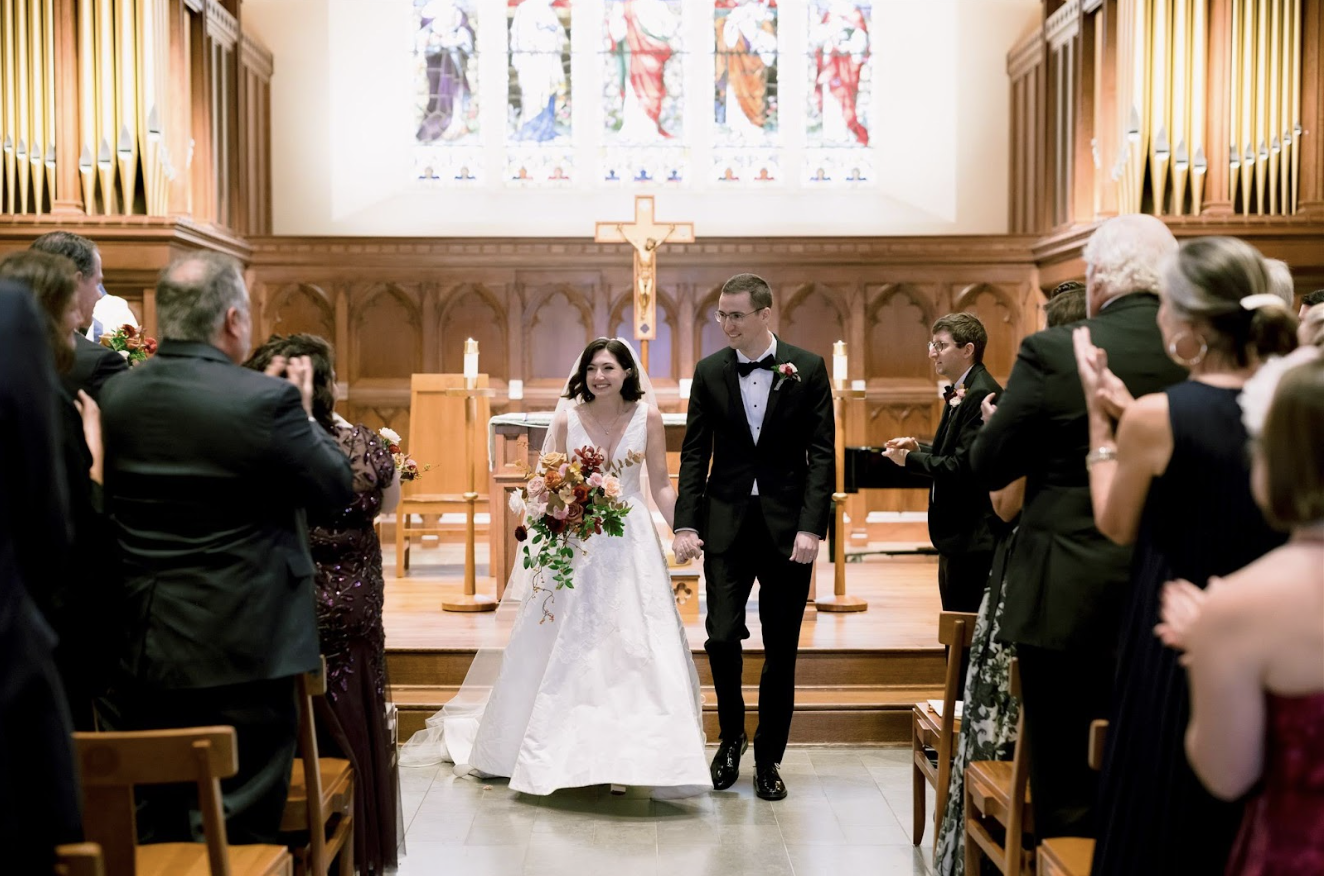
James Murray (CAS ’89) was merely doing a favor for his friend by replacing a whiteboard for a girl named Sarah, who happened to live in VCW, the same dorm as him.
This act of kindness in September 1986, unbeknownst to them, would set off a chain of events, including shared classes, typed papers, and a first date at Mr. Smith’s, that would eventually lead to a happy marriage of more than thirty years and three Hoya children, including me.
“[Having] the kind of shared experience, as teenagers, always helps the bonding experience with all college students, but in particular with Sarah,” Murray said.
Behind the clock and seal of Healy Hall stands a little brick chapel built in 1893, bringing Hoyas together for decades. Since its dedication, Dahlgren Chapel has united generations of alumni in wedding celebrations, and for many, it has come to symbolize how Georgetown impacts the people who pass through it.
Dahlgren is the chapel most often tied to the rumored statistic that 70% of Hoyas marry other Hoyas. While the real number likely hovers around 7%, according to the Georgetown Alumni Records office, the university has long taken pride in the love stories that have flourished here.
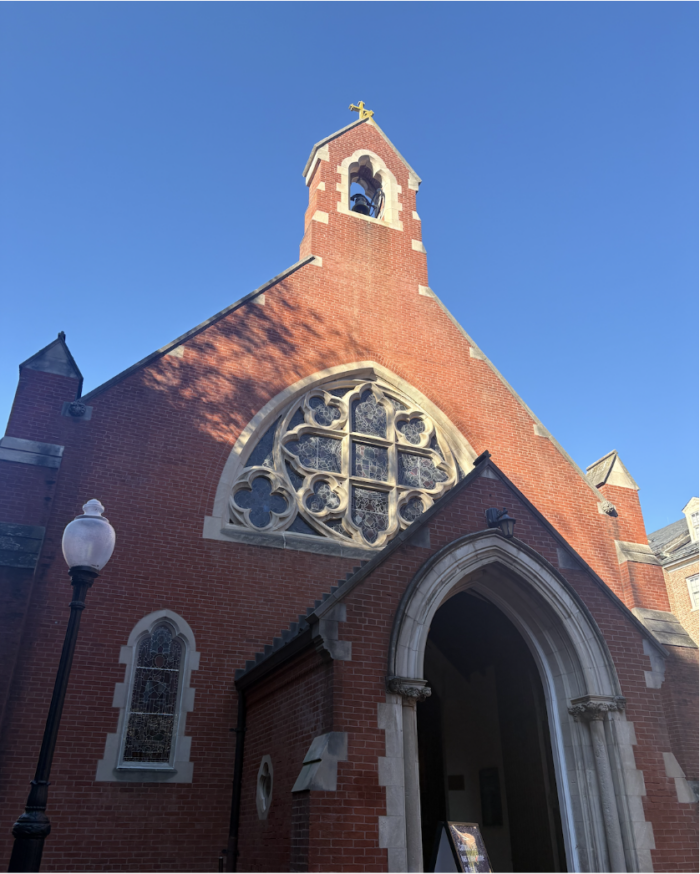 Photo by Clare Murray
A newer reunion tradition makes these marriage statistics visible: each year, slideshows celebrate the Hoya couples in attendance, reinforcing the ethos of commitment and family at Georgetown.
Father Peter Folan, a Jesuit priest and assistant professor in the Department of Theology, has assisted in one wedding at Dahlgren during his seven years at Georgetown and will perform another this fall. He believes the university purposely fosters lasting and committed relationships of all kinds, whether platonic or romantic.
Dahlgren sits at the geographic and symbolic heart of campus. While not entirely by design, it represents the values, such as generosity and love, that Georgetown hopes to form in its students.
“I hope the formation that we’re engaging in here is a formation that’s helping you all more deeply embrace your humanity, is putting at the heart of your lives, relationships with other people, people here on campus, and then people whom you’ve never met,” Folan said.
For Folan, that formation is inseparable from how the university and students understand love.
“Love should be at the heart of not just marriages, but of course, of friendships as well, and different types of love and what love looks like in different ways,” Folan said. “That would strike me as being very much of interest to Georgetown students across the board and to human beings across the board.”
Folan expressed that Georgetown’s values, particularly kindness, generosity, and love, extend beyond Catholic teaching and into all religious teachings.
On marriage ceremonies specifically, Folan describes it as something palpable and communal.
“Matrimony in the Catholic Church is a sacrament. And think of a sacrament as something visible, something that is tangible, something in some way observable, that is trying to show the community, and then beyond the community, we hope, something about God’s life and who God is. You can almost imagine it showing the face of God from different angles,” Folan said.
He added that the commitment couples make in marriage carries meaning far beyond the ceremony itself. He described the resolution couples make to each other and the new life that it brings.
“We’re in this forever, you know, [there is] kind of a dissolution about this. And this marriage is going to be life-giving. Sometimes that means biological life. Other times it means other ways of having life. Like, to spend time with a couple who have dinner parties, and you leave feeling more alive afterwards,” Folan said.
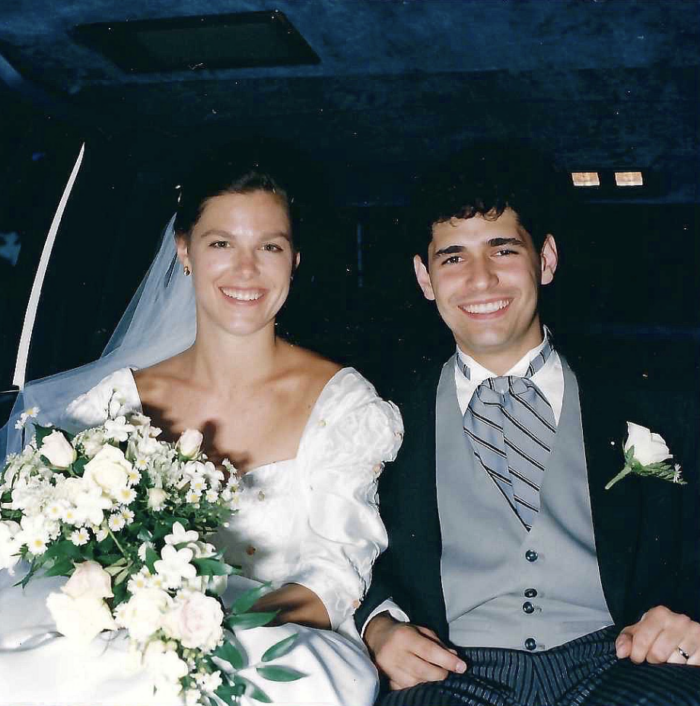
Though James and Sarah were in different schools, the two took several elective courses together, including Middle East History, 20th Century Novel, and History of Germany. James, quick at a typewriter, would often type Sarah’s papers as she read them aloud.
As they have grown up, innumerable things have changed. “You’re students, that’s one way of interacting, but then when you become parents, that’s a totally different way of interacting,” said James.
Sarah Murray (SFS ’89) reflects on watching her husband grow from the person she met at 18.
“It could be one minute or, you know, days describing change over time when you’ve known someone for almost 40 years,” she said. “He is a serious professional, and he’s changed a lot as a person, but his personality hasn’t really changed. He’s very steadfast, reliable, caring. But he has grown a lot from being 18, when we met, to 58.”
James attributes the frequency of lasting relationships that began at Georgetown in part to the university’s holistic approach to education.
“The students do go to mass on Campus. It was, you know, education of the whole person type of setting that they tried to cultivate,” he said. “That generally lends itself to people thinking about not just striving to get an education and then develop their career, but preparing themselves for broader life. So maybe you’re more open to developing relationships with your future spouse there.”
James described how Georgetown’s social scene carries a relatively more serious, family-oriented atmosphere than many peer universities, one that is more likely to draw students toward lasting friendships and partnerships.
Georgetown was not just a foundation for James and Sarah, but a throughline for the Murray family, where three of their four children attended. “It’s been fun to have my kids be part of something that I was part of,” said Sarah. “So having all the kids go to Georgetown has been great, both for me, with my connection with the kids, like going to the tombs, sitting on the lawn, you know, walking, taking pictures in front of the John Carroll statue.”
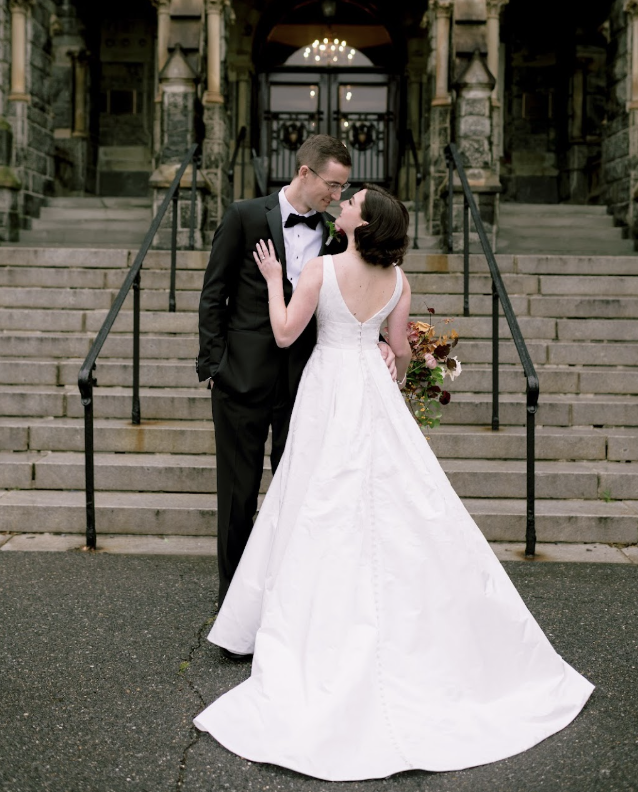 Photo from Serena Miossi
Like the Murrays, many Hoya couples trace the spark of their relationship to everyday moments on campus. Serena Miossi (CAS ’18, MLC ’19) and Jack Miossi (CAS ’15) were both excited to work at Midnight Mug, not knowing that the counter on Lauinger Library’s second floor would connect them to their future spouse.
The two met at a mutual friend’s 21st birthday party, a friend they both knew from Midnight Mug, at the then-Booeymongers (now La Bonne Vache). Serena was still a student, but Jack had already graduated. The two spent most of the night talking and began dating shortly after.
Jack still remembers his first encounter with Serena very clearly.
“My first impression of Serena is that she was very striking and beautiful and very easy to talk to. What more could you want in a person?” Jack said.
Jack feels a sense of continuity in their relationship thanks to their Georgetown connection.
“In a lot of ways, we haven’t changed that much, it’s more what we do on a day-to-day basis. We go to jobs instead of class, read books to our daughter instead of reading books for homework. But we’re the same people we met at Georgetown in the end. We do it all with the same values and sense of humor.”
Originally from Atlanta, Serena fell in love with D.C. because of her time at Georgetown, and then further fell in love with the city through the eyes of a D.C. native. She said that her time with Jack has helped her grow, yet she still feels connected to who she once was.
“We’ve grown a lot. It’s been 10 years since we’ve been on campus as students. We’ve learned a lot from each other. Jack has shared his love of DC with me, and now we call the city our home for good. Our faith has grown and shifted and intertwined with one another’s,” Serena said. “We’ve become parents and homeowners. But we don’t feel that far away from the people we were on campus–we just know more about ourselves and each other now.”
Jack explained how his and Serena’s Georgetown experience mirrored one another, making a Dahlgren wedding a natural choice.
“Georgetown was independently special to both of us, so it was a way to share an experience together on campus. We worked in the same coffee shop, took the same classes, loved the same professors, and spent our time at the same houses and bars, but at different times with distinct experiences. So, a Georgetown wedding was a way of tying it all together for us,” Jack said.
The personal touches added to their ceremony made the day even more special for them. Serena recalled how they regularly met with the pastor, marrying them in the year leading up to the wedding, where he got to know them as a couple and wove their conversations into his homily.
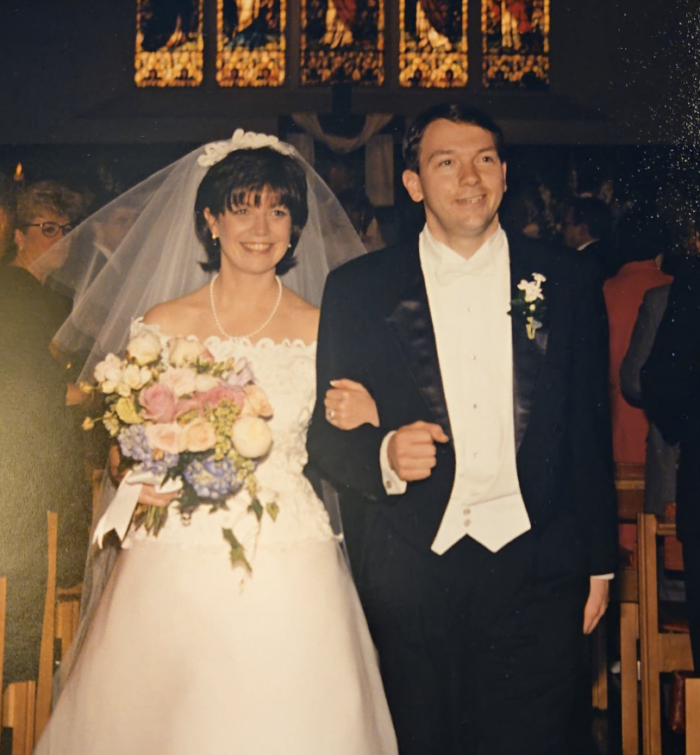
Kathie Fording (CAS ’88, GSAS ’89) and Tim Fording (MSB ’89) also owe their love story to Georgetown, though they met not as students but as alumni. In December 1994, both were volunteering for the Georgetown Alumni Association in Chicago when they crossed paths at the chapter’s Christmas party.
Kathie Fording, parent to ’25 and ’28 Hoyas, said their mutual commitment to the university created a strong foundation.
“I think our shared experiences was that we were both happy to be volunteering for the school that we had enjoyed so much attending as undergrad. And, we were happy in our volunteer efforts,” she said. “I was happy to be part of a group that was, you know, continuing our shared bond experience of Georgetown, but giving back to the community as well.”
The connection between them ran deeper than they had initially realized. Both had moved into New South during their respective freshman orientations, and during Kathie’s junior year and Tim’s sophomore year, they had lived on the same floor of Nevils Hall, only a few doors apart. Tim had even met two of Kathie’s brothers before he met Kathie herself.
When it came time to marry, Dahlgren felt like the natural choice for the Fordings, symbolizing what had brought them together.
“It felt like going back to kind of where it all began, even though it didn’t really all begin with us there. It felt, you know, appropriate to be getting married there,” Kathie said.
For Tim Fording (MSB ’89), another campus space carries particular meaning: Riggs Library, which he had visited exactly twice: once for their rehearsal dinner, and once for their daughter Caroline’s (CAS ’25) senior auction. “That’s a very special place on campus with a lot of history,” he said. “A lot of history for the school and, obviously, history for us too,” said Kathie.
The Fordings remain close with friends from their Georgetown years, frequently traveling with those friend groups and their spouses. For them, continued involvement with the university feels like both a privilege and a responsibility.
“We give back to Georgetown because Georgetown gave so much to us,” Kathie said. “We do feel, you know, happy to do it, but we also feel a responsibility to give back to the university.”
Father Folan sees couples like the Murrays, the Fordings, and the Miossis as a natural outgrowth of Georgetown’s mission.
“I hope we’re forming you into people who take those things seriously during your time here and then beyond,” he said. “When that happens, people would fall in love and want to be married to each other. That’s not a surprise, and it should be an occasion for rejoicing.”
For the Murrays, it started with a whiteboard. For the Fordings, it started with a Christmas party. For the Miossis, it started with Midnight Mug. But for all of them, it started with Georgetown, and Dahlgren has always been at the center.