

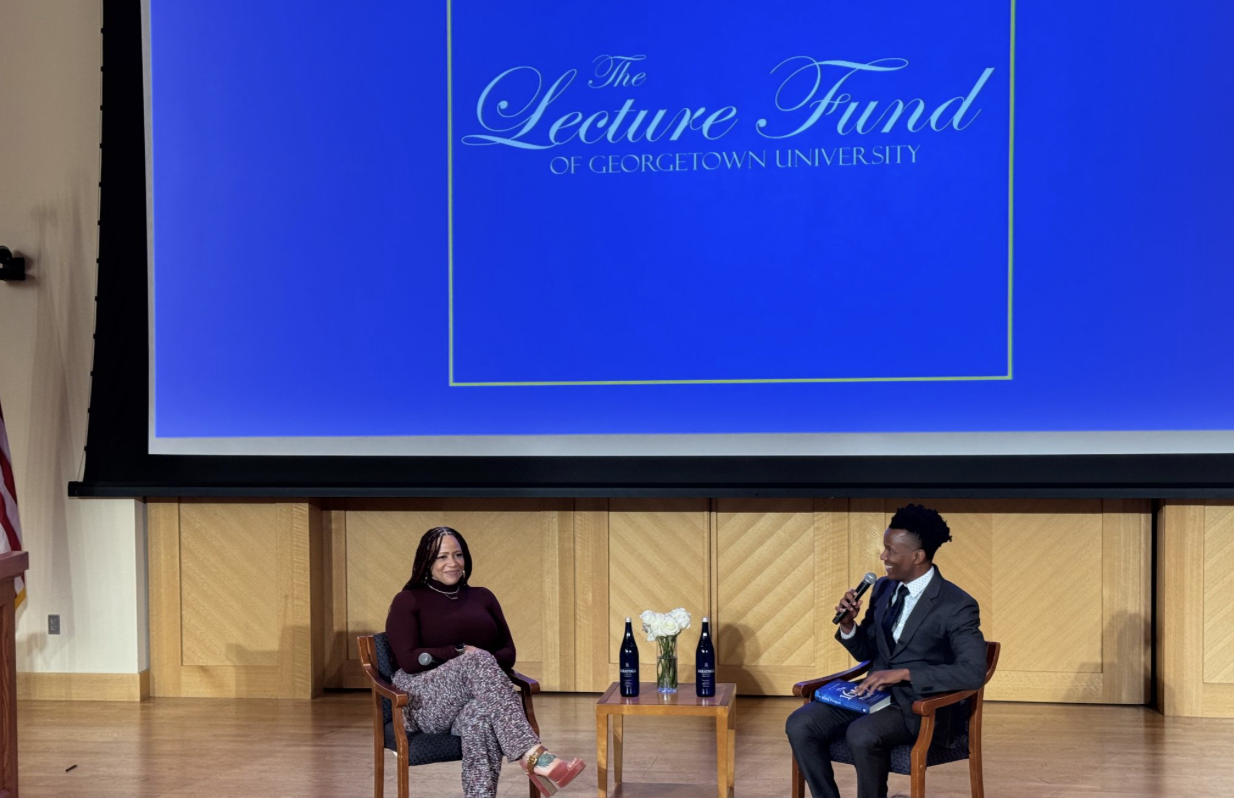

The Lecture Fund held their annual Michael Jurist Memorial Lecture on March 30, featuring journalist Nikole Hannah-Jones, author of The 1619 Project, a journalistic work-turned-book that reframes the origins of America around the arrival of the first enslaved Africans to the New World in 1619.
The Jurist lecture series is held every year in memory of the former chair of the Lecture Fund, Michael Jurist (SFS ’07). Each year, the Lecture Fund seeks to bring a speaker who encapsulates one of Jurist’s diverse passions, such as politics, athletics, travel, and gastronomy.
In partnership with the Department of Black Studies and moderated by Department Chair Dr. Robert J. Patterson, the lecture covered the competing narratives surrounding America’s past, concerns about the current political climate described as antagonistic to critical thought, and the importance to the future of America of continuing work like Hannah-Jones’ novel.
In her original work, Hannah-Jones examined how narratives of history are shaped by those in power. She emphasized that what Americans think of as factual, concrete history is actually constructed memory, and that she wanted to help people understand the “country that we actually live in, not the country of our mythology.”
She highlighted the power of journalism in achieving this task, explaining that her work was published in the New York Times to make it accessible to everyone. Hannah-Jones believes that journalism, unlike traditional forms of history works, writes for the readers.
“We write for the masses, we take the very important scholarly work that scholars like [Dr. Patterson] do and translate it for regular people,” Hannah-Jones said. “There’s just something very powerful about being able to talk about the present society.”
Hannah-Jones explained that The 1619 Project is not just about the past, although her work is rooted in history. Instead, every essay in the book is focused on modern America and uses the past to understand it.
She pointed out how the heart of the revolution was not in Boston or Philadelphia, but in “the slaveocracy of Virginia,” where the Declaration of Independence and the Constitution were written by slave owners, like James Madison and Thomas Jefferson. Yet, she notes, Americans are taught that this reality is “irrelevant to the country that they built,” an idea that she challenges in her work.
The restructuring of history seen in The 1619 Project is not a radical assertion, Hannah-Jones explained, but something that academics have discussed in the past. She mentioned scholarship from the 1980s that described America as one of five genuine slave societies in history. Hannah-Jones also explained how slavery is core to every part of America, stating she plays a game connecting modern issues back to slavery.
She said that slavery is part of why American capitalism is so brutal today.
“If you allow the buying and selling of human beings for profit, the rating of human beings for profit, forced breeding of human beings for profit, there’s nothing people won’t do for profit,” she said. “The way that we’re taught to think about capitalism is also that capitalism is a religion or a system of morality—that capitalism is intertwined with freedom.”
When writing her work, Hannah-Jones expected many conservatives to have a major reaction and explained that she was attempting to be provocative with the project. Yet, she explained that the backlash she received was different than expected: it was organized.
She described how legislation was introduced that targeted The 1619 Project. In tandem, President Trump created the 1776 Commission to write a report that would reinforce the established narratives of American origins.
Hannah-Jones emphasized that she is not immune to criticism, and when the book version of The 1619 Project was later released, there were several improvements made in response to legitimate critiques of the article. Still, she argued that most of the backlash the project received was not “about the facts” of the work, but instead accusations that she sought to “destroy the country” by talking about slavery.
“I want us to contemplate the idea that if you tell the story of the country truthfully, the country cannot bear the weight of its own truth,” she said. “It is inarguable that slavery was foundational, both to the urban wealth in the country, but also to its political, economic, social, cultural system.”
Hannah-Jones explained later in a comment to the Voice that these ideas can be disturbing for some who have never had to grapple with the centrality of slavery to America. She emphasized that shutting people down in “righteous anger” is not going to help them learn, and it is important to grant others grace. To bridge the gap, Hannah-Jones believes dialogue is essential.
“We’ve now gotten to a place where we have state legislatures and the federal government that’s saying that you can’t even debate the ideas, you cannot even be exposed to the ideas,” Hannah-Jones said to the Voice. “You can’t have a free society if you are not able to be exposed to all sorts of ideas and have those discussions.”
This resonated with Mikayla DaSilva (CAS ’28) who attended the lecture. She spoke to the fear she sees many professors exhibit around dialogues surrounding United States politics. DaSilva also described the hesitancy of her fellow students in organizing and using their voices.
“It also unsettles me that we acquiesce so easily,” DaSilva said. “Especially at Georgetown, we’re living in a privileged bubble where we get to think about our careers as potential diplomats before our lives.”
DaSilva had previously read The 1619 Project and listened to the accompanying podcast. She said attending the talk was a good recentering and reminder of how to interact with people who haven’t had the opportunity to take a critical look at American history.
“It’s our responsibility to use our education to connect other people with the information that we have the privilege of learning,” DaSilva said.
Maru Amtataw (CAS ’28) was first introduced to the project in high school. As a Black woman who wants to go into healthcare, she was especially appalled by a section of the book that connects the legacy of slavery to the treatment of Black women in the healthcare system. She specifically spoke to the pregnancy-mortality rate of Black women, which is three times higher than those of white women.
Amtataw explained that she never fully thought of Obstetrics and Gynecology as a potential career path, but the lecture inspired her to consider studying it further in order to be a voice for others. Moving forward, Amtataw emphasized the significant role young people play in transforming academic work into societal change.
“Even though all this work is published, it’s really up to us as the younger generation to really make sure it doesn’t die out,” Amtataw said. “To continually make sure that works written by Black people about the Black history are continually being uplifted from every angle, whether you are Black or not.”