


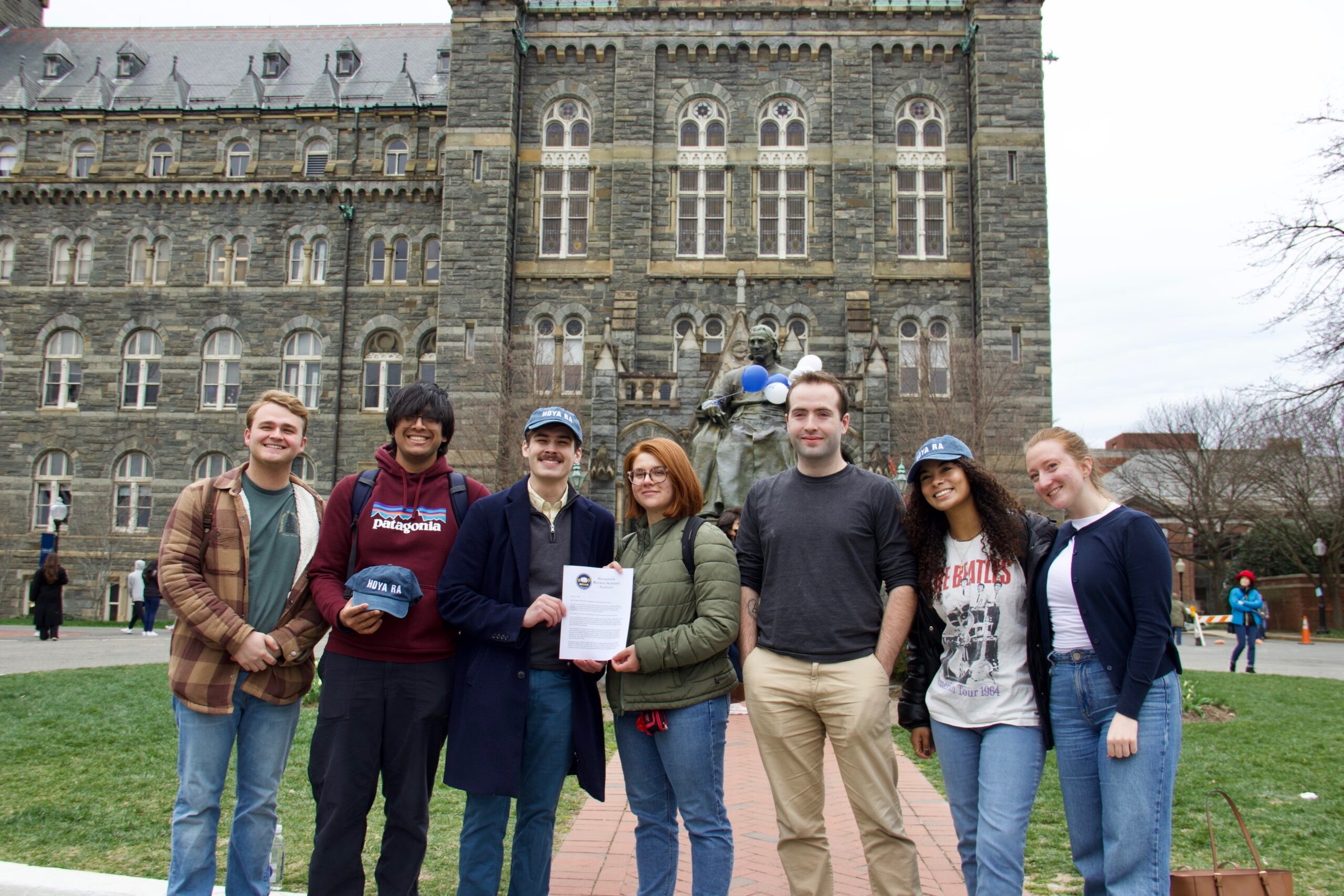

The Georgetown Resident Assistant Coalition (GRAC) has launched a new petition calling on the Department of Residential Education to “immediately cease its union-busting activities.”
The petition, launched on April 23 via Instagram, is addressed to Interim President Robert Groves and Executive Director of Residential Education Heidi Zeich. GRAC claims that the university has “weaponized” last May’s Collective Bargaining Agreement (CBA) between GRAC and the university to discipline Resident Assistants (RAs) for “minor infractions,” creating a workplace of “fear and mistrust.”
The petition says that RAs are being held to “impossible standards” in a “toxic work environment.” The union alleges that RAs have been punitively disciplined for arriving late to shifts, missing obligations when ill, or failing to notice a single trash bag left outside during walkthroughs.
RAs told the Voice that recent policy changes around living arrangements and event budgeting, misalignment with Community Directors (CDs), and the university’s alleged failure to alert current RAs to the application deadline for the next academic year have all contributed to what they say is an untenable working situation.
A university spokesperson wrote to the Voice that Georgetown values RAs and is committed to upholding the CBA.
“We deeply value the contributions of Resident Assistants (RAs) to our living and learning communities,” the spokesperson said. “We are committed to upholding Georgetown’s Just Employment Policy and honoring the Collective Bargaining Agreement (CBA) between the university and the Georgetown Resident Assistant Coalition (GRAC).”
However, the university also pushed back on GRAC’s claims in the petition.
“We disagree with these characterizations and note that many of the statements are not accurate,” the spokesperson wrote.
But GRAC sees this environment as a violation of Georgetown’s Just Employment Policy, which includes that everyone in the Georgetown community has the right to freely associate and organize without intimidation or unjust pressure from the university.
“These are not the actions of an employer that cares about its workers or its students,” the petition says.
According to CC Mesa (SFS ’26), the Organizing Lead for GRAC and one of its founding members, the union began working on its petition this past Monday. She says that the petition reflects a cumulative build-up of concerns among RAs.
“I would say it’s a combination of support from our parent union, [the Office and Professional Employees International Union] OPEIU, and a combination of RAs themselves who are pushing for us to do something about it,” Mesa said. “I know a lot of RAs from across the different campus communities, and a lot of those who I know have been impacted one way or another by these [policies].”
Policy changes lead to confusion, frustration
RAs say that a slew of policy changes have negatively impacted their ability to do their jobs.
RAs claim that they were not properly informed of reapplication deadline to become an RA for the following academic year, resulting in many losing their positions. In addition, management allegedly informed RAs they would have been notified of the deadline if they were “student leaders” instead of “employees,” which GRAC points to as an example of union busting.
Sophia Lu (SFS ’26), a third-year RA, alleged that many RAs were not informed about the application to be rehired until mere days before its due date.
“Residential living did not communicate with any of us about when the applications were due until literally two days before it was due,” she said.
A university spokesperson denied these claims, saying, “RA application deadlines were communicated to students, including current RAs, in the same manner as in prior years.”
Devan Varma (CAS ’26), another third-year RA, pointed to another policy change announced in November, which prohibits RAs from choosing their suitemates when selecting their housing.
“It makes the job worse, and it makes it harder for people to be an RA,” Varma said. “You’re in a space with three random people that you don’t necessarily enjoy living with.”
Lu explained that RAs who originally lived in singles in apartments must now live in doubles due to current living policies. This makes it more difficult for RAs to use their space for programming and conflict resolution, with Lu stating that it has led to “a lot of chaos on the housing front.”
Varma expressed that overall, this year’s policy changes seem unreasonable to him.
“There are policies this year that seem confused, and I don’t know how they practically benefit students,” he said. “They just seem aimed at making the job more difficult and more undesirable.”
Misalignment with Community Directors
The petition also references Residential Living’s staffing issues, highlighting that frequent team reshuffling and understaffing have made it difficult for RAs to fulfill their duties.
Victoria Allen (CAS ’27), a second-year RA and a steward on the GRAC board, sees the constant turnover in the department as evidence of a larger trend.
“It is sad but not surprising that the treatment [RAs] are facing is similar to that of our bosses (Community Directors), who even have higher turnover, with [two] quitting before even a full year of working here and [one] lasting only a month,” Allen wrote to the Voice.
Lu saw the impact of the new policies not only on RAs but also on Community Directors (CDs) across the university.
“There’s just been massive turnover amongst the Community Director ranks, and that has led to a gap in institutional knowledge and made it really difficult to perform our jobs,” Lu said.
Lu has personally seen a lot of difficulties programming this semester. She alleged that none of the RAs were given a budget this spring, and were instead simply advised by their CDs to keep spending low, which Lu believes hurts programming and engagement with her residents.
“Usually, I would take my residents and go out and do more activities, but I personally have felt artificially constrained in the amount of programming I could do and the different options I had,” Lu said. “It’s harder to get people to want to come out and attend these events if we don’t have as many attractive food options, or a range of different events.”
Mesa hopes that this petition brings change for both the RAs and their CDs.
“A lot of RA struggles, in the background, have a CD who is doing what they are told,” Mesa said, “And what they are told is not necessarily what is best for their team, and it might not be what they necessarily believe is best for their team.”
Mesa believes that many problems stem from upper management’s use of the CBA. She explained that she believes that it has been utilized in a very “purist” way, with Community Directors no longer given the flexibility to consider mitigating circumstances when disciplining RAs.
“Community Directors do not have the room or space to make flexible decisions because upper management is telling them that they need to do everything by the book of the Collective Bargaining Agreement,” Mesa said. “It has not given Community Directors the necessary room to make decisions for their staff that they feel is best for their staff.”
The university spokesperson said that disciplinary procedures are carried out based on the agreed terms in the CBA.
“The CBA is publicly available and outlines how infractions are consistently handled as agreed upon by the union and the University,” the spokesperson wrote.
For the future, Mesa hopes management will better account for mitigating circumstances when acting as community leaders.
“I hope that Community Directors will be able to be empowered to make informed decisions about their team, and about what their team needs,” Mesa said.
Moving Forward
In Varma’s view, the recent activities of Residential Education come from a place of ignorance rather than ill intent.
“I think a lot of this is misguided,” Varma said. “They’re making a lot of sweeping changes, but it does have real impacts, and they haven’t gotten to understand the culture or the reasons why things happen the way they do enough to make the most informed decision.”
While Varma doesn’t believe that these changes solely derive from the RAs’ decision to unionize, he thinks it may relate to the situation.
“I think it’s easier to justify a lot of these decisions by saying, ‘ Oh, you guys are employees now,’” Varma said. “It’s a reaction to the union, maybe not trying to crush the union.”
Looking to the future, Lu hopes that the university will better consider how their policies affect students.
“They should, at minimum, walk back some of the super ad hoc restrictions they’ve put on us,” Lu said, “And when making these decisions in the future, at least make a bare minimum effort to engage with the people they’re affecting.”
For the university, further communication will come through the previously established informal and formal discussion mechanisms.
“Out of respect for this legal agreement between the union and the university, which establishes OPEIU Local 153 as the sole and exclusive representative of GRAC members, Georgetown will continue to use these channels to discuss and resolve any concerns through good-faith engagement,” a university spokesperson said.
Allen hopes that this petition creates genuine engagement and respect from Residential Living and Education in future conversations about these issues.
“I hope we are met with the same level of respect that RAs bring to the table,” Allen said.
Mesa ultimately highlighted the level of seriousness associated with a petition from GRAC.
“Going to a petition, going to this level means that there is something that is seriously wrong,” Mesa said. “Whenever we do this, there is a lot of thought behind it, there is a lot of intention behind it, and there is a lot of hope behind it.”
The RA union says that the issues that led to the need for a petition conflict with Georgetown’s Jesuit values, namely cura personalis, or care for the whole person.
“RAs have never been treated as ‘whole’ people,” the petition said.