



Content warning: this article references rape and Islamophobic language
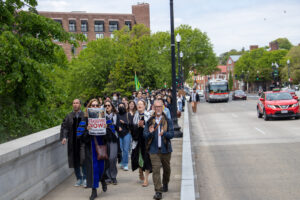
Around 30 faculty, staff, and students gathered in the ICC Galleria before Professor Jonathan Brown’s last class of the semester on April 28, two weeks after a conservative news outlet broke into his classroom. In response to the incident, community members called for the university to increase safety measures in order to protect students and faculty going forward.
Brown’s class has been meeting online since two reporters from GB News (GBN), a popular U.K. conservative news outlet dubbed the “Fox News of the U.K.,” entered Brown’s classroom without permission from him or the university on April 16. The reporters filmed both Brown, a professor of Arabic and Islamic Studies, and his students, asking Brown questions about his recent controversial reply to an X post linking perpetrators of rape cases in the U.K. to Islam.
During the incident, reporters with GBN entered the classroom where Brown was teaching his class, “War on Terror at Home,” at around 12:40 p.m. with filming and audio equipment. The reporters then began asking Brown questions about his post while filming both him and students in the class, refusing to leave even as Brown asked them to exit and escorted them to the door. GBN has not responded to the Voice’s requests for comment.
A university spokesperson told the Voice on Tuesday that they have followed up with GBN regarding the incident, but did not confirm that they are pursuing disciplinary or legal action for the organization or the reporters involved.
“The University sent a letter to the media organization involved in the incident, informing them that this conduct violates DC law and University policy, and that a similar incident could result in barring from campus, referral to local authorities, or legal action,” the spokesperson wrote.
Nader Hashemi, the director of the Alwaleed Center for Muslim Christian Understanding (ACMCU) and Brown’s supervisor, said that the university, rather than deciding to move Brown’s classes to Zoom, should have implemented necessary security precautions to ensure the safety of in-person learning.
“I think that whole conversation over how to respond to the potential disruption of this class going forward to the end of the term has created a lot of concern that the university did not provide the type of support that Jonathan Brown and his students need and deserve as members of this community,” Hashemi explained in an interview with the Voice.
A university spokesperson told the Voice that safety was the main factor guiding their decisionmaking.
“The safety of our community is our paramount concern. Security costs were not a factor in the decision to hold the class online,” the spokesperson wrote.
Hashemi also said that individuals who he believes to be the GBN journalists also came into the ACMCU office asking for directions to Brown’s office. He said that that marks two breaches of privacy and security, and that the university needs to take steps to ensure that similar incidents don’t transpire in the future, which he worries could have more dangerous consequences.
“This could happen again because of the polarization we’re experiencing nationally and internationally. Unfortunately, we’re living in this country where access to guns is very easily obtainable,” Hashemi said. “What I’m looking for is that this crisis will lead to a conversation on campus, administration, faculty and centers, to figure out how we can prevent this from happening again.”
Sam Halabi, who is the Department Chair of Health Management and Policy in the School of Health and the Director of Georgetown’s Center for Transformational Health Law, said that the university’s decision to switch to virtual learning was evidence of a failure to prioritize student safety and protect professors’ freedom of speech.
“We believe it was exactly the wrong thing to do for the university to shift the instructional setting away from in-person, rather than provide the kind of security and protection for the classroom and for Professor Brown,” Halabi said. “The signal it sends is that you should silence faculty, that faculty shouldn’t speak on controversial subjects.”
Many of the questions GBN reporters asked during the break-in were tied to a response Brown made to a post by U.K. Parliament member Rupert Lowe, who wrote, “There is a link between the rape gangs and one particular religion — we have seen it again and again and again at our inquiry. That religion is Islam. As a country, we must have the courage to face up to that fact.” In a since-deleted reply, Brown wrote, “Get over it.”
The post from Lowe references a U.K. Parliamentary inquiry into incidents of mass grooming and abuse of minors in England and Wales referred to as “grooming gangs.” The inquiry will evaluate whether cultural, religious, or ethnic factors were relevant in the cases, and will investigate the law enforcement agencies involved in addressing these incidents. It began on April 13 and currently has no final conclusions.
Some of the most well-known cases of “grooming gangs,” include prosecuted gang members of Pakistani heritage. Online controversy and comments from politicians like Lowe have largely targeted Muslims as a result of the cases involving Pakistani men in the U.K., where the majority of Pakistani people are Muslim, tying their religion to the crimes.
However, a 2020 study by the Home Office, the U.K.’s interior ministry, on group-based child sexual exploitation found that “the majority of offenders are White.” The study also found that “it is likely that no one community or culture is uniquely predisposed to offending.”
After drawing controversy and significant media attention for the post, Brown has privated his X account.
While his account is private, Brown shared with the Voice an X post he made afterwards clarifying his stance.
“Rupert Lowe and his ilk blame Muslims and Islam for countless social ills and especially claim that Islam and Muslims are somehow uniquely to blame for sex crimes like grooming and gang rape. This is just false,” he wrote. “People need to get over the fact that Muslims live in western countries as law-abiding citizens. This was what I intended in my previous comment.”
Halabi is also the Vice President of Georgetown’s chapter of the American Association of University Professors (AAUP), which organizes and defends academics amid threats to freedom of speech. He argued that the university needs to investigate the incident further.
“The first thing the university needs to do is enforce its own policies with respect to media access. It needs to pursue the perpetrators of this interruption, and it needs to provide security for the classrooms. It should not, as a default, punish the professor and punish the students,” Halabi said.
Crystal Luo, an assistant professor in the history department, emphasized that prejudices like Islamophobia can play a key role in the safety of faculty and students, and that it is important to call out the factors leading to dangerous incidents like these.
“Professor Brown is a prominent Muslim faculty member at the university who also teaches on Islam and those two things have a lot to do with why he’s been made a target,” Luo said. “I think it’s important to kind of name that structural factor going in here, because I think it explains the irrational nature of these attacks.”
At 12:30 p.m., Brown joined the Zoom and greeted his students, some of whom had joined virtually, others of whom had joined together from their former classroom.
“Hi, students. How’s everybody doing?” Brown said to the screen. “When a lot of my colleagues and other grad students [and] administrators found out the class was going to be online on the last day, they felt really bad for the students, and they said they wanted to come.”
He then turned the camera to show the crowd, who waved to the students. Then, he turned around with his computer screen to go teach his final class.
“Thanks a lot everybody, I have to go talk to these guys. See you all later, thanks for organizing!”