

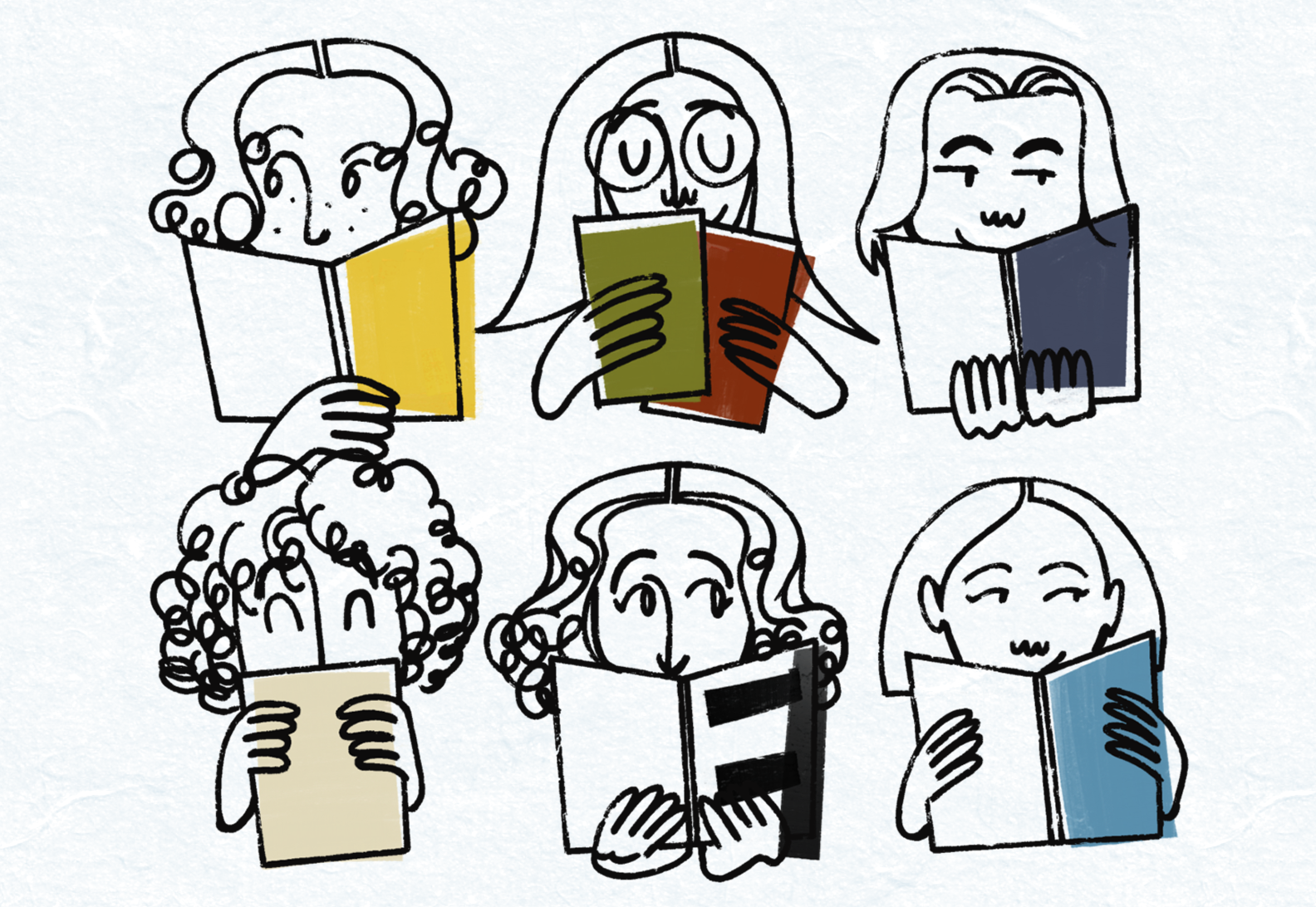
From comedy classes to ghost stories to Shakespeare, we’re making the most of our $95,000 year of education and sharing the highlights from our assigned course readings with you.
Big Swiss by Jen Beagin — Phoebe Nash
Despite warnings that I wouldn’t feel particularly funny at 8 a.m., I enrolled in Comedic Fiction and Writing. While the wake up is admittedly challenging, Jen Beagin made it worth it, if only for the two weeks we discussed her novel. My professor would like me to highlight Beagin’s metafictional prowess, admire the accurate representations of Hudson, New York, and interrogate the symbolism of a trash can. He’d also advise pacing your reading; I’d argue this book should be devoured. A woman takes a gig as a sex therapist’s transcriber and becomes transfixed by a particular client. What follows is a simultaneously comedic and melancholic tale about love, trust, and what happens when you know too much.
The Jungle by Upton Sinclair and Julius Caesar by William Shakespeare — Eileen Weisner
These riveting books carry a reassuring weight as literary stalwarts. Finally reading the heavy-hitting literature my grade school teachers alluded to year after year confirmed that I am, in fact, receiving that mystical liberal arts education.
The Jungle, the classic exposé of the meat-packing industry, follows the life of the immigrant Jurgis Rudkus as he and his family move to Chicago, where they succumb to disease, weather, untenable working conditions, and more. While Jurgis’s life seems impossibly miserable, that was life.
Julius Caesar is chock full of more relatable life references. For example, “Et tu, Brutus?” reminded me of every time my friends turn down Leo’s dessert after dinner. “The fault, dear Brutus, is not in our stars, but in ourselves” made me tear up as I remembered how much I cried over The Fault in Our Stars. John Green must be a descendant of Shakespeare.
Tales From the Haunted South by Tiya Miles — Hudson Witte
I read my fair share of classics this year, but only one book precipitated the novelty of a riveting phone call with my mom that revealed information about our family’s lineage of supposedly talented mediums. Historical monographs like Tiya Miles’s Tales From the Haunted South often lend themselves to extremely boring and obtuse readings, whereas this book pithily explains its dense subjects. Miles, an eminent historian, unpacks slave ghost tours, exploring how their untruthfulness and racial politics sustain racist narratives into the present. Even though she by and large condemns the tours, Miles still wants to believe in the impossible: the historical possibilities of the overwhelmingly fraudulent dark tourism industry and ghosts themselves. I, too, want to believe in the impossible: compelling reading assignments, interesting phone calls home, and, of course, ghosts.
The Known World by Edward P. Jones — Elaine Clarke
As someone who has also read a fair share of classics this semester, this book may not have precipitated a phone call with my mom, but I liked it so much that I certainly thought about it. Edward P. Jones’ Pulitzer Prize-winning novel The Known World offers a poignant gaze into the life of Henry Townsend, a formerly enslaved Black man turned slave owner in antebellum-era Virginia. Beyond the focus on how freed Black people reach for equality in an unjust world through their ownership of enslaved Black people, Jones weaves a behemoth cast of characters together to create one known world. What particularly piqued my interest as I attempted (but ultimately failed) to finish this book before my two-hour discussion was the way Jones played with time throughout the book. He often broke the flow of the novel to jump around his own timeline, a reminder that, as much as we pretend slavery is a thing of bygone days, the past is not as far as it seems.
The Sing Sing Files by Dan Slepian — Alex Risi
As much as I hate to admit it, I have never been a nonfiction person. So, when Professor Marc Howard assigned The Sing Sing Files in Prisons & Punishment, I was not enthused. However, after reading it, I may have had a change of heart.
The Sing Sing Files explores the career of Dan Slepian, a Dateline (1992-present) producer who, after one particularly unique project, dedicates his career to exonerating wrongfully incarcerated men. Although it was nonfiction, the characters drove the book to its emotional peak and forced readers to confront injustices within our everyday systems. This book is heartbreaking yet hopeful, a look into the deepest flaws in our systems and the very individuals who will repair them.
All Quiet on the Western Front by Erich Maria Remarque — Evalyn Lee
“Then what exactly is the war for?” asks one of the German soldiers in this novel, which takes place on the Western Front during World War I. This question echoed in my mind throughout Late European History with Professor Elizabeth Cross. The novel’s young soldiers, called “The Lost Generation,” died in the trenches in the face of technological warfare. As students who are the same age as these soldiers, witnessing the war in Iran, the genocide in Gaza, and the invasion of Ukraine, this book encourages us to investigate who profits from war, and who bears the brunt of its violence. During World War II, Nazi Germany, Italy, and France banned Remarque’s novel, revealing the threat it posed to state-powered war machines. Reading this book today in the United States, another book-banning and war-waging state, hits the core of studying the humanities: to empathize deeply with the reality of human suffering.