


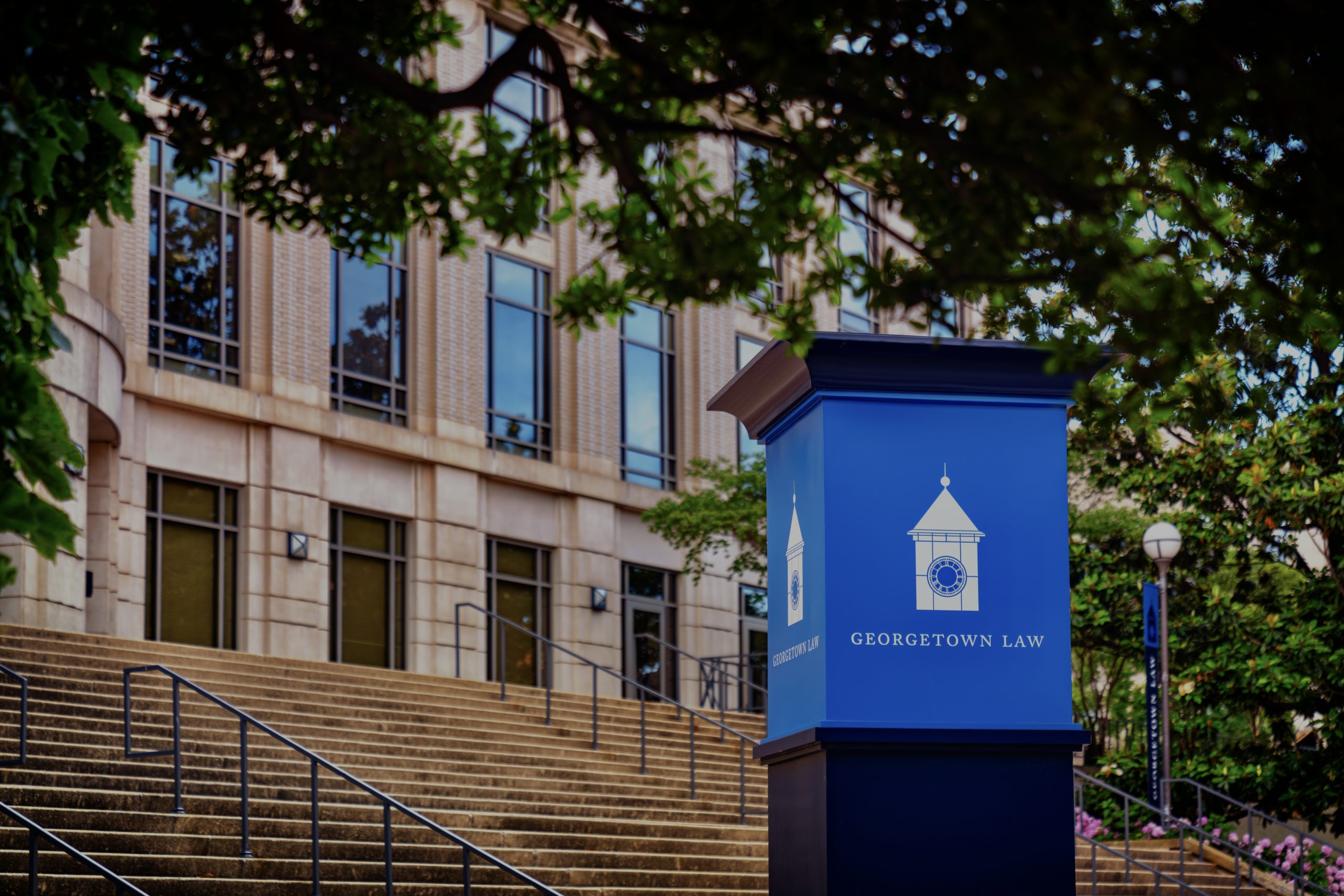

Grace Kiple (LAW ’26) was in a law clinic with other students when Georgetown’s graduation speakers were announced on Monday, April 27. Excited to find out who would be speaking at their graduation ceremony, the group quickly became disappointed after some digging.
Georgetown University Law Center’s (GULC) graduation speaker is Morton Schapiro, the 16th president of Northwestern University who has also served in administrative roles at Williams College and the University of Southern California. In GULC’s announcement of the speaker, Interim Dean Joshua Teitelbaum shared that Schapiro had taught his “Econ 101” class at Williams College, calling him “the best teacher I had in college.”
Kiple said students took issue with the fact that Schapiro is not a lawyer and has not worked in fields directly related to law, questioning whether his relationship to Teitelbaum was the sole reason for his selection. They have also voiced concerns about his views relating to Israel’s bombardment of Gaza, as well as student protesters and university administrators. As a result, Kiple launched a petition calling on GULC administration to remove Morton Schapiro as GULC’s commencement speaker. The petition currently has over 200 signatures.
“If the dean really enjoyed him as a college professor that’s great, but that doesn’t mean we all need to hear from him,” Kiple explained to the Voice. “Then we started looking into Schapiro more, and we saw that he had very controversial and harmful opinions. And I was just like, ‘I am so done with this. This is the last straw.’”
GULC did not respond to the Voice’s request for comment.
Since April 2023, Schapiro has written a column discussing faith, politics, and Jewish identity for The Jewish Journal, the nation’s largest weekly Jewish newspaper. Students who spoke to the Voice took issue with some of the articles Schapiro has written, specifically focusing on Israel and its relationship to Judaism and U.S. universities.
In October 2025, Schapiro authored an article titled, “What I Have Learned Over the Past Two Years About Israel and the World.” In the piece, he criticizes college administrators for not punishing student activists who participated in what he said was unlawful behavior, and for not limiting professors’ “political agenda” in the classroom.
“College administrators ignored myriad excesses by students and faculty alike, turning a blind eye when the humanities embraced a political agenda, or when student affairs personnel became more interested in excusing behavior that violated school rules than in preparing students for the world,” Schapiro wrote. “The pronoun police fiddled while the university burned.”
Kiple said that this alarmed some students who felt as though Schapiro was attacking student activists and LGBTQ+ individuals.
“That in particular has been sent as a quote in a lot of group chats,” Kiple said. “It doesn’t seem like [anyone] I’ve talked to has respect for this man and his opinions.”
Mari Latibashvili (LAW ’26), a student set to graduate in May who signed the petition, said that she finds Schapiro’s statements against student activists incredibly upsetting.
“The selection of Morton Schapiro as our commencement speaker is an absolute shame,” Latibashvili wrote to the Voice. “His views on the genocide of Palestinians are despicable and disqualifying; instead of holding Israel accountable for the horrors it has perpetrated, he blames the media and universities for allowing people to speak the truth.”
Schapiro also wrote about the ways in which he believes the media has contributed to the “vilification of Israel.”
“If you want to make the front page of The New York Times, take a picture of a smoldering building in Gaza or present the most inflated Hamas-based fatality statistics as if they were the truth,” he wrote.
In another article, Schapiro also referred to Jews who “condemn Israel” as “useful idiots,” a term widely attributed to Russian revolutionary Vladimir Lenin to describe individuals who support individuals that seek to harm them.
“How shameful to witness how these ‘idiots’ provide solace to the antisemites vowing to destroy not just the Jewish nation, but the Jewish people,” Schapiro wrote.
Kiple shared student comments left on the petition with the Voice. One graduating student who told the Voice she wished to remain anonymous wrote in her comment that she was specifically frustrated by Schapiro’s views on anti-Zionist Jews.
“As a Jewish anti-Zionist student here at Georgetown, the views publicly expressed by Schapiro concern me deeply. Schapiro’s equation of anti-Zionism with antisemitism not only lacks critical thought (something I thought this university valued), but endangers Jews everywhere,” the student wrote. “I would prefer to not be subjected to a speech by a man with such dangerous public views, and hope I will not have to subject my family coming in from out of town to this, either.”
Henry Mitchell (LAW ’28) wrote in his comment on the petition that the choice to have someone who is not involved in law speak at commencement seemed out of step with GULC’s values.
“Georgetown Law is too prestigious to have someone with no connection to lawyering speak at our commencement—let alone someone who holds views that make many students feel actively unsafe. Do better,” he wrote.
Additionally, students have expressed concerns about what Schapiro plans to speak about in his address. In the initial announcement, Teitelbaum wrote that Schapiro is highly informed about “the challenges facing colleges and universities today,” and that “there are few who can speak to it with as much clarity and insight as he can.”
Kiple said that she and her classmates had hoped to hear more about the world of law and what it means to be a lawyer, referencing GULC’s motto of “Law is but the means; justice is the end.”
“There are so many people in our graduating class who want to go out and aren’t going to firms, they’re going to public interest organizations and want to do good in the world despite how challenging that seems right now and how much of an uphill battle it is,” she explained. “That’s the kind of message we want to hear. We don’t really want to talk about the administrative challenges to higher education.”
This is the latest in a string of grievances GULC students have publicized ahead of their graduation ceremony. In December, GULC announced that they would no longer hold small cohort ceremonies, instead only offering a large group graduation on the Hilltop. Administration explained that the ceremonies were cancelled because of the planned demolition of Gerwiz Hall, where cohort ceremonies are typically held. However, despite the postponement of the demolition until after graduation, the ceremonies have not been reinstated.
Students raised concerns to GULC about the logistics of a single graduation for 1300-plus students, specifically regarding how much seating would be available for families, the length of the ceremony, a lack of transportation provided from GULC to the Hilltop, and the fact that the university planned to have AI read graduate names instead of a real person.
GULC admin also quietly cancelled the Graduation Gala, a formal event typically held at the National Portrait Gallery, replacing it with a smaller “Friends and Family Cocktail Hour.”
After a town hall on Jan. 21 revealed the full extent of the changes, students began a petition that has garnered 1,100 signatures. According to students, meetings with GULC administration did not result in compromises or meaningful changes to the graduation schedule based on their concerns.
Latibashvili told the Voice that the choice of Schapiro as graduation speaker has only heightened existing tensions between the school and the Class of 2026.
“This choice is a slap in the face for the class of 2026 and especially maddening because of everything the administration took away from the graduating class this year,” Latibashvili wrote. “We just want to celebrate our achievements with our families and loved ones. I am very disappointed in the Georgetown Law administration.”
Kayla Armantrout (LAW ’26) wrote on her petition comment that she is not going to be attending commencement after several events that she feels show disrespect to the graduates.
“I already had my reservations about attending this year due to the administration’s treatment of our other concerns, but had resolved to put them aside so my family could see me walk across the stage,” Armantrout wrote. “After this announcement, I am no longer planning on attending. I do not have any wish to make my family stand for hours in the hot sun just to listen to the Dean’s friend espouse actively harmful views.”




Any interest in people who are not opposed to his beliefs? He has not even said anything controversial about Israel. What a joke.
Sydney Carroll, can you clarify: Morton Schapiro has also served in [which} administrative roles at Williams College ?