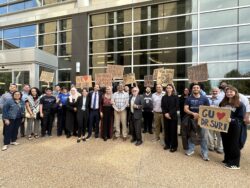




Georgetown’s College of Arts and Sciences (CAS) Dean David Edelstein hosted a town hall on May 6 to provide clarity regarding the sudden restructuring of the College’s departmental administrative staff. The initial restructuring was presented in a Zoom meeting on April 27.
The plan involves replacing department administrators with new roles titled “academic coordinators” and “business managers,” with neither position contractually connected to a department. This restructuring will result in a reduced connection between the department administrator and chair, while also moving some hybrid employees to entirely on-campus positions.
Edelstein presented these details in the eight-minute Zoom meeting—originally scheduled for three hours—without the opportunity for administrators to comment or ask questions.
In a letter sent to College departmental administrators after the initial Zoom, Edelstein explained that the restructuring will be implemented in two phases.
“The first phase will include the humanities, languages, and social sciences departments and will take effect July 1. The second phase, including the natural science departments and the department of performing arts, will follow in the fall,” Edelstein wrote.
Administrators impacted by the first phase have received their updated contracts. Signatures on the contract were originally due on May 1. Following complaints from staff and faculty, who said that five days was not enough time for an informed decision, the deadline was postponed to May 11.
According to one department administrator, who asked to stay anonymous out of fear of retribution, the new deadline still puts pressure on staff and faculty to sign the contract.
“Even though they extended the deadline, I still feel like that’s not very much time at all to make sense,” the administrator said. “For the people who are switching departments, it takes a lot more time to consider everything, meet the new department, and get a sense of if this is actually what you want.”
Given the abrupt nature of this announcement and the short duration of the Zoom call, CAS administration faced pushback and clarification requests from CAS faculty and staff members, ultimately culminating in a town hall meeting to address these questions.
During the town hall, Edelstein apologized for the manner in which the information was relayed and placed responsibility on Georgetown’s Department of Human Resources for suggesting this method. He highlighted that CAS administration is considering delaying these changes from July 1 2026 to January 1 2027, but is seeking feedback on this idea from those affected.
Department Administrator of the Department of Linguistics Francesca Di Silvio said that multiple attendees asked for an explanation about the letters to be signed by May 11 at the town hall. Edelstein emphasized that these were only letters of acknowledgement, meaning employees would not face termination if they chose not to sign them.
“He wanted to clarify that they were letters of acknowledgement, not a contract, and depending on what happens next—because it sounds like they have impatience—might be pushed back or might be changed in various ways,” Di Silvio said.
Instead, attendees were told that their jobs would be changed in any case when the restructuring is implemented, resulting in further confusion about the purpose of these documents.
Uncertainty about department shifts, according to Di Silvio, is currently the biggest concern for those affected. For those who will be moved, the restructuring means that they will have to “learn new protocols, work with completely different people, and move locations.”
The administrator also highlighted the impacts of a move from hybrid to in-person, especially for those with children at home.
“Some administrators have kids and they expect to work from home to help take care of the kids while they’re working, but now they’re going to have to try to find other arrangements for that,” Di Silvio said.
Due to staff feedback, Edelstein told administrators that the new in-person policy could be subject to change following staff feedback.
“They’re discussing to what extent both of the new roles have to be in office,” Di Silvio said. “It was notified to us initially that the department administrator role would be five days in office and the business manager would be four days in office. They’re discussing if that could be adjusted in what that would look like.”
Di Silvio added that uncertainty remains around the structure of the new roles, particularly regarding responsibilities and workload distribution. Di Silvio said Edelstein told attendees the administration is reviewing and standardizing job descriptions to ensure they accurately reflect the two positions.
Nonetheless, the administrator stressed a lack of transparency during this process.
“For the chairs and administrators, it was out of the blue, but the Dean’s office said that this has been in the works for over a year,” Di Silvio said. “So they just kind of sprung it on us. Everything’s very vague and a lot of it felt very not transparent at all.”
President of Georgetown’s American Association of University Professors (AAUP) Greg Afinogenov similarly drew attention to the lack of dialogue between CAS management and those affected by the decision.
“I would like to see a shift from this kind of top-down, authoritarian mode in which they tend to make decisions, thinking of faculty and staff as obstacles to their ability to get work done, and more towards a way of doing things that’s much more consultative and democratic,” Afinogenov said.
He also said there was concern for the potential consequences of the restructuring.
“This might set up for further budget cuts, and we should stop using staff as the university’s source of cutting costs, as the university is already understaffed as is,” Afinogenov said.
Even after the town hall, uncertainty remains. Following the quick turnaround for signing the document, which Di Silvio referred to as “extremely coercive,” many staff members have been left waiting for responses while discussing possible next steps. Di Silvio’s role assignment, finalized before the town hall, meant continuing uncertainty and frustration.
“They have not gotten back to us with responses, either for the group, or even for individuals. I can speak to myself, I strongly disagreed with the classification I was put into and sent a letter indicating why, and I haven’t got a response to that yet,” Di Silvio said. “Because we don’t have anything to even respond to yet, we don’t know if they’re going to make any concessions or changes.”
While staff are glad to have their feedback considered at last at the town hall, Di Silvio emphasized that this should have occurred all along.
“Even now, whatever changes are in effect, there was still, and [Edelstein] acknowledged, a breach of trust, and the people who should have been consulted weren’t consulted,” Di Silvio said. “But it’s in a fairly horrible way and a very quick and rushed way because of these dates we’ve been given.”