

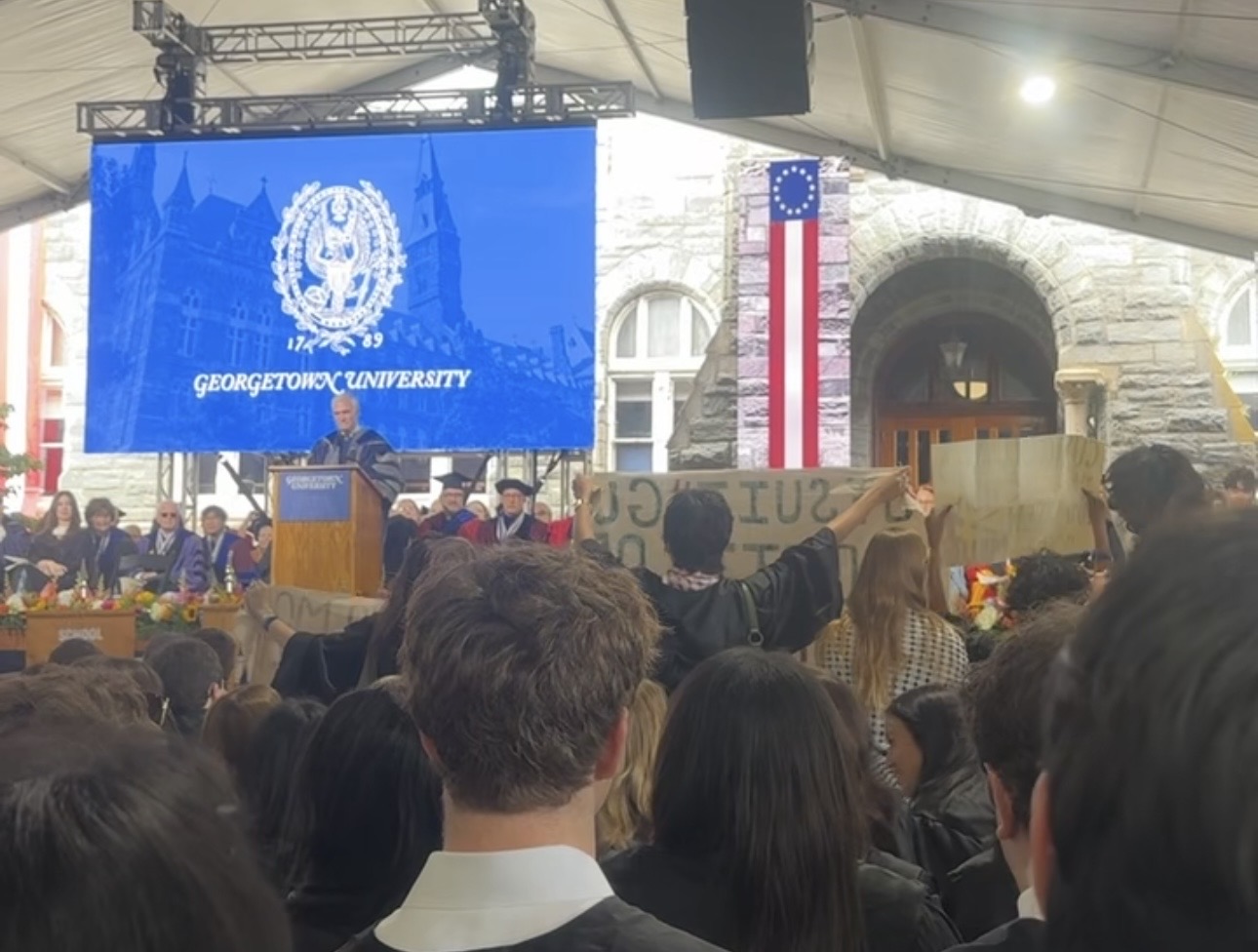
At senior convocation on Thursday, just under 30 students protested and walked out during interim President Robert M. Groves’ speech. The walkout aimed to represent graduating students’ stance against Groves’ tenure as interim president, according to Anna Broderick (SFS ’26), a student organizer with Students for Justice in Palestine (SJP) and a four-year member of Georgetown’s Coalition for Workers’ Rights (GCWR).
“When interim president Groves took the stand to speak to the Class of 2026, dozens of graduating—now alum—students walked out of his speech to show that we are completely against all the exploitation and the complicity in genocide that he has facilitated during his time as interim president, and that we demand a sanctuary campus, better pay for workers, to reinstate a lot of workers, to meet worker demands, and to end investment in the Israeli military,” Broderick told the Voice.
Students held up signs protesting for workers’ rights, immigration policies, and Georgetown’s refusal to divest. One large banner carried by students read, “GU Class of 2026 demands: Divestment from genocide; Living wage for workers; Sanctuary Campus.” Some demonstrators also held Palestinian flags and wore keffiyehs, a common symbol of solidarity with Palestinians.
“Groves, Groves, you can’t hide! We can see your greedy side!” students shouted during the protest.
While student protesters walked out voluntarily, Georgetown University Police Department (GUPD) escorted students as they walked down the aisle.
“An individual or group from the Georgetown University community wishing to protest at an event may do so if the speaker’s right to free speech and the audience’s right to see and hear are not violated,” a university spokesperson wrote in a statement to the Voice. “Georgetown University’s long-standing Speech and Expression policy has guided our approach to speech while maintaining the fundamental right of members of our community to free expression, dialogue and academic inquiry.”
Students’ chants and signs as they walked out of convocation echoed demands from several campaigns and student-led protests over their four years at Georgetown.
Calls for divestment mirrored a student-approved referendum calling on Georgetown to divest from companies connected to the Israeli military in April 2025, which President Groves rejected via email to the student body just 31 minutes after results were announced. In the email, he told students that “a student referendum provides a sense of the student body’s views on an issue. Student referenda, however, do not create university policy and are not binding on the university.”
Calls for living wages and more rights for campus workers reflected GCWR’s “Don’t Cut GUTS campaign”, which successfully fought against the university’s plan to terminate Georgetown University Transportation Shuttle (GUTS) workers’ contracts and outsource the shuttles to third-party Abe’s Transportation. GCWR and other student groups have also advocated for living wages and better treatment of facilities workers, adjunct faculty, and other employees on campus.
Students who participated in the walkout were graduating seniors, and Fiona Naughton (SFS ’26) reflected on how the walkout demonstrated a culmination of seniors’ activism throughout their time at Georgetown.
“Even in our last moments at this university with our parents watching, it’s so deeply important for us to use the lessons that we have taken here, and even as we stand, literally, not only in the belly of the beast, but as Georgetown is the encapsulation of the ongoing support of the American imperial project, for people to know that we’re still protesting,” Naughton said.
At convocation, student protesters pointed out the juxtaposition between Georgetown’s investments and the salaries and benefits Georgetown facilities and custodial workers receive. For fiscal year 2025, Georgetown’s endowment was valued at $3.9 billion.
“Most of my four years at Georgetown have been spent working with a lot of the people at Georgetown who have second jobs, who can’t afford to pay their rent, who cannot support the lives of their children because the university pays them so little. The custodial workers who are cleaning up after that ceremony are the lowest-paid people on the campus,” Naughton said.
Additionally, Naughton said that she chose to walk out during Groves’s speech because of her reservations about donating to the university.
The protest followed Groves receiving a $117,937.60 check on the university’s behalf from the Senior Class Fund, which invites members of the senior class to donate any amount above $5 to support various programs at Georgetown, with donors able to choose between “Georgetown Fund in support of undergraduate scholarships,” “Mission and Ministry,” “Athletic Director’s Priorities Fund,” “Student Affairs Fun Fund,” or any other department or program. Alexa Nakanishi (CAS ’26) and Emma Viscount (SFS ’26), co-chairs of the Senior Class Fund, announced at convocation that the Class of 2026 set a new record for participation percentage and total donors.
“I didn’t want to see President Groves accept a check… when our university has over $15 million invested in war technology and grows his salaries paid through the active genocide of the people of Gaza,” Naughton said.
Criticism of Georgetown’s administration does not solely come from students. Micaeli Dym (SFS ’26), a graduating senior, said her parents, who were watching, shared her views of Georgetown’s refusal to divest.
“My parents, who have helped me to pay my tuition, think that it is completely unacceptable that my tuition has gone to fund war profiteers and to fund genocide, and think that it’s important to stand up against that,” she said.
Dym chose to walk out to stand in solidarity with the Georgetown community and represent the true values of cura personalis, a core Jesuit value that represents “care of the whole person” by attending to the individualized needs of others.
Similarly, Broderick emphasized how, despite many of GCWR and SJP’s demands over the years not being met, the Class of 2026’s advocacy work reflects a legacy of solidarity organizing and will continue beyond graduation.
“I view the Class of 2026’s organizing as an ongoing part of a long, long history of student organizing, student labor solidarity organizing, anti-imperialist organizing,” Broderick said, “Success isn’t built within a rigid set of four years. And instead, we learn from the past, and we build up power for the future. We forge better relationships, get better strategically, all to achieve our demands.”
Editor’s Note: This article has been updated to correct a student’s organizational membership. The Voice regrets the error.