


The second week of the World Cup saw various upsets, the rise of tournament giants, and a record that gives Cristiano Ronaldo fans something to keep arguing about.
Spain
On June 21, Spain took down Saudi Arabia comfortably, four goals to none — coming back from its wildly surprising tie with Cape Verde back on June 15. That drastic scoreline change was rooted in coach Luis de la Fuente’s decision to switch three of his front players in the starting lineup. The replacements — Lamine Yamal, Álex Baena, and Dani Olmo — build their offensive momentum much less conservatively than de la Fuente’s previous picks, immediately leading Spain to more efficient changes on goal.
Additionally, while they had fewer overall shots here than against Cape Verde, Spain’s 65% possession rate indicates that Saudi Arabia did not employ the same defense-heavy strategy as Cape Verde, one that made it impossible to break through the backline. Saudi Arabia made fewer accurate passes and offensive attempts, opening the game for Spain to build more forward momentum than previously possible. Spain will face Uruguay on June 26 in their final chance to secure a spot in the Round of 32.
Portugal
Almost identical to Spain’s trajectory, Portugal, then ranked fifth globally, began its tournament run with a 1-1 tie against the Democratic Republic of the Congo, ranked 46th. The match started out promising for the Portuguese squad after a goal within the first six minutes, yet momentum stalled afterward. Despite his hopes to score his eighth World Cup goal, Ronaldo found himself with just 25 touches on the ball in 90 minutes. His contributions occurred almost exclusively in the final third — which, as Lionel Messi fans would argue, demonstrates that his playing style revolves around waiting rather than initiating.
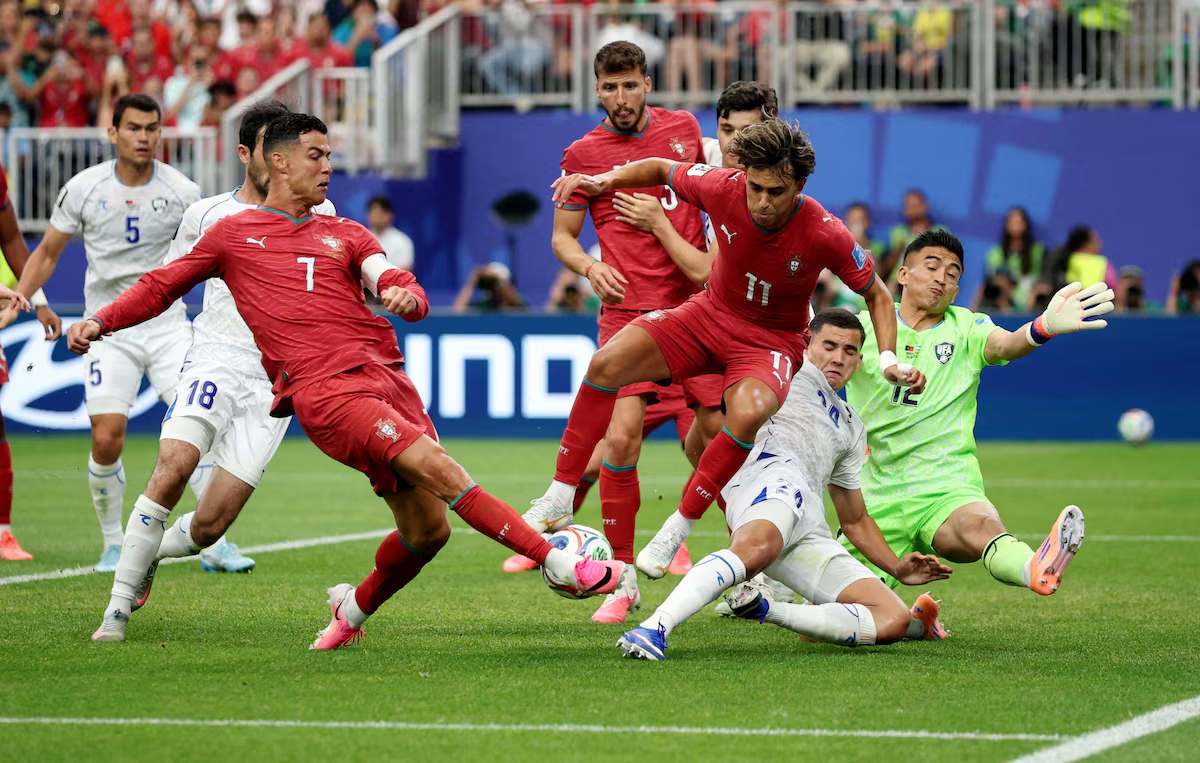
Luckily for Ronaldo, those scoring opportunities grew plentiful during Portugal’s second Group Stage match on June 23 against Uzbekistan. Portugal easily punched in a 5-0 win, making half of their overall shots on target. With two of those belonging to Ronaldo, he cemented his name as the first player to score in six different World Cups and—for now—stifled many fans’ worries that they were already watching the death of his golden status.
Argentina
Also in his sixth World Cup, Messi leads Argentina so far as the team’s sole goal scorer across both Group Stage matches against Algeria (3-0) and Austria (2-0). The latter proved to be the less comfortable of the two wins. Messi’s first shot after five minutes was disallowed due to an offside call, and the team made few promising attempts on goal in the following 33 minutes until Messi scored again just before halftime. Argentina’s promising start to the tournament, unlike that of other juggernauts like Spain, Portugal, and England, most certainly puts them ahead in predictions for a 2022 repeat.
England
England’s performance so far, unlike Argentina’s, has fluctuated. They started off strong after they put on a clinic against Croatia, the 2022 third-place finisher, beating them 4-2 on June 17. Scoreboard aside, the victory didn’t come without obstacles for the English. The possession across both teams varied by only 8%; meanwhile, the game saw a difference between each team’s total passes of just 40 and a pass accuracy differential of only 1%. These statistics play an important role in understanding how efficiently teams use their time on the ball, which, in turn, affects offensive momentum.
Looking at a similar game in terms of outcome, Switzerland took down Bosnia and Herzegovina 4-1 on June 18, with 62 possession percentage, over 200 more passes than Bosnia, and a 10% pass accuracy difference. The statistics from Switzerland’s victory highlight how close England and Croatia actually were in skill set and thus how England’s extra ounce of tactical strategy led them to their first win of the tournament.
Such persistence should indicate the presence of a tournament frontrunner; nonetheless, on June 23, England tied Ghana, then ranked 73, nil-nil. Although they controlled most of the game, England found themselves hacking through a defensive backline very reminiscent of Cape Verde’s against Spain the week prior. Ghana’s crowding of the box with bodies and two single attacks on goal forced the English to fully capitalize on every one of their scoring opportunities, which they were unable to achieve.
Senegal
A great option to room for in the coming days if you are keen for an underdog team is Senegal. Their close losses against France (3-1 loss) and Norway (3-2 loss) indicate just how close they are to securing a third place bid to the Knockout Stage. Against the former, who had a 12% chance of winning the World Cup, they maintained unexpectedly close passing and possession statistics. Against the latter, they outnumbered Norway in shots and possession, but couldn’t fend off Erling Haaland’s thirst for goals. If you are looking for a game demanding a big result, Senegal will play Iraq on June 26 in their final chance to exit the Group Stage.
The Netherlands
This week’s series of ups and downs did not extend to all teams, namely the Netherlands. If you are looking for a team to back that sits just outside the limelight, the Dutch are the perfect option. Their well-fought 2-2 draw with Japan and 5-1 demolition of Swedish spirits proves they have much more on the horizon in the coming weeks. Tune in on June 26 as they play Tunisia for a place in the subsequent Knockout Stage.
Group Stage matches will continue through this Saturday, after which the knockout rounds will commence. Nine teams — including the U.S., Germany, Mexico, and Argentina — have already earned a place in the Round of 32.




I really like reading through a post that can make men and women think. Also, thank you for allowing me to comment!