

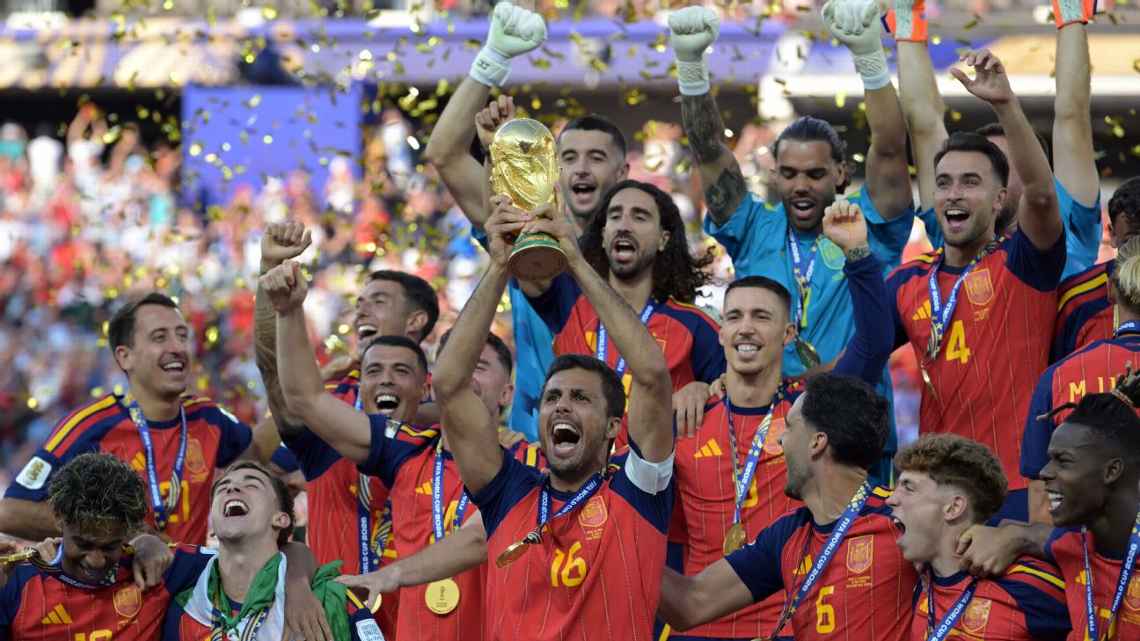

Thirty-nine days and 103 games after the tournament’s commencement in Mexico City, Spain defeated the reigning champions, Argentina, in the World Cup Final. Grueling does not fully capture the flow of this match: one-sided possession, bountiful fouls, and the pressure of two nations weighed down the pitch in East Rutherford, New Jersey. One hundred six minutes after kickoff, Ferran Torres took Spain’s 20th shot of the game. He had yet to score in the tournament so far, yet his strike became the winning goal.
Semifinals
To reach the final match, Spain first needed to power through the heavily favored French team. On paper, their July 14 match appeared eerily equal in skill level. France outshot Spain; meanwhile, Spain held 51% possession and outpassed the French by only 79 completions. Visually, however, the Spanish clearly dominated with their signature surgical offense and calm back line. France may have held the Polymarket odds to win, but Spain came out easily on top two goals to nil.
The following day, Argentina pulled off their third miracle of the knockout round against England. The game started off aggressively with bodies and insults alike flying in both directions. With five minutes and stoppage time to go, Argentina trailed 1-0. Through a combination of technical skill and mental fortitude, they managed to find the back of the net twice to advance to their second consecutive World Cup Final.
The English head coach, Thomas Tuchel, faced heavy backlash after their 2-1 defeat for his decision to substitute multiple defensively-oriented players into the game rather than prioritizing building their lead. English players also did not escape such scrutiny, and their ensuing frustration from it surfaced during the third-place match on July 18.
The consolation match exists for a single motive: money. It serves as both a method by which FIFA can further increase its tournament earnings and as a way to allocate the third and fourth place prizes, amounting to $29 and $27 million, respectively. In addition to many fans disliking the concept, Tuchel even stated in his post-match interview, “Nobody of these players, nobody of [the] French players wants to play this match.”
The distaste for the match from both teams was exemplified by the starting lineups, in which the typical English starters, such as Jude Bellingham and goalkeeper Jordan Pickford, and French players, such as Ousmane Dembélé and Lucas Digne, didn’t start. Even so, it became the highest-scoring match of the entire tournament, ending in a 6-4 English victory. While not trivial to the run of the World Cup, it lands high on my list of rewatch-worthy matches of the tournament for the way it exposes the dangers of an uncontrolled game and the strategies employed by the best teams to fight even on their worst days.
Final
Entering the match, Argentina earned the nickname the “Comeback Kings.” They trailed in three of their four matches prior to the final and scored every winning goal during either added time or overtime. In a post-semifinal interview after their win against England, coach Lionel Scaloni described his players as constantly surprising him. “We are unique,” he said, “not because of arrogance, but because of our heart and passion.”
Against Spain on July 19, however, heart and passion simply weren’t powerful enough to make another comeback. For a while, the Argentinian goalkeeper Emiliano Martínez singlehandedly upheld his team with 11 saves—the most a keeper has ever recorded in a World Cup Final. The Spaniards, however, never gave in, asphyxiating Argentina with 803 passes and an impenetrable defense. Over 120 minutes of play, Spain registered 20 shots on goal and maintained 68% possession, a statistic not the result of a late shift in momentum but one built steadily and with confidence from the first minute. Their opponent-stifling philosophy rooted in attacking mental resilience by dominating possession, brought by coach Luis de la Fuente, is the key to why they only conceded a single goal throughout the entire tournament.
Following the match, four awards were presented to players from Spain and one to a player from France. The Golden Ball—presented to the best player in the tournament—went to Spanish captain and midfielder Rodri. The Golden Glove was presented to Spanish goalkeeper Unai Simón. He maintained seven clean sheets and a 91.7 percent save percentage throughout the tournament . The FIFA Young Player is awarded to an under-21 player and was given to the 19-year-old Spanish center back Pau Cubarsí. Finally, Kylian Mbappé of France received the Golden Boot—given to the player with the most goals. Having won the award in 2022, he made history as the first to win it twice.
If a 2026 World Cup win, a 2024 European Championship trophy, and a 2025 Nations League Final appearance aren’t enough to solidify the Spaniards’ new reign over the football world, they are the first nation to win back-to-back Men’s and Women’s World Cups. Better yet, the World Cup will come home to Spain in 2030, with Portugal and Morocco as the other two host nations.