



More than two decades after Georgetown adopted its Just Employment Policy (JEP), the Georgetown Coalition for Workers’ Rights (GCWR) is calling for the university to amend the policy, arguing that existing protections have failed to keep pace with the needs of campus workers. Workers say these gaps have left them without adequate information and input in their workplaces.
Georgetown adopted the JEP in 2005 following years of organizing by campus workers and students, culminating in a nine-day hunger strike. The policy established standards for wages, benefits, and working conditions for university employees and workers employed through Georgetown contractors.
Today, GCWR’s petition calls on Georgetown to raise contract workers’ minimum wage to $25 per hour by fiscal year 2028, provide accommodations during inclement weather, and for the university to stop workplace surveillance. The petition also calls for the university to expand multilingual resources and safety training, along with prioritizing direct employment and job continuity when the university changes contractors. The coalition argues that these changes address longstanding concerns raised by workers and close loopholes in the original 2005 policy.
Elinor Clark (CAS ’27), GCWR’s facilities team lead, emphasised that even two decades later, some of the policy’s existing promises are not reaching workers.
“Every single demand that you see is the direct result of an issue that workers on campus have faced,” Clark said, citing GCWR’s regular meetings, town halls, and events with workers and union staff.
In a statement to the Voice, a university spokesperson said Georgetown is “committed to upholding the University’s Just Employment Policy and respecting the dignity of all members of our community.”
GCWR, however, argues that some protections already included in the JEP are not adequately implemented or communicated to workers. The coalition’s proposed amendments seek to strengthen those existing protections while expanding the policy to address concerns workers have raised about wages, workplace safety, job security, and access to resources.
Clark pointed to language accessibility as one area where GCWR says the existing policy has fallen short.
“Many workers have said that they don’t receive access to resources, trainings, or meetings with managers in Spanish,” Clark said. “A lot of times, workers find themselves unclear on new guidelines or in the dark about their own protections under the Just Employment Policy and also as workers in D.C.”
GWCR’s proposed amendments would require access to university resources and employment documents “in any language requested by the worker,” alongside expanded workplace safety protections, training, and benefits.
Another focus of the petition is wages, with the proposed amendments raising the hourly minimum for contract workers to $25 per hour by July 1, 2027, an increase from the $20.82 per hour currently serving as the minimum, followed by annual increases tied to the Consumer Price Index. Clark criticised the existing JEP’s use of “total compensation,” which can include benefits alongside wages.
“Georgetown gets away with saying that they’re paying workers almost $21 an hour when workers are making $18 because Georgetown includes their benefits package in that number,” Clark said. “Health insurance does not pay rent or buy groceries.”
Responding to GCWR’s calls for higher wages, the spokesperson said Georgetown is “committed to providing fair and competitive compensation packages” for university employees and full-time contract workers. According to the university, the JEP’s minimum total compensation rate is reviewed and adjusted annually based on factors including regional inflation and labor market conditions.
A university spokesperson also told the Voice that they maintain existing avenues for worker input.
“Georgetown regularly engages with the unions that represent different populations of employees on our campuses, and also receives feedback and collaborates with staff in numerous ways,” the spokesperson said.
The spokesperson added that the Advisory Committee on Business Practices, which includes student, faculty and staff representatives, advises university leadership on the JEP.
Workers interviewed by the Voice, however, described a disconnect between these formal avenues for engagement and their own experiences on campus.
A Hoya Hospitality worker employed by Aramark explained that despite working at Georgetown for years, they had not previously been made aware of the JEP or its protections. The Voice granted the worker anonymity due to concerns about potential workplace repercussions.
The worker said communications between management and employees have been limited, including around changes workers observe taking place within Hoya Hospitality.
“They just don’t tell us anything,” the worker said. “We can see things are happening with management coming in, but they don’t ever talk to us. They don’t communicate at all.”
Of the protections GCWR is proposing, the worker said workplace safety provisions would make the greatest difference to them personally. GCWR’s proposed amendments call for stronger safety measures, including proper training for handling hazardous materials and access to appropriate protective equipment. The employee said they were injured at work last year and continue to experience problems relating to their injury.
The worker said they were paid while off work following the injury, though the payments were slow. They also described workplace repairs as temporary rather than permanent.
“If they see something that’s broken, they really need to fix it,” they said. “Don’t fix it for just a week or a month. Just fix it, period.”
The worker said they often do not feel heard when they raise concerns about problems in the workplace.
“They put Band-Aids on it,” the worker said. “If the students were down here you would quickly do it, but because we’re just regular employees to you, you don’t care.”
Additionally, they said they have sometimes purchased their own work supplies when necessary materials were unavailable.
“I’ve had to buy my own supplies and stuff,” they said. “If they run out of things, then it’s just like, ‘Okay, well, I guess I have to look on Amazon to replace it.’”
The worker also said their current wages are insufficient to meet the cost of living in D.C.
“D.C. rent is so expensive,” they said. “People do a lot of work and then there’s overtime and people have families to take care of, bills to pay. It’s not enough.”
The worker said management problems can also directly affect students, particularly when employees do not receive the supplies or ingredients needed to do their jobs.
“We do care about the students and the quality of the food,” the worker said. “It’s frustrating because you come and you’re like, ‘Oh, there’s brownies today,’ but they didn’t order any of the ingredients for the brownies. We’re like, ‘I’m sorry, I wish I could do more, but I’m not a manager.’”
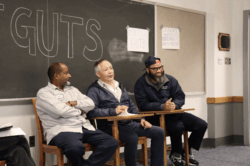
A GUTS driver, also granted anonymity due to concerns about potential workplace repercussions, said the petition’s proposed job protections are particularly important amid ongoing changes to GUTS operations.
The driver, who has worked at Georgetown for decades, said Georgetown’s increasing use of contracted buses operated by Abe’s Transportation has reduced routes and overtime opportunities available to university-employed drivers.
He said workers were previously reassured that they would remain with Georgetown, but have since seen more routes and overtime opportunities assigned to contracted drivers. The changes prompted the “Don’t Cut GUTS” campaign last year, through which drivers and student organizers pushed back against further outsourcing of the university’s bus services.
“They didn’t even give us a chance to [choose] which route we can take,” the driver said. “All the seniority, all the service we did, they didn’t count.”
He also said he does not feel drivers are sufficiently consulted when Georgetown makes decisions affecting their jobs.
“No,” he said when asked whether workers receive enough opportunities to provide input. “That’s why I’m not feeling good. I have a lot of stress right now.”
For the driver, the prospect of eventually being moved away from direct Georgetown employment is personal. He said he has spent decades building a life around the university and hopes his children may one day attend Georgetown.
“I have two kids. I worked here [for] years. My dream is for my kids to go to school here,” he said. “So what they’re telling us right now is, am I going to lose that? So it’s kind of sad for me, all these years that I worked for Georgetown.”
The driver said Georgetown’s benefits, particularly health insurance, have helped make relatively low wages manageable for his family and contributed to workers’ desire to remain directly employed by the university.
“Even if the money’s low, but the medical … we’re safe,” he said. “That’s why everybody wants to work at Georgetown.”
GWCR has not yet formally submitted the amendments to the administration. Clark declined to specify when the coalition plans to do so, saying its current focus is building awareness and support for the campaign.
“We want to make sure that the administration is aware of how many people support our amendments when we bring our demands to the table,” Clark said.
GWCR has separately called for a working group to review the JEP that would include workers across the university, from dining and facilities employees to graduate students, resident assistants, and adjunct professors.
“We stipulated that the working group needed to include the voices of all workers affected on campus,” Clark said.
Clark added that the campaign also raises a broader question about whether Georgetown’s treatment of its workers reflects the Jesuit values the university invokes.
“Georgetown has a responsibility to allocate its budget towards moral imperatives,” Clark said. “If Georgetown is choosing to pay its administrators multimillion dollar salaries, while claiming to not have enough money to give workers the bare minimum, then Georgetown cannot call itself guided by Jesuit values.”
For the driver, the uncertainty comes after decades spent watching generations of students move through Georgetown.
“I see a lot of students come and go, you know, like years. Imagine,” he said. “Some of them became professors.”
“This is my home,” he added. “This is just like a family.”