


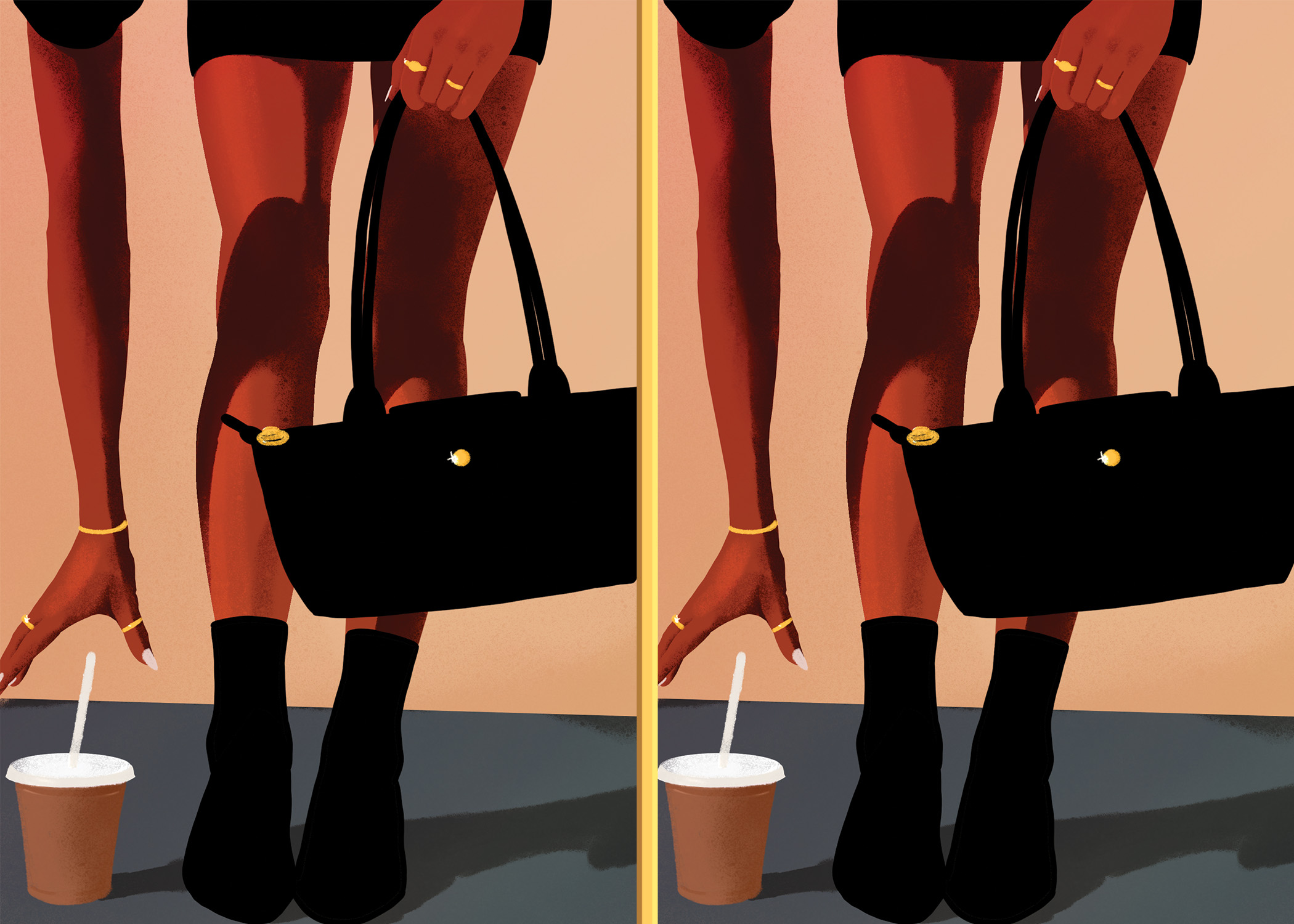
At 5 a.m. on the first Friday of her senior year, Sophia Fife (CAS ’27) was headed to New York to fulfill her agency contract as a part-time model. On her trip back, she was editing articles and meeting with writers to brainstorm ideas for Onyx Standard, the digital magazine Fife founded this summer.
From think pieces about Love Island to musings about being a Black woman at an elite institution, Onyx Standard has gained significant online traction and created a digital forum shaping dialogue on campus and beyond. The magazine’s mission is to document the “social aesthetic, and intellectual lives Black women have always cultivated.”
The name “Onyx Standard” is itself an ode to Black women, combining imagery of the black gemstone with Fife’s belief that Black luxury culture has long helped set the standard of fashion and beauty industries.
“There is a lot [of conversation] about the kind of old money Black luxury experiences that shapes the white luxury experience,” Fife said. “I feel like everyone should be credited with what they’re bringing.”
Georgetown is a predominantly white institution, with Black students encompassing approximately 5.8% of non-international students, despite Black Americans making up 13.5% of the United States population. The class of 2029 saw an over 1% decrease in the enrollment of Black students compared to both the classes of 2028 and 2027.
Against this backdrop, Onyx Standard’s roots are grounded in Fife’s own experience navigating Georgetown as a Black woman and model, a path that is uncommon for Georgetown students who typically follow more traditional career trajectories.
Fitting into Georgetown
During her senior year of high school, a friend told Fife that Georgetown did not “seem like her vibe.”
“When I thought more about it, it was very clear that I felt like the reason [Georgetown] didn’t seem like my vibe is because people didn’t view Black and luxury as compatible,” Fife said.
Fife often dresses in a maximalist style, layering items and challenging herself to make sure she is never in a repeated outfit by always making something new out of what she has. Fife said her distinct fashion has often made her stand out from other Hoyas on campus, many of whom prefer to wear business casual attire. This same visibility, however, has also made her appearance prone to judgement, even being called “ditzy.”
“When I started to ask people why they were saying that, they were just like, ‘Oh, you’re very bubbly, wear pink a lot, and you’re pretty,’” Fife said. “I’m allowed to be pretty and smart. It feels like there was a huge tension where people couldn’t accept that multiple positive qualities could coexist.”
Given that she has solidified herself as a campus fashionista, Fife said she has encountered similar assumptions that being into fashion means she cannot also be smart when discussing topics surrounding her race and the perception of Black women in society.
“There’s countless conversations I had with people where I sat down with them and started talking about some of the things I talked about in Onyx Standard, and they’d be like, ‘Oh, I didn’t know that you were so smart,’” Fife said. “I mean, why would I not be? We go to the same school.”
For Fife, these experiences created a sense that she had to negotiate between different perceptions of her identity, as if she had to choose between beauty, intellect, and existing in elite spaces. These stereotypes fueled Fife’s desire to curate a space where Black women and those of other marginalized backgrounds could engage in dialogue surrounding their intersectional identities.
“I think that’s part of the reason I started Onyx Standard, is because I felt like a lot of people who I wanted to have intellectual conversations with wouldn’t have those conversations with me because they assumed that I wouldn’t be a part of them,” Fife said. “It feels sometimes like the intellectual part [of me] needs to get presented first and other parts of it can be digested after.”
As a Black woman and someone with bold style, Fife has sometimes felt like she is always justifying her actions, appearance, and belonging in affluent spaces.
“I always had to prove that I was smart,” Fife said. “It’s obviously a privilege to be here, but I feel like we have 7000 other people on this campus who aren’t consistently questioned about their place here.”
Onyx Standard was born not just from Fife’s desire to bring visibility to those experiences, but from her desire to platform people who have not had a chance to tell their own stories.
“The overarching goal is really to normalize Black achievement,” Fife said. “I try to take a specific experience I have, or a specific experience someone else has, and to really blow it up into something that anybody can relate to, whether or not they feel marginalized, because I think that also highlights that our experiences don’t have to be talked about as a separate, foreign thing.”
During the planning stages of the magazine, Fife expressed the importance of the magazine’s content exploring the lack of credit Black culture receives as a cultural trend-starter. Fife tackled this idea through one of the magazine’s first published pieces, titled “The Gentrification of Fashion,” which explored how trends associated with Black culture go unnoticed until they are adopted and popularized through non-Black creators.
To align with the mission, Fife said she posts content that spotlights Black women who are criticized more than their counterparts for similar behavior, but who often draw commentary due to their race.
Helping Hands
As the magazine began to grow, balancing writing articles and creating posts for Onyx Standard on her own left Fife feeling overwhelmed. To expand the publication, Fife brought on Rian Carter (CAS ’27) and Naima Johnson (CAS ’28).
Carter, the magazine’s editorial and marketing associate, originally managed Onyx Standard’s Instagram account and sent Fife a weekly roundup of pop culture news surrounding the Black community to help brainstorm article ideas. Eventually, these lists developed into Carter’s own weekly Substack column, “The Standard Brief,” which covers recent events and news surrounding the Black community, often alongside her own commentary.
Coming into Georgetown during her sophomore year as a transfer student from Howard University, a historically Black university, meant that Carter had to adjust to a different campus culture. At Howard, Carter found that students would cultivate their own styles and openly embrace glamour, noticeably unlike the Hilltop.
“Coming to Georgetown is definitely a shock because the norm at Howard is to be like a ‘Black American Princess,’” Carter said. “And coming here, that was not the norm at all.”
For Carter, working on Onyx Standard has offered a space to feel more understood, uplifted, and empowered.
Fife also credits Johnson with helping the editing department and publishing lighter content to balance out the magazine’s heavier pieces.
“It’s incredibly helpful for the identity of the magazine,” Fife said. “Because, as a platform that exists on Instagram, people don’t necessarily want to digest heavy content. It’s important to break it up sometimes.”
In the coming weeks, Fife has plans to launch a new forum, managed by Johnson, within the magazine that will invite writers to share their experiences and opinions.
How modeling shaped Fife
One of the main motivators for starting this magazine was Fife’s own experiences navigating the fashion industry as a Black woman—a field she hopes to enter upon graduation. While Georgetown doesn’t offer a fashion major, Fife has built a blossoming modeling career both within and outside campus throughout her college career, which has served as a framework for Onyx Standard.
Fife first started modeling in high school to help her friends build their personal photography portfolios. At Georgetown, Fife joined Added to the File (ATTF), the university’s student-run fashion and photography magazine. By modeling for a variety of shoots, Fife said she began to learn integral skills that she would later bring into the professional world.
Fife credits ATTF with allowing her to explore how she wanted to be perceived through digital display and for providing a creative outlet in a predominantly pre-professional institution. During spring 2026, Fife signed a contract with a modeling agency based in New York.
With professional experience in the modeling world, Fife noticed the distinct experiences Black models have. For example, modeling campaigns tend to have different styling methods for models of lighter or darker shades of skin, often intensified by colorism and a lack of diversity in these spaces.
“I noticed that a lot of very dark-skinned Black models get shot almost as a background for the clothes rather than as a person,” Fife said.
Fife said she has sometimes felt that she was included in shoots to fulfill a diversity quota as a Black model. To avoid this, Fife said she has started only agreeing to campaigns of brands that always feature models of various backgrounds and are, in her view, committed to dismantling, rather than reinforcing, harmful beauty standards.
As a budding model, Fife has started being invited to industry events, such as the Fashionology conference in New York, where she gets the opportunity to learn about the behind-the-scenes work and meet influential figures.
These unique opportunities prompted Fife to launch the article series “Notes from Inside the Room,” in which Fife gives readers insight into what she has learned through opportunities as a model.
“I do recognize it is a huge privilege that I’m able to go to a school like Georgetown, and [that] I’m able to go to certain events or have this modeling career on the side,” Fife said. “I want to be able to have as many people reap the benefits of that privilege as possible by reporting on it.”
For Fife, she hopes her magazine helps Black women realize fashion is a tangible career path, even if discrimination persists in the industry.
“I don’t want any Black woman or any person, for that matter, feeling they can’t do what they want to do because they will be looked at a certain way,” Fife said.
Looking ahead
As Onyx Standard’s audience grows, Fife hopes that readers, particularly Black women, can find a sense of comfort and solidarity in the magazine.
“I hope readers take away that they should start whatever they want to start, do whatever they want to do, and that they’re also not alone in the struggles they’re having, because so many Black women who talk to me about the concepts I’m writing about before felt super alone in their struggle before I was able to put it on paper,” Fife said.
Reader engagement on social media has encouraged Fife, who said she is heartened at how many readers share similar experiences to the ones voiced in the magazine.
By building a community through Onyx Standard, Fife hopes to redefine Black students as an essential element within the university rather than an exception to the typical Georgetown population.
“At what point of having however many Black women we have here do we stop viewing it as an exception and start just accepting people?” Fife said. “I mean, we have an actual community here. We actually belong here. We’re not just a separate segment of the larger Georgetown community.”