

Georgetown University postdoctoral fellow Dr. Badar Khan Suri’s immigration hearing opened Tuesday with witness testimony from Georgetown students and colleagues before Acting Assistant Chief Immigration Judge Robert K. Lundberg in Annandale, Virginia.The hearing determines whether Khan Suri can stay in the United States or will face deportation, after another immigration court ruled that he was deportable in November 2025.
Khan Suri was detained outside his home in March 2025 while residing in the U.S. legally on a J-1 exchange visa, issued to teachers, students, and scholars. After spending 58 days in ICE detention, federal Judge Patricia Tolliver Giles ruled that Khan Suri needed to be released on bond. In July, a federal appeals court ruled that he should remain out of detention while his case proceeds.
Khan Suri is currently undergoing two different court cases. The first case, ruled on in July, addresses if the detention itself was illegal, which his lawyers argue acted as a retaliation against his support for Palestine and marriage to a Palestinian. Today’s hearings pertained to his immigration case, which determines whether Khan Suri can remain in the country. Khan Suri had previously been ruled “deportable” by immigration courts, which his legal team immediately challenged in the Board of Immigration Appeals (BIA).
Khan Suri is one of several non-citizen students and scholars across the country detained for speech critical of the U.S. and its relationship with Israel, including Columbia University student Mahmoud Khalil and Tufts University student Rümeysa Öztürk. In these cases, the Trump Administration used a rarely enforced section of the Immigration and Nationality Act of 1954, which allows the government to deport those that they believe have “adverse foreign policy consequences” for the U.S. An immigration judge terminated Öztürk’s removal proceedings in February, saying that the U.S. hadn’t given adequate reasons to deport her.
Two days after Khan Suri was detained, then-DHS spokesperson Tricia McLaughlin wrote on X regarding the case, claiming Khan Suri was “deportable” because he was “actively spreading Hamas propaganda and promoting antisemitism” and that he has “close connections to a known or suspected terrorist, who is a senior advisor to Hamas.”
Khan Suri is married to Mapheze Ahmad Saleh (MSFS ’27), an American citizen who was raised primarily in Gaza. According to a 2018 interview with the Hindustan Times, Saleh’s father was a “senior political advisor” to Hamas. Her father left the group and publicly condemned its attacks on Israel on October 7, 2023, calling them a “terrible error.”
Khan Suri’s legal team, led by Johnny Sinodis of Van Der Hout LLP , continues to deny any association between Khan Suri or Saleh and Hamas. His lawyers wrote in previous documents that Khan Suri has only met his father-in-law twice in person, and that their telephone conversations have been “infrequent.”
In an April 2025 filing, the U.S. government maintained that they revoked Khan Suri’s visa because they believe his “presence or activities in The United States would have serious adverse foreign policy consequences.”
The first witness called was Dr. Nader Hashemi, the director of Georgetown’s Alwaleed Center for Muslim-Christian Understanding (ACMCU), where Khan Suri is a fellow. He opened his testimony by stating that he was testifying to support both Khan Suri and democratic values.
“The issue at stake here is bigger than Badar Khan Suri,” he said.
When questioned about alleged antisemitism by Khan Suri or serving as a risk to U.S. foreign policy, Hashemi said that he had received zero complaints about Khan Suri during his time at Georgetown. He also said he had never seen him at any protests on campus.
Hashemi described the reaction to Khan Suri’s detainment as “shock, horror, bewilderment, and then mobilization,” describing how students rallied for his case.
Throughout Hashemi and others’ testimonies, DHS lawyers repeatedly raised objections when issues like democracy, international relations, and previous immigration cases were discussed, arguing that those testimonies deviated from the individuals’ experiences with Khan Suri and instead fell under expert testimonies. The judge overruled most of those objections.
The next witness was Jonathan Mendoza (GRAD ’26), the co-founder of the Jewish Grad Student Association and the co-author of a letter supporting Khan Suri signed by over 180 Jewish students, alumni, faculty, and staff. He said he met Khan Suri in fall 2025 at a community event, and said that he had never heard any allegations of Khan Suri being antisemitic.
“I had never heard of any peers, let alone Jewish peers, knowing who he was,” Mendoza said.
Fida Adely, the director of Georgetown’s Center for Contemporary Arab Studies, testified on Khan Suri’s behalf. She described meeting Khan Suri in the shared kitchen of their offices and enjoying giving him advice on publishing research and connecting him with other faculty members. As a result, she was shocked and appalled when she found out he was detained.
“I believe his detention and the threat of his deportation is egregious,” Adely said.
The government questioned Adely as to whether she and Khan Suri “ever socialized outside of the kitchen,” to which she replied that they had. She continued that his detention caused a “panic on campus” and that his detention ran against Georgetown’s values, as the university has “long had a commitment to interfaith understanding and dialogue.”
Several of Khan Suri’s students also testified on his behalf. Komal Samrow (SFS ’25), a student in his class during the semester that Khan Suri was detained, said that Khan Suri was a kind and knowledgeable professor.
”He was so invested in us as students, as potential scholars, as people,” Samrow said. She went on to describe the “chilling effect” Khan Suri’s detention had on international students on campus, saying that many of her noncitizen friends stopped speaking in class out of fear of being detained.
“If this can happen to him, who else can it happen to?” she recalled wondering.
Nick Hasbun (CAS ’28) took Khan Suri’s class in fall 2025 after Khan Suri returned to campus, and described his former professor as “a joy to be around.” He said that he and his classmates were invited to Khan Suri’s home for dinner multiple times, and that he has gotten to know him and his family well since being his student.
Hasbun would later go on to organize several fundraisers for Khan Suri, including two benefit concerts that, together, have raised nearly $5,000 for his legal fees.
After a break halfway through the day, journalists were barred from entering the courtroom as expert witnesses gave their testimonies.
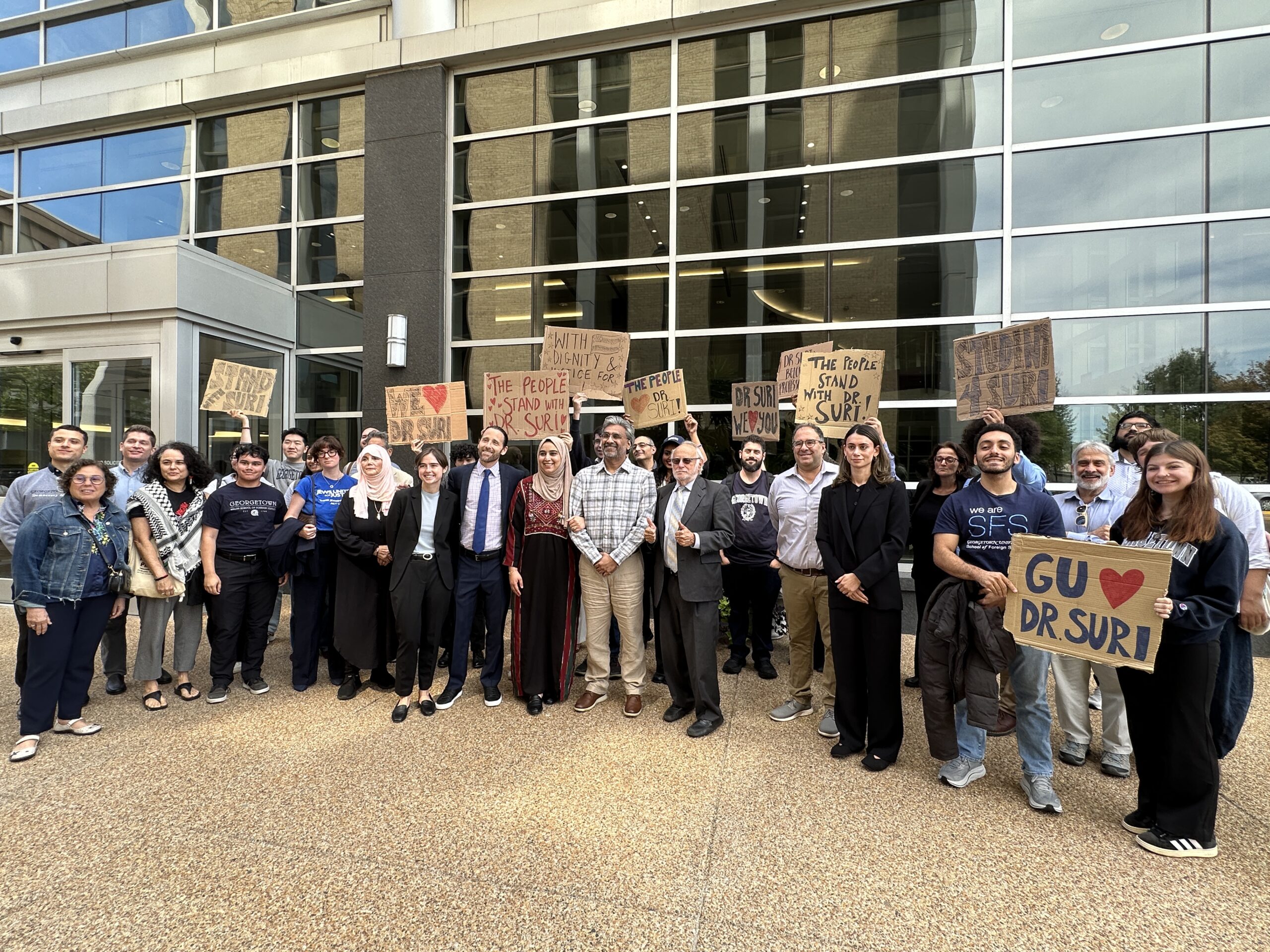
“I am very happy to hear what my students said and what others said,” Khan Suri said in a press conference outside of the courthouse.
He and his lawyers highlighted weaknesses in DHS’s argument, saying that his arrest violated the First Amendment and that the government has no reason to deport him. Khan Suri emphasized that he will continue to fight the allegations against him.
“I am ready for these challenges, and I am very hopeful that justice will prevail,” Khan Suri said.