


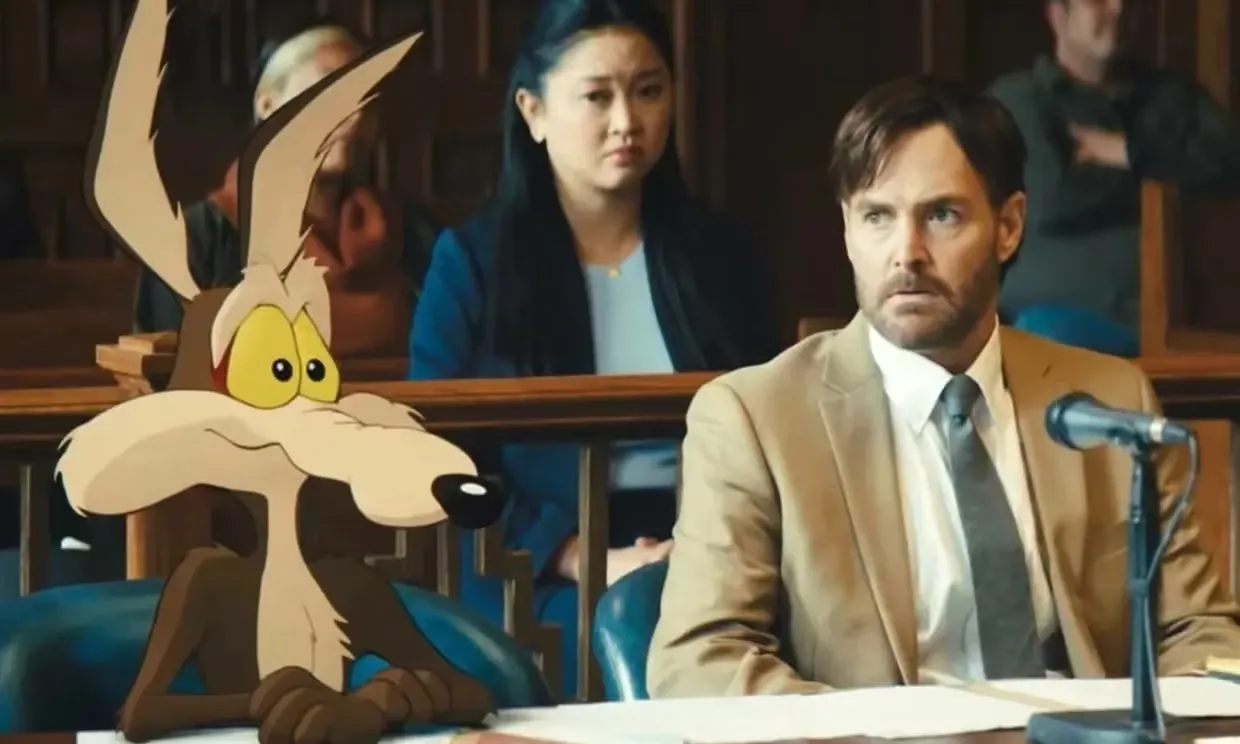

Oftentimes, fiction films are made in a world completely different from ours, exploring scenarios that have no relation to the lives we lead. But in Coyote v. Acme, despite its absolute ridiculousness, the film mimics the real-life struggles of many small organizations and individuals against tycoons amid growing corporate greed.
Coyote v. Acme (2026) is a comedy directed by Dave Green that blends the Looney Tunes world with real life, using both animated characters and real actors. The film was, in part, written by James Gunn, who is known for writing various comedies such as Scooby-Doo (2014) and the Guardians of the Galaxy (2014, 2017, 2023) series.
The film is based on a satirical 1990 New Yorker article, which explored what might happen if Wile E. Coyote filed a lawsuit against the ACME Corporation for foiling his plans to catch the Road Runner with their faulty products. In the movie, Wile E. teams up with an underdog claims lawyer, Kevin Avery (Will Forte), to take down one of the biggest corporations in the world. Along the way, their fight for justice turns into a global cartoon rights fight.
Coyote v. Acme, unfortunately, had a tough journey on the way to theaters. The movie’s production began in 2018 and wrapped in 2023. However, in November of that year, Warner Bros. shelved the film to claim a tax write-off. This meant that the finished production would essentially be buried, never to be seen by audiences. Now, this is not a new tactic for Warner Bros. They’ve shelved various films in the past, such as Batgirl (cancelled 2022) and Scoob! Holiday Haunt (cancelled 2022), because they believed that these movies would not gross well in theaters. Instead, Warner Bros. Discovery treated the films as losses for tax purposes, allowing the company to claim deductions on some of its production costs. The films’ production also coincided with the Warner Bros. Discovery merger, which some believe may be the reason for its demise.
After a few years of collecting dust, Warner Bros. allowed Coyote v. Acme’s filmmakers to look for another company to distribute their film. Ketchup Entertainment, a small movie company known for pictures such as Goodrich and Ferrari, picked up the film. Now, Coyote v. Acme has given Ketchup Entertainment their biggest opening weekend in history, making about $15.5 million dollars at the box office and being the subject of many glowing reviews.
So, is Coyote v. Acme really a good movie, or is its praise because people feel they need to show up and show out for the underdog story?
Personally, I think this film is a slam dunk (Space Jam reference hello). It’s likability, for me, comes from the fact that it perfectly balances nostalgia with uniqueness. It not only connects to Looney Tunes fans, but remains exciting enough on its own that new fans could indulge in it as well.
What brings the film back to the original Looney Tunes series is not only the plethora of iconic characters (such as Daffy Duck, Tweety Bird, and Foghorn Leghorn) who make appearances, but the constant, varying jokes that keep the film moving. It’s difficult to overestimate just how much my theater was laughing during the film. Every minute, there would be some sort of new joke, whether it was physical or verbal humor, that really kept us engaged. It felt very similar to the old cartoons we know and love, yet the human characters brought a more grounded aspect to the chaos, making the viewing experience feel entirely distinct.
One of the fears I had coming into this movie was the concept of having Wile E. Coyote as a leading character. As far as I can remember, Wile E. has not been the most likable Looney Tunes character. His predatory pursuit of the Road Runner has always made him more of an antagonist in the audience’s eyes, so it was definitely a risk to have him be the centerpiece of the film.
Making it even more challenging, Wile E. does not speak in the film. At all. He relies on facial expressions and (very limited) signage to drive the story. But it works. Wile E. is, in fact, one of the most enjoyable characters in this movie. The production team really brings out the complexity in him, showing a more abrasive, sassy side of the infamous coyote as well as the part of him who just really wants to succeed at something. At his core, Wile E. is a character in pursuit of greatness, and one who can teach us that we should never give up on what we believe in.
Will Forte is also incredibly delightful to watch. He’s very normal and a straight shooter, but he’s exactly what the film needs. He doesn’t buy into all of the ridiculousness around him, which makes the chaos seem even more chaotic. He’s a foil to the world of Looney Tunes, and someone that the audience can heavily relate to. This makes his ultimate success as a lawyer, once other cartoons begin to use his services, a truly heartwarming moment for audiences.
If I had to make one complaint about the film, I think that it sometimes bit off more than it could chew. The movie not only juggles Coyote’s legal battle with ACME, but tries to follow “Project Sisyphus,” a secret initiative at ACME that deliberately tests faulty products on cartoon characters to improve ACME’s products for human consumption. While it definitely is a very interesting storyline, it feels too big to be a subplot, and thus sometimes lacks proper explanation and depth.
Yet, Coyote v. Acme feels as though it was made by a team that truly loves movies. It is not the first live-action Looney Tunes project, with some of its most popular predecessors being the Space Jam movies (1996, 2021). However, whereas the latest Space Jam film often felt like a jumbled, huge advertisement for the Warner Bros. universe, Coyote v. Acme sheds the bells and whistles of a big blockbuster picture and simply relies on good humor and heart to resonate with audiences.
The script is incredibly witty, and is truly written for both adults and children. A lot of younger movies these days fall victim to stripping themselves down for younger audiences, but Coyote v. Acme takes on the pitfalls of capitalism and corporate greed in a way that both kids and adults can learn something. The movie also doesn’t shy from the waterworks, exploring the true friendship between Wile E. and the Road Runner, and how the chase might actually be enjoyable for both parties involved.
The best part of Coyote vs. Acme is the messaging it takes on. The film demonstrates a real underdog fight against major corporations which, in a time where companies are beginning to monopolize all aspects of our lives, delivers the story people need and the push to keep fighting for what’s right. No matter how difficult it may be, we all still have the ability to create change, no matter how unbeatable our competitor may be.
In a very interesting way, the movie’s own journey to theaters echoes its message. Movie empire Warner Bros. refused to share the film with the world in order to make more money, so the small filmmakers had to fight for it to be released. They had to fight for what they believed was right, much like Wile E. did.
Honestly, it makes Warner Bros. look quite bad for having cancelled the film, given its anti-capitalist message and all. There’s speculation that the company shelved the movie because they felt attacked by what it stands for, but this is not confirmed. What we do know is that Warner Bros. has been accused of mistreating employees in the past, so maybe they aren’t as different from ACME as one might believe.
Ultimately, in a way, it’s better that the film was released the way it was. Its long battle to get to theaters and the way it has stunned viewers since is a testament to the power of the little guy and how vital it is to never give up.