


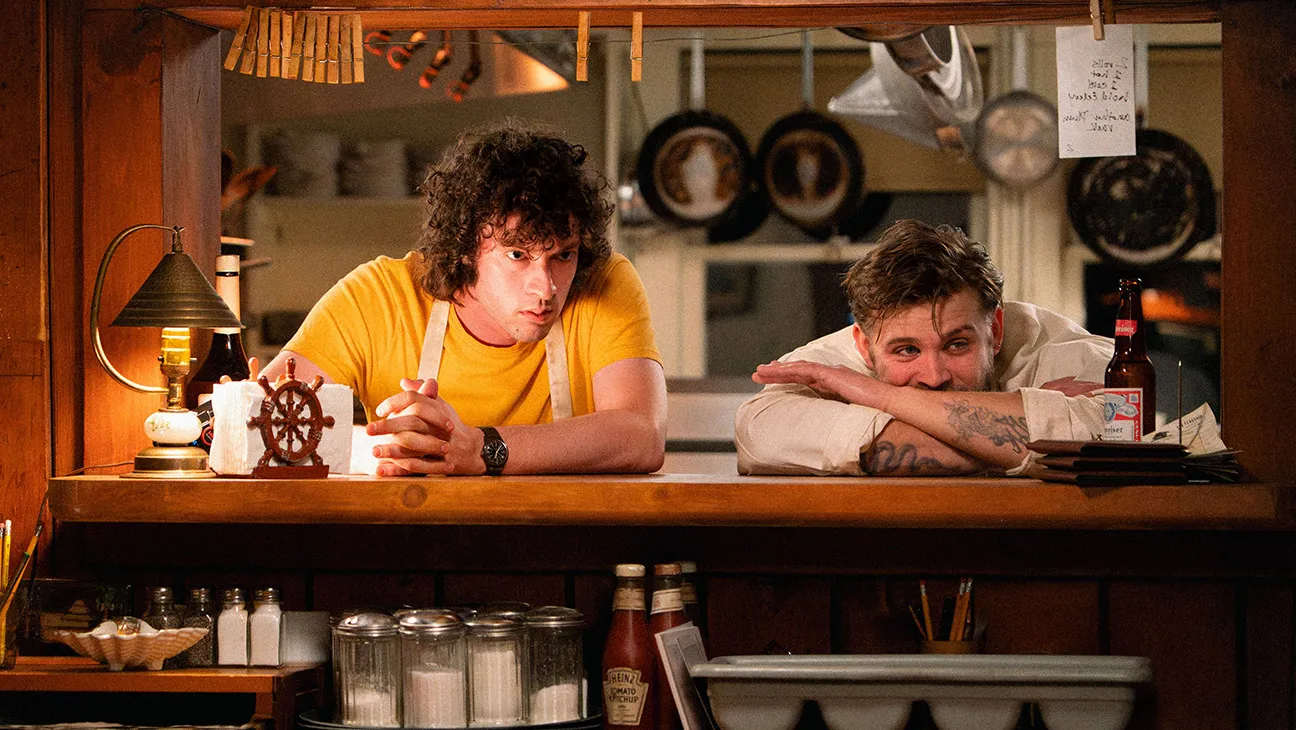
Anthony Bourdain is spoken of by many today with the utmost gravitas, life, and authenticity. His legacy has rendered him, in some strange way, permanently alive. So when I heard his biopic was officially in the making, I immediately thought, “Oh boy, here we go.” It’s safe to say I had some reservations about the depiction of the globally-revered No Reservations (2005) star.
The unfortunate truth is that successful biopics are few and far between, while poorly-delivered attempts at capturing an individual’s story beyond surface-level perceptions we hold in public conscience are the norm. As much as I would love to be plunged into the fears, hopes, and complexities of monumental figures, I have too often found myself suffocated by the conventions of the biopic instead: the initial struggle, the montage, and the neat little moment when everything suddenly makes sense.
Tony is not entirely that movie.
Tony Bourdain is played by Dominic Sessa, who, after his breakthrough performance in The Holdovers (2023), promises a worthy performance, possessing the particular lankiness required to make young Bourdain look cool yet deeply and embarrassingly desperate to convince everyone of it. His Bourdain is arrogant, insecure, and, most importantly, unfinished. But it isn’t Dominic Sessa who strikes the fatal blow to this movie.
The problem is not that the film fictionalizes Bourdain. Biopics have always played fast and loose with facts, and Tony is no exception. There was no Sal. There was not just one pivotal restaurant. Bourdain did not go to Provincetown under the circumstances that drive the movie’s plot. The restaurant, Chef, and much of the summer itself have been reshaped into something more narratively convenient.
This can be understood. What is harder to understand is how the movie forgets the ‘bio’ factor of the biopic.
The film follows nineteen-year-old Bourdain during the summer of 1975 and his first brushes with the culinary world before his global reputation. Tony arrives at a seafood restaurant in Provincetown with little money and an inflated sense of precociousness. This is the most authentic characterization the creators facilitate, expressing Bourdaine’s own retrospective understanding that he was “a spoiled, miserable, narcissistic, self-destructive and thoughtless young lout, and badly in need of a good ass-kicking,” as he famously writes in his memoir Kitchen Confidential (2000). Whilst in Provincetown, he falls under the influence of two opposing forces: Chef Vatel (Chef), played by Antonio Banderas, who introduces him to the spiritual discipline and rewards of the kitchen; and Sal, played by Leo Woodall, a fellow young kitchen worker with whom Tony quickly bonds and who later introduces him to the seductive chaos of self-destruction. Where Chef offers Tony belonging through discipline and routine, Sal does so through excess and rebellion, becoming a representation of everything Tony thinks he wants—freedom without responsibility and a sense of identity without principles. Throughout the movie, Tony grapples with these two paths, wondering whether indulgence is a satisfying enough endeavor.
However, this is where the movie begins to fall short. It recreates the summer and slaps a cigarette and a leather jacket on Dominic Sessa, but it fails to dissect the intricacies of Bourdain’s youth. Sessa, with the look and the talent, does what he can with what he’s given. The script given lacks depth, failing to effectively communicate the story of transformation it attempts to depict. We know Tony was initially flawed and arrogant, but what changes after 19 years, and why does it happen in the community of the kitchen? What about the kitchen is so cataclysmic for him? It’s all too easy and all too inauthentic to pin this transformation on the bad cop/good cop dynamic that he finds himself within, and I find it hard to believe that Antonio Banderas and one successful recipe harness every lesson Bourdain learned that summer and catapult Bourdain into his ‘journey of enlightenment.’
One of the few ways Tony displays Bourdain’s internal arc rather than simply telling a good story is through the cyclical return of the same musical motif in the movie’s soundtrack. At first, I wondered if some producer was really into Spotify’s “Lock-In Instrumentals” playlist or if the crew ran short on the soundtrack budget. But, as it continued to reappear, the music began to feel less like a soundtrack and more like a memory—something Tony keeps returning to without realizing it, as if he’s watching his own growth unfold, moment becoming memory and memory becoming lesson. It grounds the movie just like how certain smells or songs can suddenly transport us back to a certain memory or point in time and put our actions, worries, or values into perspective.
Unfortunately, the soundtrack is where the biopic is at its most compelling, leaving much of Tony’s coming-of-age up to our imagination. The movie understands that the Anthony Bourdain the world came to love did not simply appear fully formed, but it fails to describe the process, reducing Bourdain’s story to one of before and after—a story of him as a product without the pieces that put him together. It forgets that the story is Bourdain’s, not the summer in Provincetown’s. Rather than exploring Bourdain’s inner monologue and progression, it focuses too heavily on the kitchen as a character, jumping from the initial grungy teenager to an awakened Bourdain without any real character dissection. In failing to roll up its sleeves and explore the ‘confidential’ aspect of Kitchen Confidential, in the end, it fails to do Bourdain justice.
Anthony Bourdain’s appeal was never simply that he was a chef or that he traveled; it was never simply about the food or the kitchen. It was that he seemed genuinely interested in the people he encountered in both stages of his career (chef and travel show host) and the power of food in that relationship. Food was a vehicle, not the end product. His ability to inspire introspection and give our lives some perspective in a single episode was the quality that made his work so deeply human and resonant.
Tony wants us to believe that this summer was the moment the Bourdain we know was enlightened and became the legendized individual he is. But take away the title and the sideburns, and this could have been a movie about any other lanky jerk from New Jersey finding out for the first time that the world doesn’t actually care that you can use the word ‘bildungsroman’ semi-accurately in a sentence.