

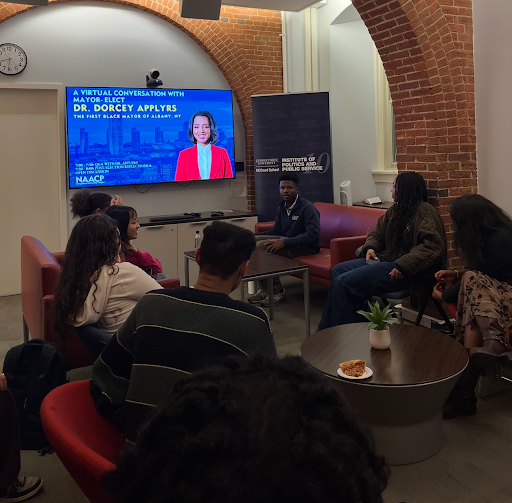

Georgetown University’s NAACP Chapter hosted Mayor-elect of Albany, New York, Dr. Dorcey Applyrs, to share her experiences in leadership, public service, and the reality of breaking political barriers.
The event, titled “A Conversation with Mayor-elect Dr. Dorcey Applyrs: The First Black Mayor of Albany, NY,” on Nov. 12, gave students the opportunity to dialogue with the rising political figure, who has drawn statewide media attention from her historic election. Applyrs will soon become the first Black mayor in Albany’s 339-year history, a milestone she emphasized was neither sudden nor accidental.
“This didn’t just happen,” Applyrs said. “We fought like hell.”
Her statement spotlighted the strategic organizing and personal resilience required to win political power, especially when working in communities Applyrs believes to be resistant to new leadership.
Applyrs opened the conversation by sharing about her childhood, being raised in the District in the 90s.
“It was a tough place to grow up,” she said. “It was known as the murder capital. Lots of violence, lots of drugs, lots of HIV.”
After losing her father to HIV/AIDS at a young age and being raised by a single mother, Applyrs was inspired early in her life to give back to her community. Initially, she pursued a career in public health, going on to earn both a master’s degree and doctorate from the University at Albany’s School of Public Health.
However, Applyrs realized that community well-being is often determined by public policy, and not only within the doctors office. Seeking to address these root causes, she transitioned into local government, serving two terms on the Albany Common Council beginning in 2013. In 2020, she was appointed as the city’s chief auditor. While this was a role focused on government accountability rather than healthcare, Applyrs discovered how seamlessly her public health training could inform local government.
“All of these issues we’re dealing with are public health related, whether it’s public safety, housing, access to healthy foods,” Applyrs said. “When COVID-19 hit, I was newly chief city auditor, and I was able to spring right into action because of my public health training.”
Outside of her elected duties, Applyrs devotes her free time to teaching young students similarly interested in the intersection of health and politics. She works as clinical associate professor in the Health Policy, Management, and Behavior Department at her alma mater.
Despite the deep roots in the community she serves, her path to leadership was far from straightforward. While Albany leans heavily Democrat, Applyrs explained that her decisive four-way primary win last June was a grueling contest marked by racism, sexism, and persistent doubts about her viability as a candidate.
In early strategy meetings, she recalled being told that nearly every part of her identity—being Black, a woman, a mother, a young person, and even her degrees—would be perceived as a shortcoming by voters.
“I walked out of that room thinking, ‘Well, why would I even run if everything about me is seen as a weakness?’” she said.
Instead of stepping back, she leaned into her identity, a choice that resonated deeply with voters. She recalled seeing residents moved to tears at polling places, overcome by the realization that the city’s leadership was shifting.
Applyrs emphasized that her victory was more than just securing a title; it represented a break from historical precedent, as she became the first mayor to come from a long overlooked neighborhood.
Growing up in D.C., Applyrs understands the strong governance needed to revive communities historically neglected by the city’s previous leadership. She described how disinvestment has left certain Albany neighborhoods feeling like “a different city entirely,” stressing that her administration will focus on ensuring equitable government service delivery.
“City Hall should work for everybody, not just people with means or certain zip codes,” she said.
Her upcoming transition operations will include the creation of two major committees: a Talent Committee that vets applicants for key roles, and an Activate Albany Committee that prepares a wide-reaching community survey to inform her policy agenda.
Applyrs also reflected on how her win fits into a broader national trend of increasingly diverse municipal leadership, touching on other recent wins, including the elections of the first Black woman mayor of Syracuse, the first female mayor of Detroit, and the first Muslim mayor of New York City.
“What these victories show is that people are hoping again,” Applyrs said. “People are starting to pay attention again.”
Nearing the end, Applyrs bestowed students with a clear call to action.
“You all are the ones that will help to change the world,” she said. “With privilege comes pressure. That pressure is to take everything you’re gaining and use that to advance.”
Encouraging students to stay open to unexpected paths, including public office, Applyrs returned to the theme that framed her own journey.
“Be open to possibilities,” she said. “I never thought I would run for office. And yet here I am.”
Editor’s note: Content pertaining to events Applyrs will be attending as mayor has been removed for privacy concerns.