

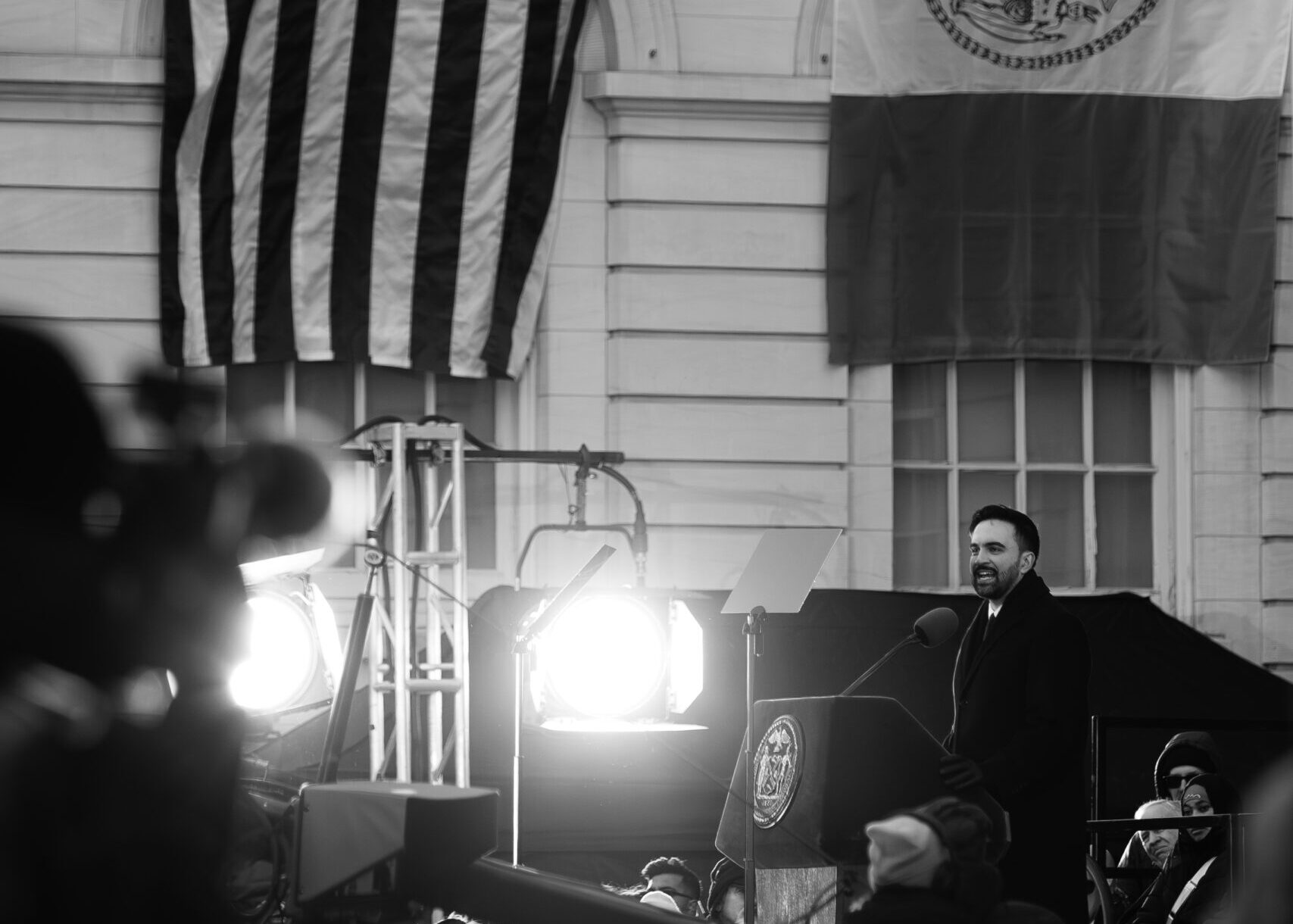

“To live in New York, to love New York, is to know that we are the stewards of something without equal in our world. Where else can you hear the sound of the steelpan, savor the smell of sancocho, and pay $9 for coffee on the same block?” Zohran Mamdani, the newly appointed mayor of New York City, said during his inauguration speech on Jan. 1.
Mamdani’s description of the City represented the multitude of immigrant communities that imbue New York City with its vibrant energy. Mamdani’s speech transformed the mayoral inauguration into a deeply personal moment for me–a reflection of tangible future career possibilities in public service and government that I had not previously considered my own.
Mamdani, a former New York State assemblyman and failed SoundCloud rapper, was initially the underdog against incumbent Eric Adams, former Mayor Andrew Cuomo, and recurring Republican candidate Curtis Silva. Unlike the other candidates, Mamdani embodied to many a sense of relatability and cultural representation. Although some advised against it, Mamdani embraced his identity as a Muslim immigrant born in Uganda to South Asian parents. He used the staple colors of Bollywood movies in his campaign imagery, spoke to South Asian voters in their native tongues, and was the first Mayor-Elect sworn in using a Quran.
New York City is often labeled as one of the most diverse cities in the United States, where its inhabitants speak 700 languages. In his victory speech, Mamdani attributed his success to “Yemeni bodega owners, Mexican abuelas, Senegalese taxi drivers, and Trinidadian line cooks.” Mamdani constantly celebrates the city’s complex network of identities. Resisting Trump’s attack on immigrant communities through aggressive ICE arrests, Mamdani called out President Trump, while both Adams and Cuomo failed to stand up to Trump’s repeated claims to stage a “federal takeover” of the city. Mamdani defends the working class immigrants who are the backbone of the city’s perceived glamorous ambiance.
Oftentimes, especially at Georgetown, I have met individuals whose perception of New York City solely consists of Manhattan, the borough that houses most of the city’s largest corporations, wealthiest populations, and transplants. This sidelines the neighborhoods of the working class who don’t live near Manhattan skyscrapers or indulge in glamorous lifestyles. I’ve become so accustomed to my community being an afterthought to elected officials that Mamdani’s direct recognition of New York’s overlooked neighborhoods caught me off guard.
As a daughter of Guyanese immigrants, a hindu, and a woman of color, I have grappled with the difficulty of expressing my culture beyond the safe borders of “Little Guyana” to those unfamiliar with Indo-Caribbean history. When Mamdani finished his acceptance speech with the title track from the popular Bollywood film Dhoom, it felt like a needed acceptance of my background. To me, he represents the real New Yorker attitude: being unapologetically yourself, embracing cultural diversity, and a love for chicken over rice.
In addition to recognizing New York’s multifaceted immigrant boroughs, Mamdani’s young age and charisma enabled him to connect with a voter demographic often sidelined by other candidates: young voters. During the election, there was a 28 percent turnout amongst youth voters, 75 percent of whom cast their ballot for Mamdani. Throughout his campaign, he appeared on unconventional media outlets—such as street interviews, underground podcasts, and short-form social media—broadcasting his reach to even the most chronically online voters.
My first digital encounter with Mamdani was his appearance on Hasan Piker’s, a popular progressive Twitch streamer and political activist, live stream prior to the democratic primary. Piker is someone who has grown in popularity in the political commentary space, attracting the attention of progressive politicians like Senator Bernie Sanders and Representative Alexandria Ocasio-Cortez. Witnessing Mamdani’s embrace of new media and ability to combine humor with policy explanation solidified him as someone worth following for me.
In addition to connecting with a GenZ audience, Mamdani also connected with a multi-generational audience. I remember watching Mamdani’s feature on the Breakfast Club Podcast, gathered with my family in the living room during Thanksgiving break. What started as background noise drew curious ears for Mamdani’s insightful claims. Without alienating New Yorkers by using complex political jargon, he skillfully explained his background, plans, and administration’s goals in conversational language.
His accessible communication style even caught the interest of my sister, who was previously uninterested in the inner workings of politics. Growing up, my mom would always take my sister and me to vote with her. I was always invested in understanding the logistics of rank choice voting and debating ballot proposals, while my sister went along with us for the sake of tradition. However, this election cycle brought a spark out in her that I had never witnessed before. My sister would send me articles about campaign developments and inform me of election happenings. Even though neither my mom nor I was able to cast an in-person ballot this election, she participated in early voting, joining the 60% of newly registered voters who turned out.
For my parents, who spend a portion of each night watching TV, Mamdani was a beacon of light in the current unsettling news cycle. My parents have begun joking that I could run for mayor once my higher education is complete. To them, he represented a possibility that the American Dream” was real–that a kid with an immigrant background can use his education to give back to his community.
Mamdani proved that despite the challenges faced by politicians of color, it is possible to rise among the ranks of politics. He showed working-class, immigrant youth all across the country that, despite the hate and fearmongering, to both Mamdani and immigrants at large, we should not back down. We deserve to have our stories, voices, and concerns heard. We deserve to be protected by those we put into office. We deserve to have representation at all levels of government.
Now, almost one month into the new administration, Mamdani has already demonstrated progressive change. One of his headline campaign promises was his guarantee to lower the city’s cost of living. On his 8th day in office, he announced—in partnership with New York Gov. Kathy Hochul—the expansion of free childcare options for over 100,000 children. Just a few days later, he announced that he would be launching a series of hearings, coined “rental ripoffs,” to listen to New Yorkers’ concerns about the actions of corrupt landlords.
Of course, even though Mamadani is a refreshing face in American politics, New Yorkers tend to be skeptical of their mayors. Just because he won a majority of the votes doesn’t mean that we will immediately stop paying attention to his actions. He represents the will of the people. As “the people,” I hope my fellow New Yorkers will strive to hold him accountable to his campaign promises.
As I sat on my couch, on the first day of the new year, surrounded by my family in our neighborhood of South Jamaica, Queens, a breath of fresh air washed over me. I saw a glimpse into our future. For once, it didn’t feel like politicians were speaking past us, but rather with us and for us.