



In director James Cameron’s latest film, Avatar: Fire and Ash (2025), an esteemed 10-foot-tall blue humanoid shouts “He’s a loose cannon!” about a whale who speaks in papyrus font—a moment so flabbergasting I felt compelled to lift up my 3D glasses and look around the theater, fruitlessly trying to gauge the audience’s reaction. Now, the downright dazzling special effects and images prevent the viewer from ever doubting the reality of the events on screen, but in that moment, I could only wonder who this movie was for.
In the Avatar franchise’s third installment, Cameron welcomes audiences back to the magical world of Pandora, still full of Na’vi—the aforementioned blue aliens—and colonizing humans. We’re reunited with the Sully family, the protagonists of the series, who try to lay low but are inevitably drawn into conflict, following the same structure from the last film. The family interacts with a new band of Na’vi, hangs out with various sentient alien creatures like dragons or talking whales, and gets hunted by human forces, with the only updates being the addition of a villainous Na’vi tribe and more whales in the final battle.
Jake Sully (Sam Worthington), the human-Marine-turned-Na’vi, remains centerstage, struggling to balance his role as the chosen leader of the Na’vi with his duties to his family. Worthington’s performance remains commendable in that it struggles only in maintaining an American accent and not at all in embodying a great leader and patriarch. In contrast, Neytiri (Zoe Saldaña), Na’vi wife of Jake and fierce warrior, has little to do in this film, resigned to the domestic background in her role as a matriarch. It’s an especially disappointing turn given that Saldaña should now be free from toiling in the dregs of T-Mobile ads and Emilia Pérez (2024).
Shifting generations within the family, we also have Lo’ak (Britain Dalton), Kiri (Sigourney Weaver), Spider (Jack Champion), and Tuk (Trinity Jo-Li Bliss). Lo’ak struggles over his grief for his brother, who died in the last film, and with completing simple tasks, but Dalton delivers a focused performance, never letting his character become too grating. Although the most venerated member of the cast, Weaver delivers a baffling performance, failing to convincingly portray a teenager. She affects a bizarrely high-pitched voice with an almost-British accent, which is quite odd considering her notably raspy voice, iconically put to use by Cameron himself in the 1986 film Aliens. The motion capture performance creates a deeply uncanny viewing experience, even with the jaw-dropping effects. This uncanniness becomes overwhelming when she repeats a line from Aliens in the climax, a moment that fractures the reality of the events on screen—even moreso than the plots for her character that include channeling nature-god magic, revelations of her immaculate conception, and convening with said nature god Eywa.
The biggest problem with the movie comes in the character of Spider—a human white boy with dreads who delivers charming lines like, “That’s right, buttholes!” — who is also the adopted son of Jake and Neytiri and the biological son of Avatar (2009) villain Col. Miles Quaritch (Stephen Lang). Even when considering the scraps he had been given, Champion’s catastrophically stilted performance leaves much to be desired.
To make matters even worse, Spider drives the whole plot, making Champion’s awkward acting inescapable. Everything unravels for the Sullys as they journey to a place where Spider, the only human in the group, can breathe the air without suffocating. Spider’s central role even leads him to a near-death experience twice in the first act alone, although he continues to live, much to the audience’s chagrin.
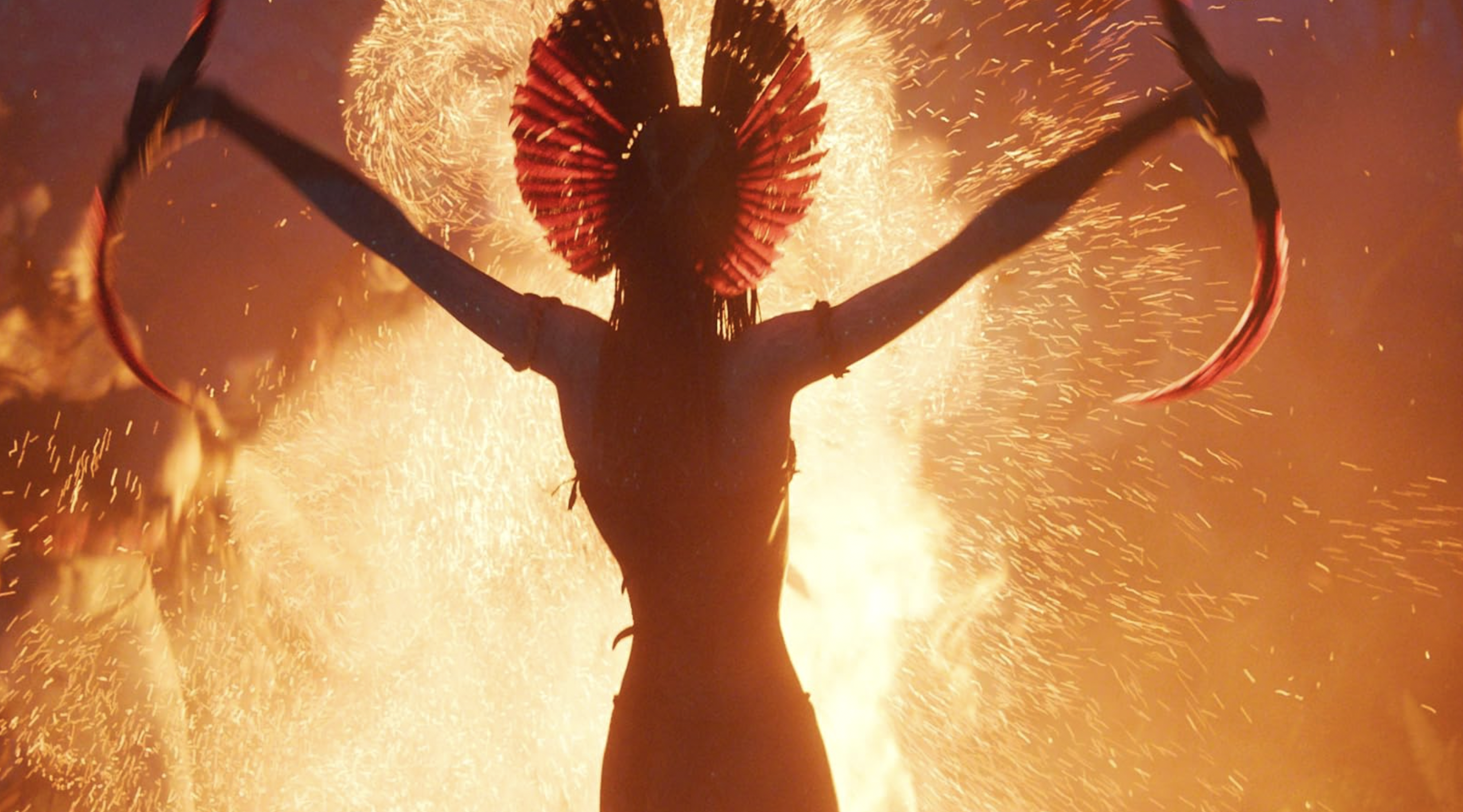
Instead, the movie should center around Varang (Oona Chaplin), the leader of the Ash people, the new band of villainous, radical, and violent Na’vi. Chaplin, in the movie’s best performance, plays a domineering seductress Na’vi who wants to burn the whole world down, with her perpetually swaying physicality and big, curious eyes leaving a lasting impression. Additionally, Varang uses her kuru, the tails that let the Na’vi plug in to their banshees or to Eywa, to stun and overpower other Na’vi, which is a fascinating and exciting turn of world-building and infusion of sexually charged imagery. Just as the audience falls in love with her, so does Quaritch (who has miraculously survived death twice so far in the franchise). Over the course of relatively little screen time, Quaritch—while still endeavoring to capture Jake Sully—steadily sheds his closeness to the military in favor of his flirtation with Varang and her people
The slightness of Quaritch’s arc is doubly frustrating, both because his plot features by far the best, most exhilarating moments and performances in the movie and because it captures Cameron’s capacity for effective storytelling seldom found elsewhere with this clunky screenplay. No characters explain Quaritch’s arc with thudding lines, as happens with any Spider plot point. Some red face paint tells the audience all they need to know, and some feathers amp up this shift in character, both touches swiftly demonstrating Quaritch’s deepening relations with Varang’s people.
However, the feathers represent a much more intractable problem with Cameron’s film than the deftness of character development. Varang and the Ash people add an immense amount of energy and intensity, but Cameron’s reliance on a sexed-up dominatrix alien is a warning sign of the sheer volume of racist tropes about Indigenous peoples within the film. Varang leads a band of raiders adorned with face paint and feathers who scalp people, yell out battle cries, dance around fires with drumbeats, and do psychedelics to see someone’s true soul—all of which are racist stereotypes of Indigenous peoples on screen.
The Avatar franchise has always been a reskin of old Western tropes, The Last of the Mohicans for the digital age, with this one still carrying over the fundamentally broken premise of a white colonizer, in this case Sully or Quaritch, being able to enter and take on an allegorically Indigenous body. These stereotypes have helped drive fiction about the American frontier for hundreds of years—The Last of the Mohicans having been originally published in 1826—with them underscoring differences between Indigenous peoples and colonizers and entirely exoticizing and otherizing populations to make colonizing violence palatable.
By this point in time, the tropes have become complete simulacrums, the list being a laughably (as in it should be laughed at) faithful recreation of the shlockiest and least sensitive outputs of the Western genre that already lacked fidelity to history. As an American kid born in the 1950s, Cameron would have been taught through culture, just like all his peers, that the specificities of each tribe, let alone person, did not matter because the cowboys and the settlers would always win at the end of the day. Even when something like the Avatar franchise ostensibly shifts the focus and sympathy to the (allegorically) Indigenous population, the viewer still knows that Jake Sully and his allies can never win, that more settlers and ships will keep coming. The villains not dying at the end is the major tell; our heroes may have won this battle, albeit with heavy losses, but the conflict seems inevitably lost from the outset. Therein lies the core myths about Indigenous peoples in the American context: that they are fundamentally different and strange, that they are vanishing in the midst of unwinnable conflict, thus meaning their land is up for grabs by the settler population. No matter how much the movie attempts to espouse a decolonial point, its trope-ified structure cannot facilitate that.
Further, Fire and Ash represents an escalation for the franchise, doubling down through the sheer volume of tropes. Although most glaringly manifested with the racism, the repetition of faulty premises and double-downs filter throughout the movie. Not only does this film cycle through staid beats of the Western genre, it also repeats tropes of its own franchise. Jake Sully repeats his actions from the first movie, again riding the dragon Toruk and uniting the Na’vi clans, while the movie repeats the climax of the prior film, down to a whale again taking revenge on the same whaler from the last movie. There may even be more whales this go around, including a council of whale elders who give up their nonviolent tenants to fight back against the violent coalition of humans and Ash people. This blending of ecoterrorist whales—the film rejoices thoroughly and gleefully at the murder of colonizers—and racist regurgitation of tropes creates a fascinating mix, something wholly unique and utterly contradictory, all delivered, thankfully, with stunning visuals and effects.
Over the course of the movie, these ideas and moments never cohere, creating quite a mess. One thing that does become clear, however, is that this movie and franchise were never for anyone besides James Cameron. As the plots become more staid and tropey, the characters even more simple and vapid, the writing more blunt and inelegant, the resulting ecoterrorist fantasia only becomes more deranged. Despite flagrant flaws with this film, on some level, it is ineluctable, made all the more so by the incredible 3-D and high frame rate; nothing else presents this blend of unrepentant madness, whether it be the wondrous or ruinous, the visuals or the premise, talking whales or racist stereotypes, quite like Cameron does in these Avatar movies.




This movie is for people whose imagination isn’t so dead that they can’t imagine a whale being a loose cannon.