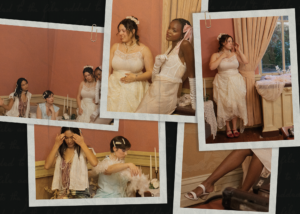


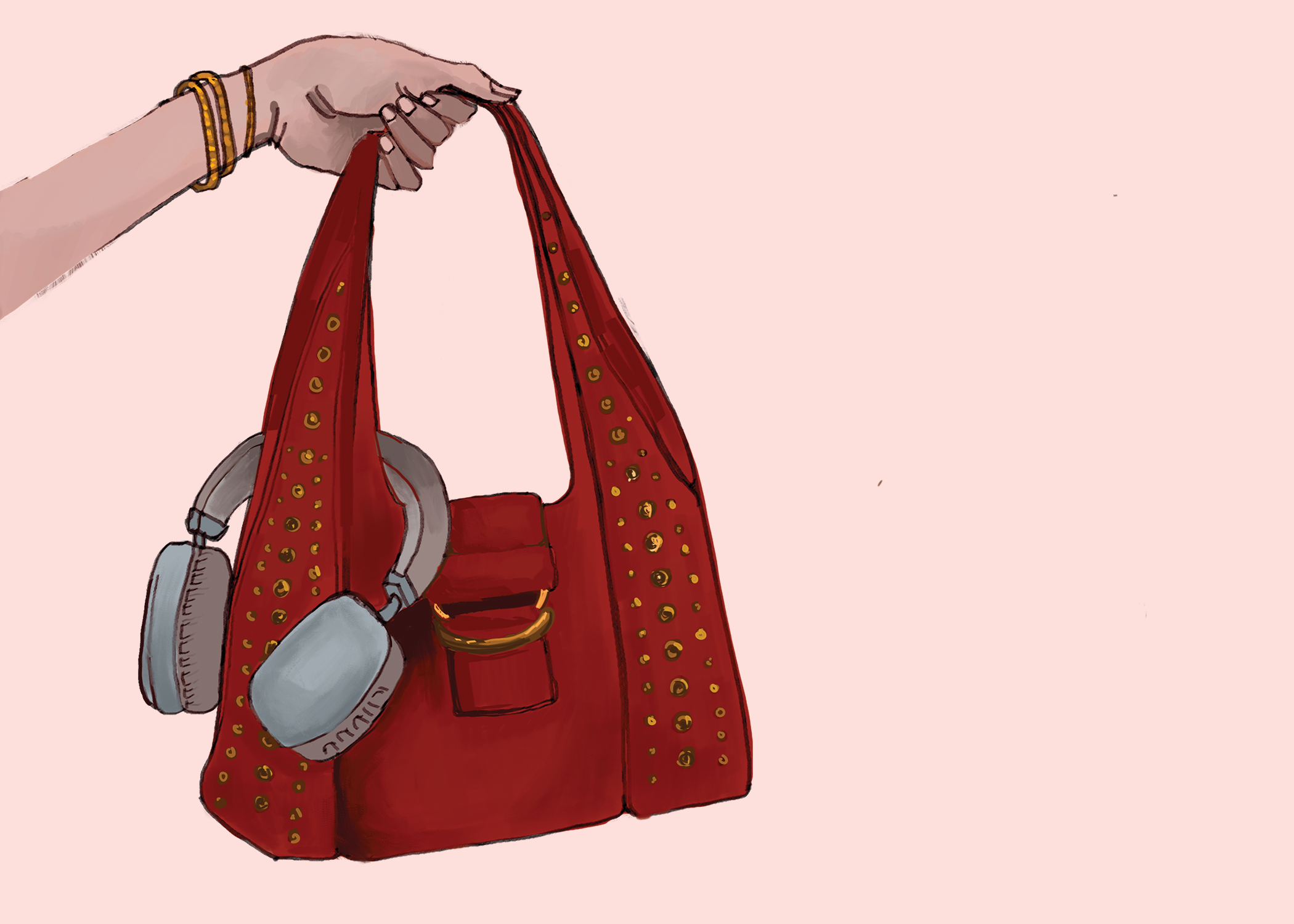
At Georgetown, fashion rarely announces itself. It covertly arrives in beige knit sweaters and navy trench coats, in quarter-zips and discreet designer totes. It’s a careful and cohesive look repeated across lecture halls and libraries, familiar enough to fade into the background but distinctive enough to define the space.
Georgetown fashion is often perceived as preppy and polished, quietly reflecting access and expectation. While some students at Georgetown see the university’s fashion culture as motivating, others question who it serves, who it excludes, and how its reliance on consumption impacts both campus equity and environmental sustainability.
The New York Times found in 2017 that 61% of Georgetown’s student body comes from a family in the top 10% of median income in the U.S., a demographic that helps sustain a campus where costly consumption is both visible and normalized. Still, students experience and interpret this fashion culture in different ways. For Nicole Ridel (MSB ’28), feeling the need to “dress up” actually helps her.
“At Georgetown, I do feel a little more self-conscious if I dress casually. But at the same time, you could argue it’s a good thing, because sometimes it encourages me to dress nicer for class, and I will admit when I dress nicer, I feel better,” Ridel said.
Coming from a high school where pajamas and sweatpants were typical class attire, Ridel said she experienced a shift when coming to Georgetown. She quickly felt that she had to buy more jeans and nice blouses after seeing campus fashion.
Pressure to dress a specific way or buy brand-new clothes to fit in can contribute to the lack of affordability students say dominates Georgetown’s fashion culture. However, Ridel said she believes that in order for this culture to change, it would take “a shift in the Georgetown acceptance demographics and statistics.”
Coming to Georgetown, first-generation and low-income student Hudaa Chaudhry (CAS ’29) knew that there was an emphasis on success and career among the student body, but not to such a physically conspicuous extent.
“I feel like a lot of people here measure success by materialistic or visible status. So whenever I see someone who’s wearing some designer brand or high-end cost shoes, I always think, ‘Wow, they must really have it down,’” Chaudhry said.
She explained that these visible markers of wealth can create an implicit hierarchy on campus, leaving some students feeling out of place in academic and social spaces.
“Walking into places like the MSB or SFS, I felt really ashamed of how I was presenting myself because I just felt like I wasn’t fitting the stereotype of a Georgetown student,” Chaudhry said. “Buying clothes is a big restraint for me, and I feel like being at Georgetown, you’re kind of pressured to buy certain brands, because you see everyone else displaying them.”
Some student organizations have acknowledged the inaccessibility of fashion as a creative opportunity and seek to address this issue in various ways. At the Georgetown Retail and Luxury Association (GRLA), a student organization educating Hoyas on the retail and luxury industries, combating barriers to fashion is a priority, according to Sophia Leissner (CAS ’29), the club’s president.
“Whether it’s at Georgetown or anywhere, the luxury space can at times feel like there’s a barrier to entry and as if it’s a space that might not be for all. And so what GRLA tries to do is make it more accessible,” Leissner said.
The organization is dedicated to shedding light on what the industry looks like. They also bring opportunities to the Hilltop to show accessible avenues for students to enter the retail and luxury fields as a profession.
She highlighted that the unapproachability of the retail and luxury industry is an assumption that she sees as an untrue representation of the industry’s true goals.
“At the end of the day, for us, it’s not just about a price tag. It’s so much about the craftsmanship and the storytelling that’s involved in it, and about the culture and the artistic practices,” Leissner said.
The greater wealth concentration at Georgetown is also a contributing factor to overconsumption, an issue that already plagues many university campuses. With the ever-looming presence of social media accelerating trend cycles and normalizing constant consumption, falling victim to a new microtrend and the subsequent environmental harm is a mere scroll away.
Chaudhry said that fashion becomes a point of contention when it comes to fast fashion, referring to the rapid production of inexpensive and trendy clothing, notably seen with companies like SHEIN and H&M. Students like Chaudhry want to be eco-friendly with their clothing choices, but sometimes struggle with the financial burden of sustainability.
“A lot of people judge low-income students who are wearing fast fashion, but they don’t know that that’s really all we can afford. I try to steer away from fast fashion, but it’s always something I can come back to because it is so cheap,” Chaudhry said.
Sara Lignell (CAS ’26), chief executive officer of Georgetown’s 501(c)(3) sustainable clothing non-profit REUSE, noted an added pressure since arriving at Georgetown to update her wardrobe to a business aesthetic.
With apps like Amazon so accessible and stores like H&M at our doorstep, many students turn to fast fashion for its affordability. Lignell confirms that this is the case from her experience taking inventory at REUSE, often finding these pieces discarded among the high-quality designer pieces donated by Georgetown students.
“I think fast fashion is very common, especially more towards trendy items. There’s going-out tops, Halloween costumes, St. Paddy’s tops we see a lot—things that people need for some type of themed event,” Lignell said. “When it’s something that you think you’re just gonna wear once, then people tend to want fast fashion.”
Additionally, many Georgetown students feel more compelled to shop new because of the lack of thrifting options in the neighborhood. Within a 30-minute walk of Georgetown’s main campus, there are only three thrift or vintage shops.
“It’s really tough around the Georgetown area because you either have very expensive or more vintage-y shops,” Lignell said in reference to finding good thrift stores. “You have the market, which is becoming increasingly more expensive and less easy to find.”
Social pressure, age, and social media can culminate in a self-reinforcing cycle that exacerbates overconsumption, said Emma Lindbergh (CAS ’26), head of REUSE’s free mending and upcycling program ReStitch.
“There definitely is a pressure to be fashionable and with the times, especially when you are young and with just constantly having social media, being inundated with different trends and all of that. So, a lot of consumerism is pushed onto us,” Lindbergh said.
While environmental awareness about overconsumption is growing, according to Lindbergh, it does not dissolve the cultural pressures that shape how students dress, particularly in a campus environment where professionalism and polish remain the norm.
Co-founder of Added to the File (ATTF), Georgetown’s student-run fashion and photography magazine, Lindsay Khalluf (CAS ’26), felt that there were limited opportunities for creativity on campus.
Khalluf said that Georgetown’s pre-professional focus and competitive club applications can prioritize resume-stacking over creative expression or leisurely activities.
“I think it tends to discredit your creative pursuits or hobbies or more creative clubs because those are seen as not ‘serious,’” Khalluf said. “A lot of people don’t want to go into careers in those fields or don’t think that those fields can translate into a career.”
Khalluf believes the lack of thrift culture reinforces a narrow, uniform approach to consumption. Instead of refashioning old clothing, students just buy new.
“When you have to edit clothing or alter them or find whatever, and you can’t plan what you find, it’s a lot more time and creativity that you put into your appearance,” Khalluf said.
Given that many Georgetown students emphasize the professionalism of the school’s fashion culture, clothes can contribute to restrictive perceptions of success. Chaudhry certainly believes that is the case.
“I think our definition of professional is kind of just cookie-cutter, but I think we need to branch out and realise there are so many professions out there, and not just a suit and tie will get you the career that you want,” Chaudhry said.
For ATTF wardrobe team member Abdur Rahman (CAS ’28), this pressure to dress a certain way manifests less overtly, but just as persistently.
“I think a lot of people see the way that other people dress and try to conform to that. It’s not a lot of external pressure, but that internal pressure is still really valid, because you see the people around you, you want to be like them, you want to be like your environment,” Rahman said.
Rahman believes that there has actually been an increase in students embracing alternative fashion at Georgetown, suggesting that this internal pressure is beginning to loosen and Georgetown students are becoming “more open to other forms of dressing.”
Aaron Pan (MSB ’29) said that the university’s “WASP-y” demographic is very different from what he is used to back home in northern New Jersey, referring to Georgetown as a “major market demographic change.” Pan suggested that this shift was not only regional, but racialized, permeating campus fashion and shaping which clothing is seen as normative.
“Especially here, we see the prototypical New England and Nantucket sort of preppy vibe. I’ve never seen more quarter-zips in my life, I’ve never seen more Vineyard Vines in my life,” Pan said. “It’s a cultural expression that these kids have that you just wouldn’t find back home.”
Pan elaborated on this idea, suggesting that this way of dressing creates a “cultural economic barrier,” which may discourage students from expressing themselves through their outfits.
“When you wear these clothes, you’re indicating a belonging to a social group. And when you clearly don’t belong, you have no motivation to do so, and you’re not able to do so. There’s no access to that sort of way,” Pan said.
Rahman refers to Georgetown fashion as “entwined,” highlighting that no single style operates in isolation on campus. Instead, different fashion styles blend to create a unique university identity.
“Everyone kind of adjusts to the other people and starts dressing like the people around them, but they also copy their styles, and so everyone kind of comes together,” Rahman said.
Ultimately, Khalluf stressed that there is little inherent issue with how students choose to dress if they feel comfortable in what they wear. However, campus fashion culture becomes an issue when students feel that their creative expression through fashion is being limited by an implicit expectation to conform as the cost of belonging.
“I think people should be allowed to wear whatever they’re confident in, even if that is professional attire,” Khalluf said. “But I do think sometimes it gets to the point where people might not feel comfortable wearing other things because of what the norm is here, and people might feel more afraid to wear clothes that are more out there.”