


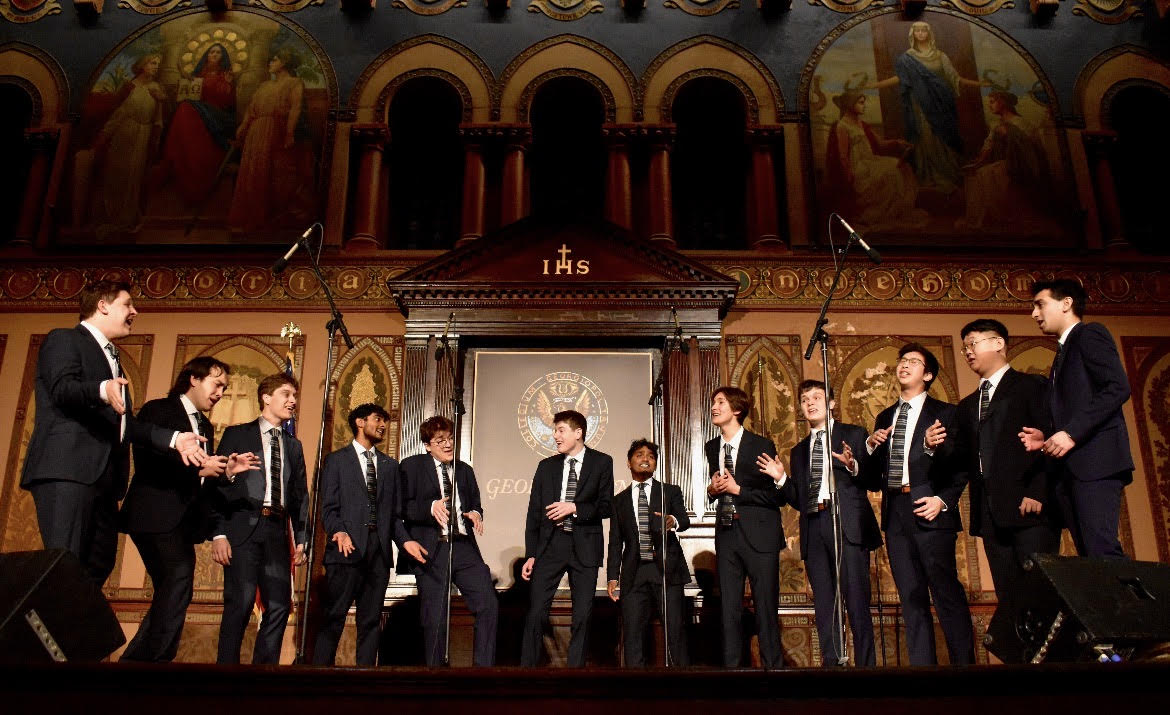
For Aidan Metz (MSB ’26), finding a community at Georgetown also meant performing musical numbers around the country with some of his closest friends.
Metz is the artistic director and Chime #283 of The Georgetown Chimes, the university’s oldest and only all-male a cappella group. He joined the group in late February of his sophomore year, and now, as a senior, reflects on the lasting sense of brotherhood he’s found in the group.
“It’s, of course, bittersweet as I think being a senior generally kind of is with the Chimes, though, it won’t really end,” said Metz. “It’s really exciting to know that after I graduate, I’ll still have the Chimes in my life.”
For Metz, the range of ages for Chimes, from college students to members in their 80s, and the continued participation from alumni is what makes the group feel timeless.
“It’s really exciting to know that alums are around pretty frequently. They’re a big part of our group. And they really make the experience so much richer,” said Metz.
The Chimes celebrate their 80th anniversary this year. While the group started small, it has grown into a hallmark of Georgetown with over 294 lifetime members today. Now, the Chimes has become a place where students can find their community through singing and shared traditions.
Francis E. “Frank” Jones (G ’48, G ’52), a Georgetown graduate student, founded the Chimes in 1946, intending to create a fun way for people to come together through music during the post-WWII boom. Jones, the Chimes’ first Ephus (leader), named the group after the hourly chimes that ring from Healy Hall’s south tower. Together, the men performed numbers in a traditional barbershop style in locations both on and off campus.
Now, 80 years later, the group has steadily expanded its reach. The Chimes have sung in various locations around the country, even performing at the White House for the Biden family. They’ve also accumulated some notable alumni, such as Senator Jon Ossoff and comedian Jeff Civillico.
The Chimes’ signature event each year is their Cherry Tree Massacre. As one of the East Coast’s longest-running a cappella showcases, now in its 53rd year, the Cherry Tree Massacre brings together guest groups from across the region to demonstrate various vocal talents. This year’s groups included the GraceNotes, the Phantoms, Superfood, the Capitol Gs, the Virginia Belles, Catholic University’s Take Note, and American University’s Treble in Paradise.
The Chimes have stayed true to their roots in barbershop harmony, a quintessential American a cappella style with unaccompanied four-part vocals as a dedicated barbershop quartet. However, they’ve also incorporated more modern twists on their work. This year, their set highlighted a blend of styles: pop mashups like Noah Kahan’s “Stick Season” and Katy Perry’s “The One That Got Away,” jazz standards such as “Day In, Day Out,” classics from The Sound of Music, and a special Andrew Sisters medley performed alongside the Georgetown GraceNotes. These selections reflect the group’s expanded repertoire, with more than 150 songs, mixing barbershop and jazz with musical theater and carefully selected modern pieces.
Metz leads rehearsals, conducts during performances, and helps shape sets that honor Chimes’s classical style while implementing more modern twists. He explained that the group’s musical identity sets them apart from other a cappella groups on campus.
“The biggest differentiator is definitely our music style,” Metz said. “We generally do not do a lot of pop. [Other groups’] arrangements also tend to include beatboxing and vocal percussion, which is not part of our style.”
Each year, the Chimes look a little different in their makeup. “Active Chimes,” usually undergraduates, are the specific Chimes who make themselves available for practice and performance. Because of the difficult induction process, there are currently only 12 “Active Chimes.”
Metz noted that input from all Active Chimes is considered when selecting songs for big shows like Cherry Tree, with every member having an equal voice in the decision-making process.
“We all submit a few songs,” Metz said. “We want to showcase the strengths of our group. We want to showcase musically. We want to showcase the traditions.”
Upholding these cherished traditions, such as the Chimes house and the group’s international trips, requires ongoing fundraising and generous alumni support to cover travel and production costs. Youngsung Sim (SFS ’27), Chime #292, and business manager of the group, oversees gigs, tickets, contracts, and major events.
Beyond large annual events like Cherry Tree, Sim highlighted how the group’s more frequent, smaller performances bring positivity to campus. One example he shared is their singing birthday grams that exploded in popularity last semester. These grams are quick a cappella serenades performed to celebrate birthdays or other special moments.
“It started with a request in November,” Sim said. A student sent the Chimes a request in November to sing her friend a happy birthday song. What started as a one-off favor quickly went viral in the Georgetown community, leading to an influx of requests and opening up an “untapped market.”
The Chimes also bring positivity to the Georgetown community through smaller, longstanding gigs. Thanks to their flexible, quartet-based structure, the Chimes are readily available to accept private gigs through their website. These include weddings, corporate events, private gatherings, and many other occasions.
Monthly performances at The Tombs, a beloved Georgetown restaurant, have also been a tradition since 1964. The most recent Chimes Night at The Tombs was led by the newest “Baby” Chime, a longtime tradition that lets new members take the lead soon after being inducted into the group.
This idea of an “induction process” is unique to the group. The Chimes are known for the intensity and length of their training, specifically the “Neophyte Process,” or the Chimes’ initiation, which can take anywhere from eight months to three years.
Students audition for the group and are accepted as “Neophytes” based on their singing ability. Neophytes must then master and perform the group’s repertoire of over 130 songs, call dozens of alumni to learn the history and traditions of the group, and prove their commitment through a rigorous and mostly self-directed journey.
Sim explained that the Chimes aim to strike a balance between including new members who haven’t yet been fully inducted, while making sure the Active Chimes always represent the group at their highest level.
“Generally, we try to include the Neos where possible, ” Sim said. “But it’s also important as Active Chimes to be representatives of the group in the best way that we know how.”
Upon successful completion of the Neophyte Process, each new member is formally inducted and receives a signature Chimes tie and a sequential membership number, starting with founder Frank Jones at #1. This number corresponds to the order of induction and stays with a Chime for life, marking their place in the group’s history.
Stephen Yupa (CAS ‘27), the most recent Chime to complete the process and the last to perform at the Tombs, shared what the Neophyte journey taught him.
“The biggest thing it has shown me is my strengths and weaknesses as a person. It truly is a more personal sort of thing. The process prepares you to be a Chime, prepares you for life,” said Yupa. “It’s really shown me my growth and my character and how I approach different challenges.”
While the process may be daunting, Yupa appreciated the support built into the tradition of becoming a Chime.
“Every Chime that has ever been a part of the group has gone through this process since 1946. You’re not alone in this,” he said.
As a recent inductee, the group’s camaraderie is what encouraged Yupa to join and has made him want to stay.
“This is the first time it’s shown me what brotherhood feels like,” said Yupa. “My favorite part is the big group of friends, these are the guys that I study with, that I hang out with.”
The result of this process is a lifetime connection to the group. Alumni from the 1950s still return to harmonize with current undergraduates, and regional “hums” in places like New York, Los Angeles, and even Paris keep the group singing together across generations. The Chimes as a group have taken trips to Virginia Beach, California, Puerto Rico, and even Ireland.
Each year, leadership in the Chimes aims to keep its traditions alive. The Active Chimes elect one of their members as “Ephus,” the acting head of the group. This year’s Ephus is Arjun Singh (MSB ’26), Chime #284. Singh clarified that the Ephus is not like a traditional president; it’s more of a “leader among equals.” All the Actives run the group’s operations together.
“The Actives are completely responsible for running the group,” Singh said. “We make the decisions, we earn the money, we spend the money.”
Looking back at Jones’s work, Singh reflected on the founder’s legacy. “Frank would be incredibly proud,” he said. “He certainly laid the foundation for an institution that has the fundamentals to live forever.
For Singh, the songs the Chimes perform embody the group’s heart. He referenced “Goodfellow,” a song always sung at the end of the Cherry Tree Massacre. This short but heartfelt closing, sung in barbershop style, encapsulates the values of the group, such as a lasting brotherhood, loyalty to Georgetown, and the use of music for good.
Despite their connection to the music, members said that being a part of the Chimes is about more than just singing. Philanthropy is a major part of the group’s mission, through initiatives such as selling Valentine Grams and donating the proceeds to refugees, as well as regular visits to the Father McKenna Center to help men experiencing homelessness.
“Philanthropy and service are always important to the Chimes,” Singh said. “We strive to embody those Jesuit values.”
The Chimes have become an iconic part of Georgetown’s identity, representing a mix of tradition and community that defines the Hilltop. Events like Cherry Tree, which now regularly bring more than 120 alumni back to sing “Goodfellow” together with current members, show how that legacy continues to thrive across decades.
Metz echoed the group’s classic saying, “Once a Chime, always a Chime.” It means there’s really no such thing as a “past” Chime; you stay one for life, no matter where you end up.
For Metz, that legacy is more meaningful now than ever.
“We’re a group that is really steeped in tradition and is really proud of it,” he said.

When the Chimes was down to one Chime in its early days, Richard McCooey told me that he decided to start a Chimes Night in his restaurant, The Tombs, because he believed in the Chimes, loved to listen to them, and was devoted to their success; the rest is history. Congratulations!!!!! FYI My late husband, Richard McCooey (C’52) founded, created, solo-owned, designed, and operated The Tombs, the 1789, and the old F. Scott’s restaurants, for decades before selling to Clyde’s (who became Richard’s favorite restaurant design client of our firm, obviously, as they expanded across the region).